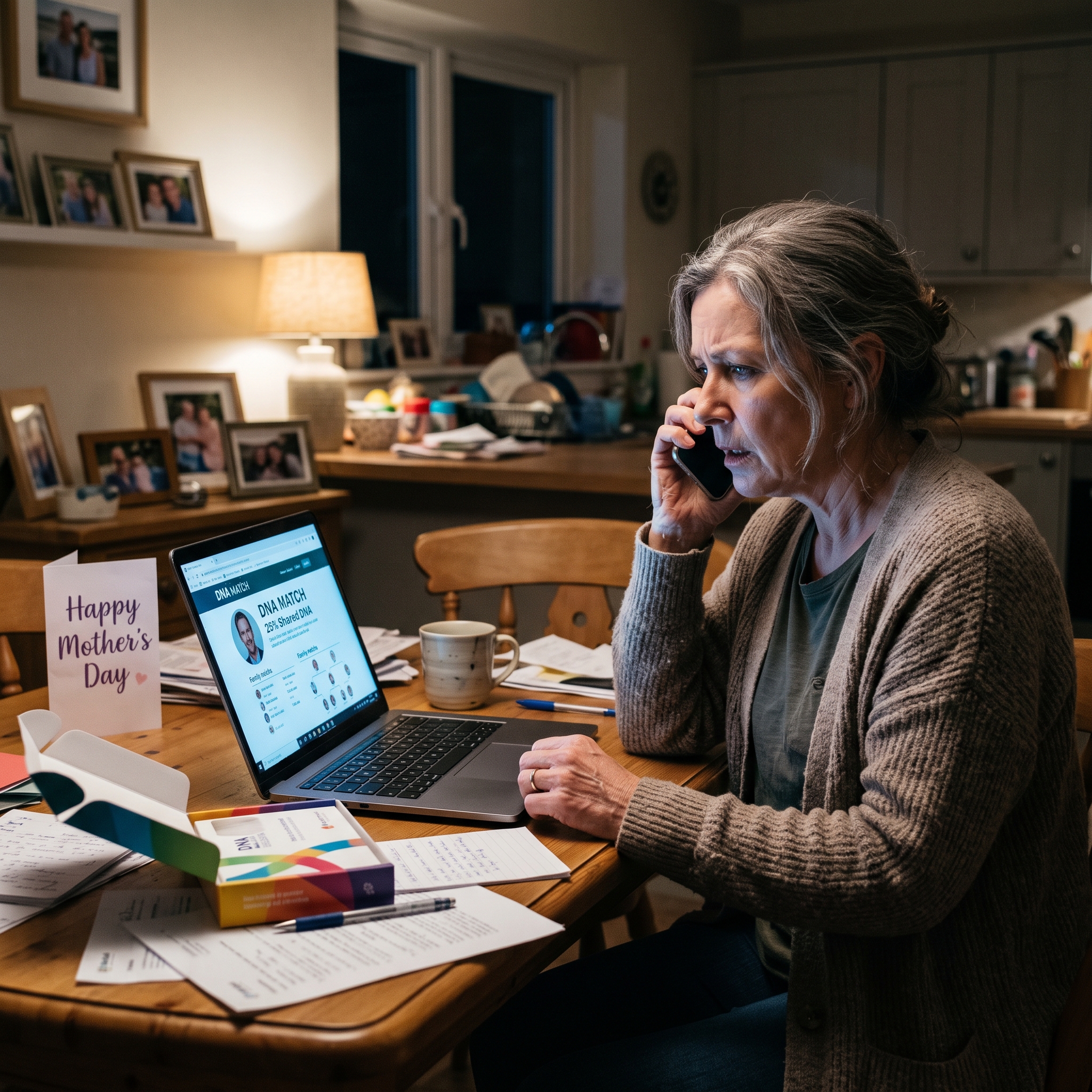
PART 1 My son gave me a DNA kit for Mother’s Day,
$99, joking that we might finally solve the mystery of our
“Irish roots.” I laughed when I opened it. I was sixty-four years
old, both my parents had been gone for more than a decade,
and as far as I knew, our family history was painfully ordinary
. I mailed the sample and forgot about it. Six weeks later, an
email arrived saying my results were ready. I expected percentages
and distant cousins. Instead, at the top of the family-match
page was a man named Thomas Keller, Ohio, born 1949 —
25% shared DNA. Close family. The website suggested
half-brother, uncle, or grandparent. My heart began
pounding. Both my parents had insisted I was their only
child, and my grandparents had been dead long before DNA
testing existed. I clicked Thomas’s profile. His photograph
stopped me cold. He had my exact widow’s peak, but it was
his heavy eyebrows that made my hands shake. They were
my father’s eyebrows. Same shape. Same downward angle
at the corners. I stared at his face for several minutes before
calling the last person alive who might know anything—my
Aunt Ruth in Dayton. She was eighty-seven and my mother’s
younger sister. “Ruth, do you know a man named Thomas Keller?”
Silence. Not confusion. Silence. “Aunt Ruth?” I heard her breathe in sharply.
“Where did you hear that name?” “A DNA test matched us.
Twenty-five percent.” Another long pause. Then she whispered,
“Oh, Lord.” I stood up from my desk. “Who is he?” “Honey, you
need to sit down.” “Please just tell me.” Her voice cracked.
“That man isn’t your half-brother. He’s your uncle.” I couldn’t speak.
“My father didn’t have a brother.” Ruth began crying. “Yes, he did.”
She told me my father, Robert, had been born with a younger
brother named Thomas. They were only eleven months apart
and looked so similar that strangers often mistook them for twins.
Their father died when they were teenagers, and their mother struggled
afterward. Then something happened in 1968 that shattered the family.
Thomas disappeared after a violent argument with Robert.
A few months later, my grandmother told everyone Thomas
had joined the military and wanted nothing more to do with
the family. “Why didn’t Dad ever mention him?” I asked.
Ruth’s answer came quietly. “Because your father
believed Thomas betrayed him.” “How?” She hesitated.
“This isn’t something I should tell you over the phone.”
My stomach tightened. “I’m sixty-four, Ruth. Whatever
happened, I can handle it.” She began to cry harder. “Thomas
didn’t disappear because of your father. He disappeared because
of your mother.” I felt cold. “Mom?” Ruth explained that before
my parents married, my mother, Helen, had briefly dated Thomas.
Then Thomas left town unexpectedly. Months later, she married Robert
. “Your father found out later,” Ruth said. “He believed Thomas had tried
to take Helen from him.” I looked at Thomas’s photograph again.
“Did Mom love him?” “Once. Maybe.” Then Ruth said something
stranger. “There was a letter.” “What letter?” “Thomas wrote your
mother before he left. Your father found it and hid it.” My pulse quickened
“What did it say?” “I never read the whole thing. But Helen did, years later.
After that, she cried for days.” “Why?” Ruth went silent again. “Because
Thomas said he hadn’t left voluntarily.” I grabbed a pen. “Where is he now?”
“Last I heard, somewhere outside Columbus.” I looked at the DNA site.
Thomas’s profile had a message button. My finger hovered over it for
almost a minute before I finally typed: My name is Laura Bennett.
My father was Robert Bennett. I believe you may be his brother.
If you are willing, I would like to talk. I expected days of silence.
Thomas replied twelve minutes later. Laura, I have waited fifty-five
years for someone in your family to find me. Before we speak,
ask Ruth what happened at St. Matthew’s Hospital in March of 1969.
Ask her whose baby your mother brought home. I read the message twice.
Then a third time. My birthday was March 18, 1969. I immediately called Ruth back.
The second I mentioned St. Matthew’s Hospital, she started sobbing. “Aunt Ruth,
whose baby did Mom bring home?” She whispered, “Laura, your mother
loved you more than anything.” “That isn’t an answer.” “I know.”
“Whose baby was I?” Then she said the words that changed
everything I knew about my life: “Robert raised you, honey.
But there was always a chance Thomas was your biological father.”
If you want to see Part 2 and the full conclusion of this story,
please type “Yes” and press Like. Thank you for your support!
PART 2 — FINAL PART I sat frozen with the phone against my ear.
“That’s impossible,” I whispered. “The DNA says twenty-five percent.
” Aunt Ruth explained that Thomas wasn’t my father. The DNA
percentage proved that much. But the secret surrounding my birth was still real.
“Then what are you saying?” I demanded. Ruth took a shaky breath.
“You weren’t the baby Helen gave birth to.” For a moment,
I couldn’t understand the sentence. “What?” Ruth began telling
me a story that had been buried for fifty-seven years.
My mother had gone into labor at St. Matthew’s
Hospital in March 1969. Her baby girl was born
critically ill and died within hours. My mother
was devastated. In the same hospital, another young
woman had delivered a healthy baby girl but disappeared
shortly afterward. The baby’s father was Thomas. “Thomas?”
I whispered. Ruth said Thomas had dated a young woman named
Margaret Keller after leaving my mother. Margaret became pregnant,
but Thomas never knew until much later. She gave birth at St.
Matthew’s and vanished the following morning, leaving the
child behind. My mother, shattered by the death of her
own newborn, learned about the abandoned infant through
a nurse she knew. What happened afterward would never
be legal today, Ruth admitted, and even then it was deeply
questionable. But through a combination of family pressure,
private arrangements, and records altered by people who
believed they were “saving” everyone, my parents took the
abandoned baby home. Me. “So Thomas is…” My voice failed.
“Your biological uncle according to the DNA,” Ruth said.
“Which means Margaret must have been closely related to your
father’s family too—or something about the story we were told was wrong.”
That was when I realized even Ruth did not know everything. I contacted
Thomas the next morning and asked if he would meet me. Three days later,
my son drove me to a small restaurant outside Columbus. Thomas was already there
. When he stood, I nearly cried. He looked like an older version of my father.
Not identical, but close enough to hurt. He stared at me for several
seconds before saying, “You have Helen’s smile.” “But she wasn’t
my biological mother.” Thomas shook his head. “That part is true. But neither
was Margaret.” My heart sank. “Then who was?” He slid a
yellowed envelope across the table. Inside was a hospital
bracelet bearing my birth date and the name Baby Girl Keller.
Beneath it was another document. My hands shook as I read the name
of the mother: Eleanor Bennett. “Bennett?” I looked up.
“That was my father’s surname.” Thomas nodded slowly.
“Eleanor was our older half-sister.” I stared at him.
My grandparents had never mentioned an older daughter.
Thomas explained that Eleanor had been born before my
grandmother married his father. She was raised by relatives
and rarely spoken about. At twenty-two, she became pregnant.
The father disappeared. Eleanor developed serious complications
after childbirth and died several weeks later. The family panicked.
My mother had just lost her own baby. My father had a newborn
niece with no mother. So the decision was made: Helen and Robert
would raise Eleanor’s daughter as their own. “Then why did everyone
say you were involved?” I asked. Thomas’s expression hardened.
“Because I objected.” He had threatened to tell authorities that
the paperwork was being falsified. Robert saw it as an attack on
his grieving wife. Their argument became so severe that Thomas
left Ohio and cut contact. “I wasn’t trying to take you away,” he
said. “I wanted them to do it legally.” Tears filled his eyes. “But your
father believed I wanted to destroy his family.” For decades, Thomas
stayed away because Robert made it clear he would never be welcome.
“Did my mother know who I really was?” I asked. “Helen knew everything.”
He smiled sadly. “And she loved you completely.” That mattered more than
I expected. Over the next several months, my son and I worked with
a genealogist and additional DNA testing to confirm the truth.
The results fit: Thomas was my biological great-uncle through the
Bennett line, which explained the approximately twenty-five-percent
match better than the original family assumptions had. Eleanor was
my biological mother. Robert, her half-brother, had raised me as his daughter.
Helen had no biological connection to me at all. Yet she was the woman
who sat beside my bed when I was sick, taught me to drive, argued with me
about curfews, helped me through my divorce, and called me every Sunday
until the week she died. DNA changed my family tree, but it did not erase my life.
Thomas and I slowly built a relationship. The first Christmas after we met, he
came to my house carrying a cardboard box. Inside were photographs of Eleanor I had never seen. In one,
she was nineteen, laughing beside a lake. I stared at her face and saw my own eyes.
Thomas said, “I thought you deserved to know where those came from.” I
cried for a long time. Then I asked him the question that had been bothering me since
the beginning. “Why didn’t you find me?” He looked down. “I tried once, afte
r your father died. Helen asked me not to. She said telling you at sixty would only
cause pain.” “Were you angry?” “For years.” He looked at me. “Now I understand she
was scared of losing you.” She never would have. That was the saddest part. A
year later, I visited my parents’ graves with Thomas. I placed flowers between their
headstones and whispered, “I know now.” I wasn’t angry anymore. I wished they
had trusted me with the truth, but I also understood that people sometimes bury
secrets because they mistake silence for protection.
My son’s $99 Mother’s Day gift was supposed to tell us whether we were Irish. Instead, it uncovered
a hidden sister, a lost uncle, an altered birth record,
and a secret my parents carried to their graves.
But it also taught me something I never expected. DNA can
tell you where your blood came from. It cannot tell you who stayed
up with you when you had a fever, who held your
hand when your heart broke, or who chose to
be your parent every single day. Helen and Robert
were not the people listed in my DNA as mother and father.
But they were still Mom and Dad. And Thomas, the
stranger whose face stopped me cold on a computer screen,
became something I thought I had lost long ago—a living
connection to the family story nobody had
ever dared to tell. THE END! THANKS FOR READING!❤️