146 views
And then I looked at the cost. And I looked at Mom’s library salary. And I went to the state university instead and got a degree in business administration. Because that was the smart thing.
After college, I took an office job doing scheduling for a medical supply company. It paid steadily. It had health insurance. It was fine.
I kept telling myself I’d go back to sewing someday.
Then Mom got sick.
I started spending my evenings driving her to appointments. Picking up her prescriptions. Sitting with her in waiting rooms. Doing her laundry when she couldn’t carry the basket down to the basement.
My sewing machine went into my hall closet. Behind the vacuum cleaner.
I hadn’t touched it in two years.
“Claire?” Ben said.
I was just standing there holding the fabric.
I turned it so he could see.
“I made Mom an apron out of this pattern,” I said. “When I was sixteen. This exact fabric.”
He looked at it for a second. Then he smiled.
“The one with the crooked pocket?”
“She wore it for years.”
“She said the pocket was supposed to be crooked,” Ben said. “She told Aunt Linda it was a design choice. Linda believed her.”
I laughed.
Then, right in the middle of laughing, I started crying again. I couldn’t stop it. It came out of me like a hiccup.
Mom had remembered something I’d almost forgotten myself.
She’d gone looking for this fabric. Somewhere. Online, probably, squinting at her old laptop with her reading glasses on the end of her nose. She’d found the exact pattern from an apron I made when I was sixteen.
Ben put down the birdhouse kit and came over and put his arm around me.
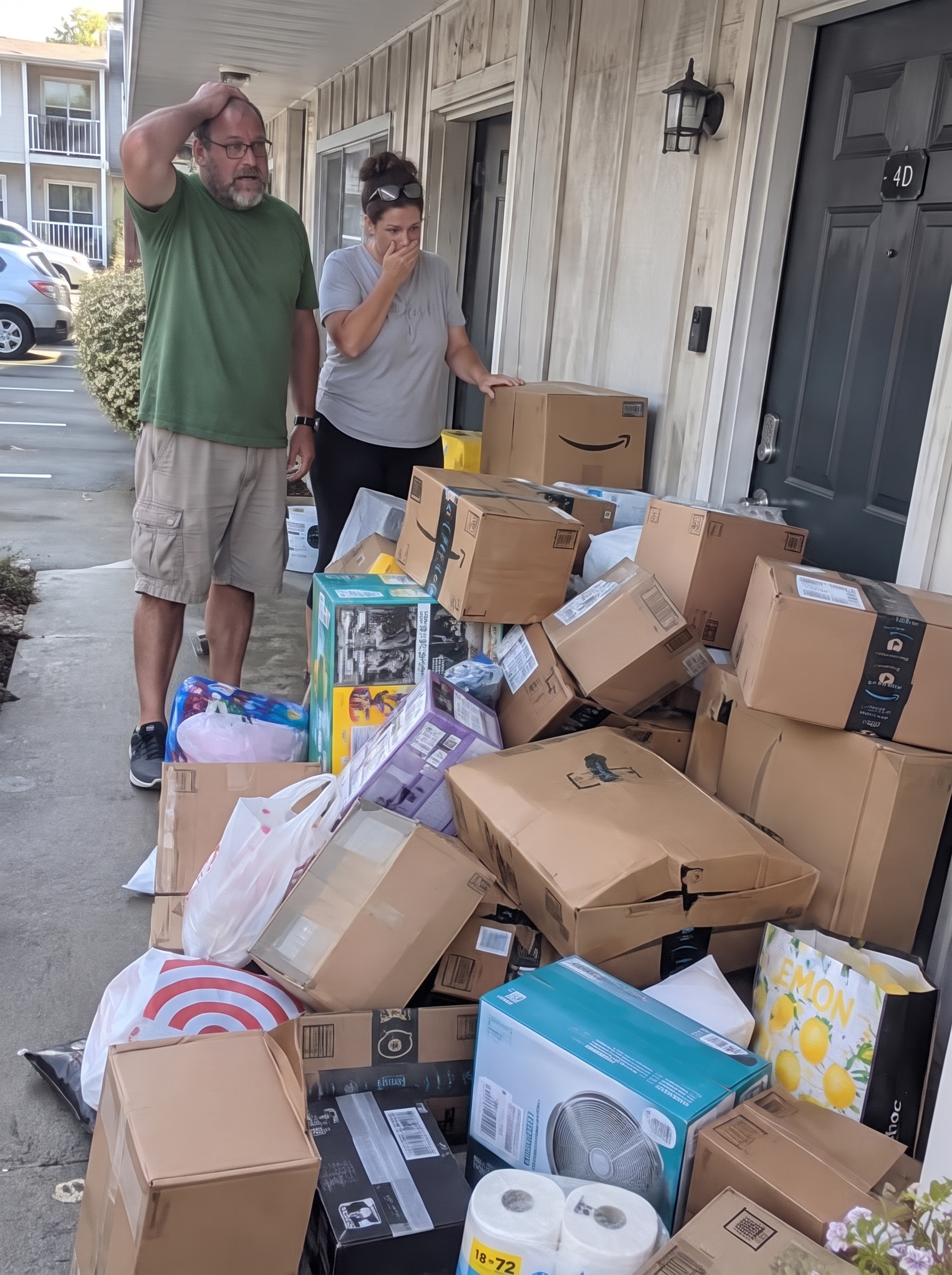
We stood there in the living room, among twenty-eight boxes, while I cried into his shoulder.
On Saturday, we finally started on her bedroom.
I’d been avoiding it. Ben had too, I think. We kept finding reasons to work on the kitchen or the closet in the hall.
But we couldn’t avoid it forever.
Her bed was made. Of course it was. She made her bed every morning of her life, even the morning she went into the hospital. The quilt was pulled up smooth. Her pillow had a little dent in it.
On her bedside table was a lamp, a glass of water with a film of dust on top, a bottle of hand lotion, and a small spiral notebook with a green cover.
Ben picked up the notebook.
He opened it.
“Shopping lists,” he said. “And delivery dates. And order numbers.”
He flipped a few pages.
Then he stopped.
“Claire,” he said. “Come here.”
Between the shopping lists, in the margins, in her loopy handwriting, she’d written notes.
Notes about us.
Ben says he’s fine, but he looks tired.
Claire hasn’t mentioned sewing in months.
Ben fell asleep in the chair again. Third visit in a row.
Claire answered work emails the whole time at Dr. Mehta’s. Didn’t even look up when they called my name.
I read that one twice. My face went hot.
Then there was one more, on its own, near the bottom of a page:
They keep asking what I need. I wish they’d tell me what they need.
I sat down on the edge of her bed.
I read that line several times.
I turned the page.
Ask Ben about his workshop.
Find Claire’s old sketches. (Hall closet? Box marked SCHOOL?)
Yellow daisy fabric — found it! $6.49/yd. Order 3 yds.
Blue bowl — keep looking. (Check estate sale site again.)
Watercolors — for me. It’s my turn.
Birdhouse — build with Ben in spring. If I’m home.
I put my hand over my mouth.
There were more. Pages of them. Notes about our birthdays. About our favorite foods. Ben’s love of burnt toast, which she’d always found horrifying. My terrible habit of eating cereal for dinner. Things we’d said during her hospital visits that I didn’t even remember saying.
I remembered one of those visits now. Reading her notes, it came back to me.
It was a Wednesday afternoon. I’d come straight from work, still wearing my lanyard. She was sitting up in bed, and she asked me out of nowhere, “Are you still drawing designs, honey?”
“Not really,” I’d said.
“Why not?”
“Life gets busy, Mom.”
She’d looked at me for a long moment. She’d looked disappointed. Not angry. Just sad, the way she used to look when I came home with a B-minus on a test I hadn’t studied for.
I’d assumed she was just being sentimental. Getting old. Thinking about the past.
Now, sitting on her bed with her notebook in my lap, I understood.
She’d been worried about me.
And next to that visit’s date, in the notebook, she’d written: Not really. Life gets busy. — C. And under it, pressed so hard the pen had almost gone through the paper:
That’s not good enough.
Ben took the notebook gently out of my hands.
He sat down next to me on the bed.
“She noticed everything,” he said.
“Apparently.”
He turned another page.
Then his whole face changed.
“What?” I said.
He didn’t answer. He just handed it back to me and pointed.
At the top of the page, written carefully, in her best handwriting, like it was something she’d wanted to get exactly right:
They’ve both been putting their lives on hold. I don’t want them doing that forever.
I looked over at her empty side of the bed. At the dent in her pillow.
She’d been the one who was sick. She’d been the one who was dying.
And she’d spent the last of her energy worrying about what her illness was doing to us.
Ben sat with his elbows on his knees, looking at the carpet.
“There’s something I haven’t told you,” he said.
I waited.
“I turned down a job last spring,” he said.
I stared at him. “What job?”
“A good one. A really good one. Assistant manager at a custom furniture company. Up in Grand Rapids. They build high-end stuff. Dining tables. Built-in bookshelves. They saw some photos of my old work online and reached out.” He shrugged. “More money. Better hours. Actual woodworking. They said I could even do some of my own designs.”
“Ben. Why didn’t you take it?”
“It was in Grand Rapids, Claire. Three hours away.” He looked at me. “I couldn’t leave while Mom was sick.”
I stared at him.
“You never told me,” I said.
“Neither did you,” he said.
“Neither did I what?”
“When you stopped applying to design programs.”
My face went warm.
“How did you know about that?”
“Mom told me,” Ben said. “Last year. She said you were thinking about going back to school. Some part-time program. Evening classes. She was so excited about it. She told me three times.”
“I was,” I said quietly. “I’d filled out the application. I’d even picked out a portfolio. And then her appointments got more frequent. And then she couldn’t drive anymore. And I thought, how am I going to go to class three nights a week when she needs me on Tuesdays and Thursdays?”
“So you didn’t send it.”
“I didn’t send it.”
Ben looked down at his hands.
“I thought you were doing okay,” he said.
“I thought the same thing about you.”
We sat there on our mother’s bed.
For months, we’d been asking each other if we needed help.
You okay?
I’m fine. You okay?
Yeah, I’m fine.
Every phone call. Every hospital visit. Every time we passed each other in the parking garage. And we’d both always answered the same way.
And we’d both been lying.
I suddenly remembered something Mom said during one of her last hospital visits. It was late. Ben had gone down to move his car. I was fixing her pillow.
She’d reached up and caught my wrist.
“Claire,” she’d said. “You and Ben don’t have to protect each other from everything.”
I’d brushed it off. “We don’t, Mom.”
“Yes, you do,” she’d said. “You’ve done it since you were little. You both think if you tell the other one something’s wrong, it’ll make it worse. It doesn’t. It makes it lighter.”
I’d smiled and told her to get some sleep.
I hadn’t really listened.
Now her words felt completely different.
“She knew we were both pretending,” I said.
Ben nodded slowly.
“She knew the whole time,” he said.
We had our first real fight that Sunday.
It was about the plates.
We were in the kitchen, packing up her cupboards. Ben was wrapping things in newspaper and putting them into boxes marked DONATE. I was wrapping things in newspaper and putting them into boxes marked KEEP.
After about an hour, I noticed that my KEEP boxes were full and his DONATE boxes were almost empty.
Because I kept taking things out of his.
“Claire,” he said. “You can’t keep her can opener.”
“Why not?”
“You have a can opener.”
“It’s her can opener.”
“It’s a can opener. It doesn’t even work right. You have to turn it backwards.”
“That’s how she always did it.”
He picked up a box. “And her measuring cups? You have measuring cups. And six dish towels? And her spatula with the melted handle?”
“I’m keeping them.”
“Where are you going to put all this? You live in a one-bedroom apartment. Your kitchen is the size of a bathtub.”
“I’ll make room.”
“Claire.”
“I’m not throwing her things in a dumpster, Ben!”
It came out much louder than I meant.
He put the box down.
“Nobody said dumpster,” he said quietly. “I said donate. Somebody else could use them.”
“I don’t want somebody else to use them! I want them to be hers!”
My voice cracked. I turned around and faced the window so he couldn’t see my face.
Ben didn’t say anything for a long time.
Then he said, “They’re not hers anymore, Claire. That’s the whole problem.”
I went home early that day. I didn’t say goodbye.
I sat in my car in my own parking lot with the engine off for twenty minutes. My phone buzzed. It was Ben.
Sorry. I’m sorry. I shouldn’t have said it like that.
I didn’t answer.
An hour later, it buzzed again.
You can keep the can opener.
I laughed out loud, alone in my car. Then I cried for a while. Then I wrote him back.
I’m sorry too. I’ll think about the spatula.
We found the letter on Monday evening.
We’d come back after work to finish the kitchen. We both pretended Sunday hadn’t happened. That’s the Callahan way. Mom used to say we could have an argument at breakfast and be passing each other the butter by lunch.
Mom’s old recipe book was on the shelf above the stove. A three-ring binder, falling apart, stuffed with index cards and torn-out magazine pages and handwritten notes.
I took it down to pack it. It fell open in my hands.
It fell open to the page for birthday pancakes.
Her handwriting. A grease stain in the corner. A little doodle of a smiling sun.
And tucked behind the plastic sleeve, right behind the recipe, was an envelope.
On the front, she’d written:
For my two favorite people. Read together.
Ben was across the kitchen wrapping glasses in newspaper. He saw my face and put down the glass he was holding.
“What?”
I held it up.
He came over and sat down next to me at the kitchen table. Her kitchen table. The same one we’d done homework at on Hadley Street, with ink stains from my glitter pens still in the wood.
I opened the envelope carefully. My hands were shaking.
Three pages, folded in thirds. Her handwriting.
I started to read out loud.
My dear Claire and Ben,
If you’re reading this, I hope you’re sitting together. And I hope you haven’t argued about who gets Grandma’s plates.
Ben laughed softly. Then he looked at me.
“We argued about a can opener,” he said.
“Shut up,” I said. But I was smiling.
I kept reading.
I know the packages probably surprised you. I’ve been planning them for a while. Since August. Since Dr. Mehta sat me down and told me some things I didn’t tell you.
I’m sorry I didn’t tell you. I want you to know why. It wasn’t because I didn’t trust you. It was because I knew exactly what you’d do. You’d drop everything. You’d stop living your lives and start living mine. And I’d already watched you both do that for two years.
So I ordered a strawberry milkshake instead. And then I went home and made a list.
I had to stop for a second.
“The diner,” I said. “In August. She drank the whole thing.”
Ben squeezed my hand.
I kept going.
At first, I just wanted to make sure you’d have presents for the birthdays and holidays I might miss. That’s all I meant to do. A bowl for Claire. Some tools for Ben. Something under the tree.
But the more I thought about it, the more I realized that presents weren’t really what I wanted to leave you.
I wanted to remind you of the people you were before you became so busy taking care of me.
I stopped reading.
I couldn’t.
Ben reached over and took my hand again and held it. He didn’t say anything. He just held it.
After a minute, I kept going.
Claire, I still remember you sewing your first dress. You were thirteen. It was purple with orange polka dots, and it was the ugliest thing I’d ever seen. You were so proud of it that you wore it to the grocery store, even though one sleeve was two inches longer than the other. When the cashier said it was pretty, you told her you made it yourself. You stood up so straight.
I want you to stand up that straight again.
Ben, I remember you making me that little wooden shelf. You were fourteen. You worked on it in the garage for three weekends. You insisted it was perfectly level.
It wasn’t. My spice jars slid to the left for eleven years.
I kept it anyway. It’s in the hall closet. You can have it back. Maybe fix it this time.
Ben made a sound. Half a laugh, half something else. He wiped his face with the back of his hand.
I know you’ve both given up things because you wanted to be close to me. Ben, I know about Grand Rapids. Your friend Danny told me at the Fourth of July picnic. He thought I already knew.
Claire, I know about the application. I found it in your car when you drove me to the eye doctor. Filled out. Stamped. You never mailed it.
I love you both for that. I love you more than I know how to write down.
But please don’t spend the rest of your lives proving how much you loved me by refusing to move forward.
My voice broke completely.
I put the letter down on the table. I couldn’t see the words anymore.
Ben picked it up and read the last page himself. His voice was rough. It shook. But he read it.
You don’t have to keep every possession in this apartment. Most of it is just stuff. Keep the plates, and the recipe book, and anything that makes you smile. Give the rest to someone who needs a can opener.
I let out a sound that was somewhere between a laugh and a sob.
“How did she know?” I said.
“She knew everything,” Ben said. He kept reading.
You don’t have to feel guilty when you laugh, or when you celebrate, or when a whole day goes by and you realize you haven’t thought about me. That’s not forgetting. That’s living. It’s what I want.
And you don’t have to pretend you’re fine just because you don’t want to worry each other. I watched you both do that. For two years. It broke my heart more than my heart was already broken.
Take care of yourselves. Take care of each other.
I’ll always be your mom. Whether you’re making pancakes in my kitchen, or building a completely different life somewhere else.
Love you both more than you know.
Mom.
P.S. Ben, fix your faucet.
Neither of us spoke for a long while.
The refrigerator hummed. Somebody upstairs was walking around. A car drove by outside with the radio on.
Ben folded the letter carefully along its creases. He put it back in the envelope. He set it on the table between us.
“I thought leaving would mean abandoning her,” he said finally.
I looked at him.
“Grand Rapids?”
He nodded.
“Even after she got sick, she kept telling me to apply for things,” he said. “She’d send me job listings. Furniture makers. Restoration shops. Places in other states. I thought she just didn’t understand how serious it was. How bad she was. I thought she thought she had more time.”
“She understood,” I said.
“Better than I did,” Ben said.
I looked at the yellow daisy fabric, folded on the counter where I’d left it.
“I kept thinking I’d start sewing again when everything settled down,” I said.
“And now?”
“I don’t know.”
He nodded.
“Me neither,” he said.
For once, neither of us pretended to have an answer.
We just sat together at her kitchen table. In the dark, because neither of us had gotten up to turn on the light.
After a while, Ben got up and went to the hall closet.
I heard him moving things around. Coats. A vacuum cleaner. A box of Christmas lights.
He came back holding a small wooden shelf.
It was simple. Pine. About two feet long, with two little brackets underneath. It had been painted white once, but the paint had worn off at the edges.
He set it down on the kitchen table. Then he took a marble out of a bowl on the counter. Mom always kept a bowl of marbles there. Nobody ever knew why.
He set the marble on the shelf.
It rolled slowly to the left. All the way to the end. Clink.
Ben stared at it.
Then he started laughing. He laughed so hard he had to sit down. He laughed until he was crying, and then he was just crying, with his face in his hands.
I got up and put my arms around my big brother. And he let me.
Before we left that night, we went back to her list.
There was one line we hadn’t touched.
Related stories

How One Orange Peel in the Mess Hall Brought Down Sergeant Miller

<h1 class="page-title">After my husband shoved me down the stairs, my mother-in-law stood over me and called me “a worthless disgrace.” Then she called my father and said, “Come take your broken daughter. She’s no longer our problem!” My father calmly replied, “Touch her again,</h1>

“She wrote about you every night,” Daniel said. “Ninety-four times.”

I Returned to My Hometown After 20 Years and Found the Woman I Loved Walking Barefoot, Carrying Firewood While a Little Girl Helped Her. The Businessman Who Ruined Her Still Lived in Luxury: “She Was Always Too Smart for Her Own Good.” I Canceled My $12 Million Deal and Ordered an Investigation Into His Accounts. Then I Saw a Mark Behind the Little Girl’s Ear… Identical to Mine.

LAST PART- My mother warned me not to embarrass her at Christmas, while my wealthy sister mocked my business.