1 view
Part 1
I slammed on the brakes of my luxury car
when I recognized the woman
I had loved twenty years earlier.
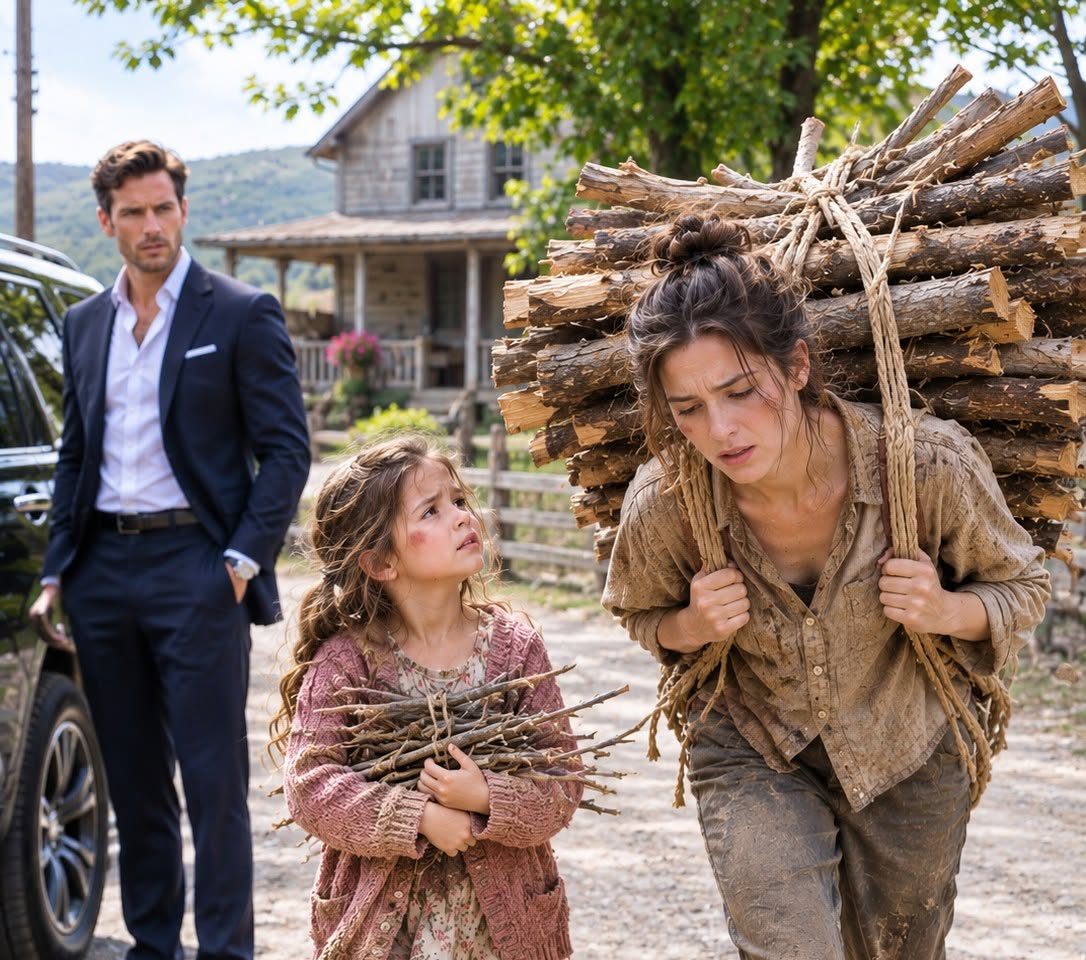
She was walking barefoot along a
mountain road, a huge bundle of
firewood on her back, with a four-year-old
girl carrying sticks beside her.
But what almost made me lose my
senses was not seeing her in such poverty.
It was discovering that the little
girl had exactly the same birthmark
as my late mother.
My name is Grant Whitaker, and
I had come back to the mountains of
western North Carolina to close a real
estate deal worth $12,000,000.
My company, based in Atlanta, planned
to buy 400 acres of forest land near a
small town in the Blue Ridge Mountains.
I meant to sign the papers and
leave before nightfall.
I had avoided that place for twenty years.
I had grown up there in hard times.
I had buried my mother there.
And I had left Shelby Marsh there,
the only woman I had ever promised to love forever.
When I took that narrow curve,
I recognized her immediately.
Shelby wore a worn-out T-shirt and
an old skirt, and her feet were bloody from the stones.
The girl, with light brown hair and bright eyes, walked next to her, trying not to drop a single stick.
“Mama, I can carry more,” the little girl said.
“You’re carrying plenty, sweetheart. You’re my favorite helper.”
I turned off the engine.
I wanted to call out to her, but something stopped me.
I waited until they disappeared among the trees, then followed from a distance, leaving the car where the road ended.
They reached a small stone cabin with a damaged roof, windows covered with plastic, and a tiny vegetable garden.
There were no power lines in sight.
Shelby dropped the firewood and leaned against the wall, exhausted.
Then the girl asked:
“Mama, when is my daddy coming?”
Shelby knelt in front of her.
“Sweetheart, we’ve talked about this.”
“But you said maybe someday…”
The air left my lungs.
The little girl turned her head.
Behind her left ear was a tiny crescent-shaped mark.
The same one my mother had had.
The same one I had carried since birth.
And then I remembered something I had spent years trying to forget.
Four years earlier, I had come back to town to bury my father.
During that visit, I had run into Shelby.
We had shared a dinner, memories, and tears.
That night we ended up together in the old family house.
The next morning, I went back to Atlanta without saying goodbye.
Now, looking at that little girl, I understood that I might have abandoned far more than an old love story.
Not daring to introduce myself, I returned to my car.
That night I canceled the signing of the sale and rented a room at a boarding house.
The next morning I visited Dot Pruitt, who had run the general store for decades.
“I need to know what happened to Shelby Marsh.”
Dot stopped stacking shelves.
Her expression changed completely.
“Grant, some things are better left alone.”
“What things?”
She glanced at the door and lowered her voice.
“Shelby doesn’t live like that by choice. Five years ago she reported something that could ruin the most powerful family in this county. And they made sure nobody would ever believe another word she said.”
I stood perfectly still.
Then Dot said the family’s name.
It was the very same family that was trying to sell me the 400 acres of forest.
PART 2: The Folder Under the Floor
“The Hargroves,” I whispered. “What did they do to her?”
Dot locked the shop door before she answered.
Five years earlier, Shelby had worked as an office clerk at Hargrove Timber, a logging company owned by Russell Hargrove. He was a powerful man who controlled contracts, trucking, and most of the jobs in the county.
One day, Shelby noticed something strange in the paperwork. The trucks were hauling far more lumber than the permits allowed. Crews were cutting trees in a protected area, the same hillside that fed the springs for several nearby communities.
She took photos. She kept copies of permits that looked fake. Then she went to the state authorities and to a reporter in Asheville.
A few weeks later, she was fired.
The company said she had stolen $18,000 from an office cash box. She was never convicted, but the lie spread, and her good name was gone. Nobody would hire her.
“Even some of the neighbors stopped saying hello,” Dot said. “By the time her baby was born, she was nearly alone.”
I felt sick with shame. While I had been piling up money, Shelby had been fighting just to find food, heat, and medicine.
For two days, I studied land records, logging permits, and county files with the help of an environmental lawyer named Gwen Abernathy. What we found was troubling. The cutting maps included acres outside the approved land. A signature on one permit, said to belong to an old county inspector, looked different from his other signed papers.
And the deal I had almost signed was worse than I’d thought. If I bought that land, the Hargroves would control the road to the exact place where the illegal cutting had happened. The sale could help them hide the evidence.
I went back to the cabin.
Shelby came out holding a small hatchet. When she saw me, her face turned hard.
“You’ve got a lot of nerve coming here.”
“Shelby, I need to talk to you.”
“You promised you’d come back!” she said. “I waited years for a phone call while you were in the magazines with a different woman every month.”
I lowered my eyes. “You’re right.”
“Then what do you want?”
I looked at the half-open door, where the little girl was hiding.
“I want to know if that child is my daughter.”
The hatchet fell to the ground. Shelby went white.
“Leave, Grant.”
“I only need the truth.”
“Get off my land!”
I stepped back and left.
Three days later, my phone rang. It was Shelby, and her voice shook.
“Yes, Grant. Willa is your daughter. I wrote you when I found out I was pregnant, but the letter came back because you’d moved.”
I could not speak.
“And there’s something else you need to know,” she said. “Russell Hargrove knows about Willa. For years he’s used what he knows about that night to threaten me.”
“Threaten you with what?”
Shelby began to cry.
“With taking my daughter away if I ever talk about those documents again.”
PART 3: What I Carried
I stood there with the phone against my ear, unable to answer.
I had made deals worth hundreds of millions. I had faced lawsuits and betrayal. But I had never felt fear like this.
“Shelby, listen to me. No one can take Willa just because some rich man says so. We’ll get legal help.”
“You don’t understand how things work here,” she said. “Russell has friends everywhere. When they said I stole that money, nobody would listen. Why would this time be different?”
“Because this time you won’t be alone.”
The line went quiet.
“You said the same thing twenty years ago, Grant.”
She hung up. That sentence hurt more than any insult.
I didn’t sleep that night. I kept seeing Shelby at nineteen, sitting beside me on the old stone wall by the bridge. She wanted to study accounting and open her own small office. I wanted to leave for the city and become a businessman. We had promised each other that when I found steady work, I’d come back for her.
But my first big contracts took me to Chicago. Then came the travel, the deals, and the money. At first I wrote every week. Then every month. Then I stopped.
Now I understood that I had mistaken success for the ability to run away from anything that asked me to be responsible.
The next morning, I called Gwen.
“I need you to look into a timber company,” I told her. “But first, I need to protect a woman and her child.”
“Grant,” Gwen said, “your money can help us gather evidence. But it doesn’t give you the right to decide for Shelby. If we do this, she has to choose it herself.”
I understood. For the first time in years, I couldn’t fix a problem by giving orders.
Later, Shelby told me what happened in that stone cabin the night I called. Willa had been drawing by the window with crayons worn down to stubs.
“Mama, is the man with the big car bad?”
Shelby had put down the coat she was mending. “No, sweetheart.”
“Then why were you mad at him?”
She searched for words a four-year-old could understand. “Because sometimes people hurt others without knowing how much it hurts.”
Willa thought about it. “Then he should say sorry.”
“Yes, baby,” Shelby said. “He should.”
She told me that, and I had no defense.
That afternoon, I left a note in the little mailbox by the road. It said I had canceled the land purchase for good. It said I would do nothing about Willa without talking to her first. It gave Gwen’s phone number and asked if Shelby would be willing to go through the evidence against the Hargroves with her.
Shelby read the note three times. The next day, she called Gwen.
We met in an office in Asheville. Shelby brought a blue folder she had hidden for five years under a loose floorboard. Inside were photographs, copies of shipping forms, printed emails, and notes on truck movements.
“I kept it because I knew someday somebody would try to make me believe I imagined it,” she said.
Gwen went through every page. Some photos showed bulldozers working on a protected slope. Others showed trucks loaded with logs whose tag numbers matched the transport records.
There was one more thing. Shelby had saved a copy of the cash sheet that supposedly proved she stole $18,000. The date on it was a day she had been out on medical leave, and the computer record had been changed after she was fired.
“This will need an expert to confirm it,” Gwen said. “But it could tear down the story they used to ruin you.”
Shelby covered her face with her hands. For five years she had waited to hear that her proof could matter.
I wanted to hug her. I didn’t. Instead I asked, “What do you need from me?”
She looked up. “Don’t disappear when things get hard.”
The case grew. Gwen tracked down Tess Calloway, the reporter who had first received Shelby’s tips. Tess had moved to Raleigh and worked for an independent news site. She still had the original photos and messages proving Shelby had raised the alarm before she was fired.
“My old paper wouldn’t touch it,” Tess said. “The company threatened to pull its ads and sue us. Soon after, they moved me to another desk.”
She had saved everything, waiting for a second chance.
I paid for an independent study of the hillside. Gwen sent the evidence to the right state and federal agencies. The study found signs of cutting beyond the legal lines and soil damage that could have harmed the springs. The old county inspector agreed to talk. He said he didn’t recognize several signatures on the permits as his own.
The Hargroves had real reason to worry now.
Russell found out before the story went public. One evening he walked into my boarding house with his two grown sons.
“I hear you’re asking questions you shouldn’t.”
I closed my laptop. “I’m reviewing paperwork about a deal you offered me.”
He smiled. “And you’d throw away a twelve-million-dollar deal for a woman who didn’t even tell you that you had a child?”
I felt my jaw tighten. “Don’t ever use Willa to threaten her mother again.”
“Be careful. A lot of families in this valley depend on my company.”
“Then you should care about the trees, and the water those families drink.”
Russell leaned over the table. “Shelby was always too smart for her own good. She thought she could take me on with a few papers, and now she picks up sticks for a living. Want to end up like that?”
I held his stare. “I’d rather lose every dollar I have than become someone like you.”
He stopped smiling. “Then you’re about to learn what it costs to cross the Hargroves.”
The threat came true two nights later. Someone smashed a window on my car. That same night, Shelby heard noises near her woodshed. She didn’t go out, because Willa was asleep and she was afraid.
At dawn she found the padlock cut. Most of the firewood she had stacked for winter had been thrown into the creek. Tools were gone. One window of the cabin was broken.
When I arrived that morning, I found her sitting on the ground, crying without a sound. Willa stood beside her, staring at the soaked logs.
“Mama, are we going to be cold now?”
Shelby pulled her close. “No, baby. We’ll find a way.”
Then she looked up at me. “This is what they always do,” she said. “They don’t have to hit you. They take your job, they take your friends, they scare you, until you stop talking.”
I knelt next to her. “We’re going to report this.”
“And then what? You’ll go back to Atlanta while we stay here?”
I didn’t argue or make promises. I took out my phone, called Gwen, and asked for help filing a report. Then I started pulling logs out of the creek.
I felt her watching me. I was wearing a coat that probably cost more than everything she owned. Yet there I was, on my knees in the mud, hauling wet wood with my bare hands.
When I finished, I asked if I could buy firewood to replace what was lost.
“I don’t want your charity,” she said at once.
“Then think of it as a debt. For years I should have been here, and I wasn’t.”
She shook her head. “You can’t pay back being gone with money.”
“I know. That’s why I want to stay and pick up what’s left.”
She said nothing. Then she handed me a pair of old work gloves. “You’ll need these.”
The sheriff’s office took the report and began to investigate. Tess published her story about the illegal logging. It had photos, expert findings, witness statements, and all the problems with the permits.
It spread fast across the state. Others began to speak up. A former truck driver said he had hauled timber from restricted land. A farmer said his well water had turned muddy after the cutting.
The state attorney general’s office received new files and opened a formal inquiry. The Hargroves realized they could no longer keep everyone quiet.
Their lawyers asked for a settlement. Gwen made it clear that any deal with Shelby would be separate from the public investigation, and could never stop her from testifying. After several meetings, the company agreed to withdraw its accusations, admit it had no proof she took any money, and publish a correction. It also agreed to pay her for the harm she could show she had suffered. The legal and environmental cases would continue on their own.
When Gwen told her, Shelby didn’t ask how much money it would be.
“Will they say out loud that I didn’t steal anything?”
“Yes, Shelby. It’s in writing.”
She put her hand over her mouth. For years she had avoided the store when other customers were there. She had watched mothers pull their children away from Willa. She had listened to people talk about her poverty and the child’s missing father.
And now someone would have to admit they had ruined her life for no reason.
The day the correction went public, I brought her a copy. I found her sitting on the doorstep, Willa asleep in her lap, a candle glowing by the door.
I sat beside her. “It’s published.”
Shelby read it slowly. When she got to the line where Hargrove Timber admitted it had no basis to accuse her of theft, she began to shake.
“Five years,” she whispered. “Five years I thought I’d been stupid to report what I saw.”
I shook my head. “You were the bravest person any of us knew.”
She cried. It wasn’t the desperate crying she had hidden through so many nights. It was the kind that comes when a person finally puts down something too heavy to carry.
I stayed beside her without touching her. After a while, Shelby rested her head lightly on my shoulder.
“You could have started with ‘I’m sorry,’” she murmured.
“I’m sorry, Shelby. For leaving. For not coming to find you. For taking so long to see what I’d lost.”
She breathed deeply. “I don’t know if I can forgive it all.”
“You don’t have to today.”
Willa woke up at the sound of our voices. She looked at me with curious eyes.
“Mama, is that the man who helped with the firewood?”
Shelby stroked her hair. “Yes, baby. And there’s something I want to tell you.”
Willa sat up. Shelby looked at me, then at her daughter.
“You know how you always ask about your daddy?”
Willa nodded.
“Well, Grant is your father.”
The little girl’s eyes went wide. She stared at me for a few seconds.
“Really?”
My voice broke. “Yes, Willa. I’m your dad.”
She studied me as if she needed an explanation. “Then why didn’t you come sooner?”
That question went straight through me. I could have talked about lost letters and distance and mistakes. But a child deserved a simple, true answer.
“Because I did things very wrong, sweetheart. I didn’t know you were born, and I didn’t take care of your mama the way I should have. I’m so sorry.”
Willa looked down. Then she asked, “Are you going to leave again?”
Tears ran down my face. “I’ll have to travel for work sometimes. But I want to be in your life always. If your mama lets me, I’ll come see you, and we can get to know each other a little at a time.”
Willa looked at Shelby. Shelby nodded slowly.
Then Willa crawled over and held out her arms. I hugged her carefully. As she rested her head against my chest, I understood that none of my companies had ever given me anything so valuable.
Life didn’t change overnight. Shelby and I agreed to a paternity test and to handle Willa’s legal recognition with proper advice. The result confirmed what Shelby had always known. But that didn’t mean she was ready to take me back. Some wounds ran too deep.
I rented a house near town and rearranged my work so I could spend most of my time in North Carolina. I didn’t buy a mansion or try to win Willa over with gifts. I learned which stories she liked, how to make her breakfast, and which songs helped her fall asleep.
I also learned that Shelby needed to stand on her own feet, not trade one powerful man’s control for another’s.
With part of her settlement, she rented a decent home and signed up for a course to update her accounting skills. The first time she walked into class, she had a new notebook and shaking hands. When she got home, she called me.
“Today the teacher asked about my work experience,” she told me, crying. “And for the first time in five years, I wasn’t ashamed to say where I’d worked.”
I smiled. “I’m so glad, Shelby.”
She was quiet for a moment. “Thank you for helping me get my name back.”
“You got it back yourself. I just got to stand beside you.”
Months passed. The investigation into Hargrove Timber went on, and officials demanded repairs to the damaged forest. Neighbors who used to avoid Shelby began to greet her. Some apologized. Others stayed silent, unable to face their own cowardice. She didn’t need everyone to like her. She only needed to walk through town with her head held high.
Willa started school and soon covered her bedroom wall with drawings. In one, three people held hands in front of a house with flowers. Underneath, with help from her teacher, she had written: MAMA, DADDY, AND ME.
Shelby showed me the picture one evening and stared at it for a long time. That night she invited me to dinner. After we put Willa to bed, we sat on the porch.
“It still hurts to remember,” Shelby admitted. “Some days I think about everything we could have had if you hadn’t left.”
I took her hand. “Me too. And I know I can’t get those years back.”
“No,” she said. “But maybe we can stop wasting the ones we have left.”
I looked up. Shelby smiled shyly. It wasn’t a promise of happily ever after. It was something harder and truer: a chance.
The next winter, I walked the mountain road where I had first seen Shelby and Willa carrying firewood. This time I wasn’t driving a luxury car. I walked beside my daughter, who carried a little basket of pinecones for the fireplace. Shelby strode ahead of us, enjoying the cold air.
Willa stumbled a little, and I caught her.
“Daddy, do you remember when Mama and I carried wood up here?”
“I remember, sweetheart.”
“Mama used to carry so much.”
I looked at Shelby. She turned and smiled.
“Yes, Willa. Too much.”
The girl thought for a few seconds. Then she took my hand and ran to catch up with her mother.
“Now we can carry it together, all three of us!”
I looked at our small hands joined. I had spent twenty years collecting money, buying land, and building companies, sure that wealth meant owning more and more. But that afternoon I learned what no fortune could teach me.
Real love isn’t coming back when everything is already lost and promising never to leave again. It’s staying when trouble comes, respecting the wounds you caused, and proving, day after day, that the arms that were once missing are now willing to share the load.
And as Willa walked happily between her parents, I hoped Shelby felt what I felt: that life hadn’t given back our lost years, but it had given us something we no longer expected to find. A future where neither of us would have to carry everything alone.
THE END.