1 view
I touched her cheek.
“You were my little girl.”
She closed her eyes.
And for the first time in fifty-five years, I kissed my daughter on the forehead.
The pastor came back.
He looked at us.
“Miss Ona, the funeral home is ready.”
I nodded.
“Give me a minute.”
He looked at Rebecca.
“Would you like to walk with your mother?”
Rebecca looked at me.
I took her hand.
“Yes,” I said. “She would.”
We walked together behind Mama’s casket.
The congregation stood.
Some people stared.
Others whispered.
I didn’t care.
For the first time in my life, I wasn’t walking alone.
PART 4 – THE CHRISTENING GOWN
The next morning, Rebecca came to my house.
She arrived at nine with a paper bag from a bakery.
“I didn’t know what you liked,” she said, “so I brought a little of everything.”
I laughed.
It was the first real laugh I’d had since Mama died.
“Well, honey, that’s how you feed an old woman.”
She smiled.
We sat at my kitchen table.
She looked around the house.
There were photographs of my husband on the wall.
A picture of Mama beside the television.
A little ceramic rooster on the windowsill.
Nothing fancy.
Nothing worth much money.
But everything had a place.
Rebecca picked up a photograph of my husband.
“That’s your daddy?”
I nodded.
“Your daddy in the ways that mattered, anyway. He raised me better than I deserved.”
She smiled.
“He looks kind.”
“He was.”
I poured coffee.
She looked at the empty chair across from me.
“Did Grandmother sit there?”
“Every morning.”
“What did she eat?”
“Toast. One egg. A little jelly.”
Rebecca smiled sadly.
“She liked jelly?”
“Strawberry. Always strawberry.”
We sat quietly.
Then Rebecca said, “I need to ask you something.”
“Go ahead.”
“Do you want to see the box?”
I knew what she meant.
Mama’s bedroom.
The blue box.
The hospital papers.
The gown.
I looked toward the hallway.
“I don’t know if I’m ready.”
Rebecca nodded.
“We don’t have to.”
I thought about it for a minute.
Then I stood.
“Yes, we do.”
We walked into Mama’s bedroom.
Her perfume still lingered in the curtains.
Her slippers were beside the bed.
On the dresser sat a little glass dish full of buttons.
I had cleaned the room after she passed, but I hadn’t opened the closet.
Rebecca found the blue box on the top shelf.
It was an old hatbox.
The lid was tied with a faded ribbon.
She placed it on the bed.
I sat beside it.
My fingers trembled as I untied the ribbon.
Inside were photographs.
Hospital documents.
A newspaper clipping.
A small envelope of birthday cards.
And underneath everything else was a piece of white satin.
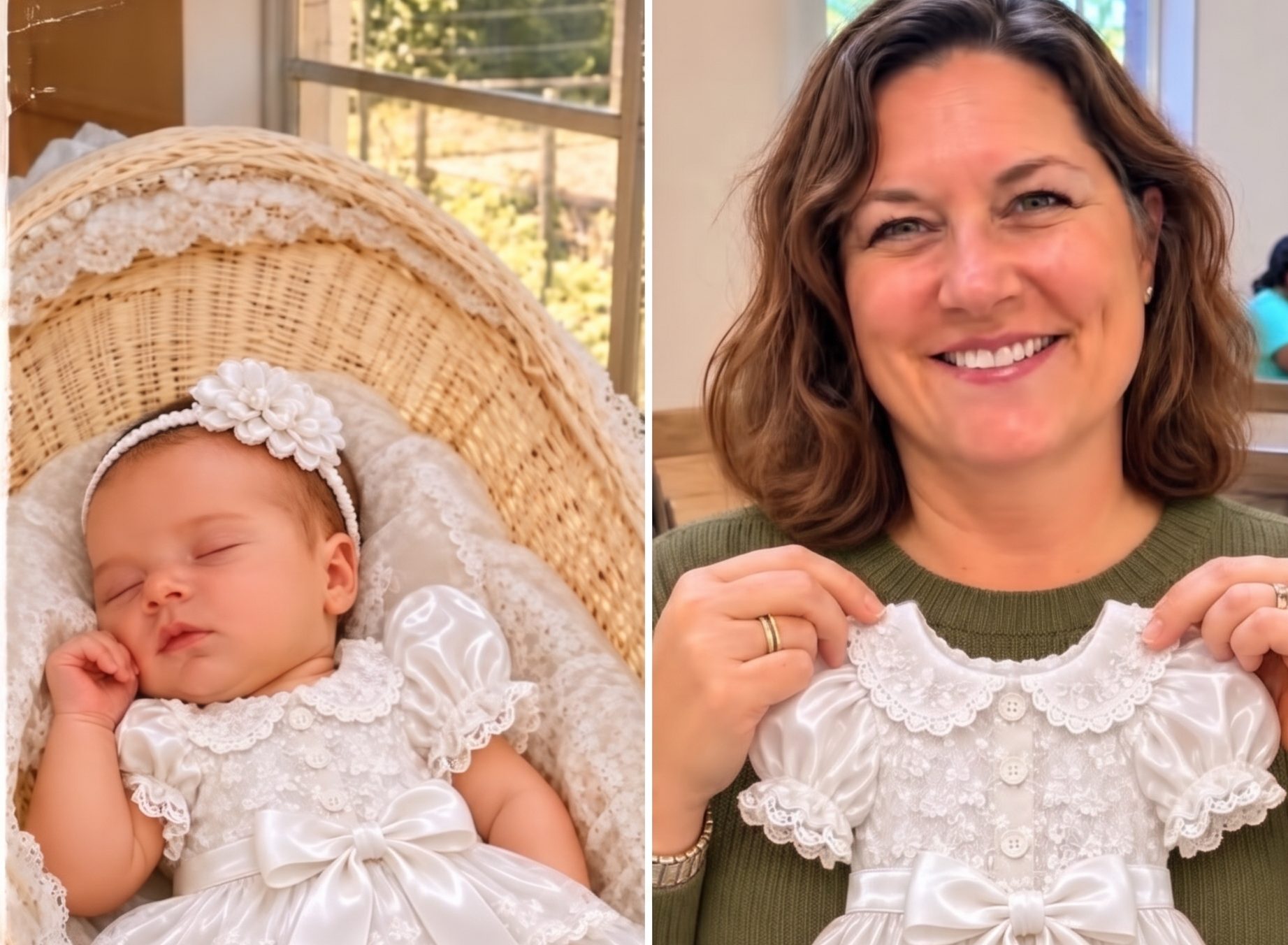
The christening gown.
I lifted it carefully.
The fabric was yellowed with age.
The lace around the collar had come loose in one place.
A tiny pearl button was missing from the back.
But I knew it.
I’d held that gown against my belly every night.
I’d talked to my baby while Mama sewed the little sleeves.
I pressed it to my face.
It smelled like old fabric and lavender.
And I cried.
Rebecca sat beside me.
“Is that it?”
I nodded.
“Yes, sweetheart.”
She touched the lace.
“Grandmother made this?”
“She did.”
“Did she make it for me?”
I looked at her.
“Every stitch.”
Rebecca lifted the gown.
There was a little folded note tucked into the lining.
She opened it.
It was written in Mama’s hand.
For my granddaughter, on the day she meets the Lord.
Rebecca covered her mouth.
I looked at the words.
Then I looked at my daughter.
“She never stopped thinking about you.”
Rebecca nodded.
“I know.”
I shook my head.
“No, honey. I don’t think you do.”
I placed my hand over hers.
“She was wrong to take you from me. But she loved you, too. In the only way she knew how after she’d done what she did.”
Rebecca held the gown against herself.
“Do you think I could keep it?”
I nodded.
“Of course.”
Then I stopped.
“Wait.”
I reached into the box.
There was another envelope underneath the hospital records.
This one had Rebecca’s name on it.
For my granddaughter, when the time is right.
Rebecca opened it.
Inside was a photograph of Mama holding a newborn baby.
The photograph was faded.
But Mama’s face was unmistakable.
She was young.
Her hair was dark.
She was smiling.
And in her arms was a little girl.
Rebecca looked at me.
“That’s me?”
I studied the picture.
Then I noticed something.
The baby was wearing a hospital bracelet.
The date was written on the back.
September 1971.
I sat down.
“She held you.”
Rebecca stared at the picture.
“She held me?”
I nodded.
“She must have.”
There was another note.
I held you for eleven minutes before I gave you to Evelyn.
You had a little patch of dark hair and a dimple in your left cheek.
I wanted to keep you.
I wanted to give you back to your mother.
I was afraid of what would happen if I did.
I have never forgotten the weight of you in my arms.
Rebecca began crying.
I put my arm around her.
And we cried together over the little girl neither of us had known how to find.
After a while, she looked at me.
“Can I ask you something?”
“Anything.”
“Would you tell me about my birth?”
I smiled through my tears.
“Oh, honey. I can tell you everything I remember.”
So I did.
I told her about Louisiana.
About Aunt Lydia.
About the hospital.
About how I’d talked to her before she was born.
I told her I had imagined her eyes.
Her hair.
Her little hands.
I told her I had wondered whether she would have liked dolls or bicycles.
I told her I had imagined teaching her to bake.
And then I told her something I’d never said aloud.
“Every year on your birthday, I bought you a present.”
Rebecca looked at me.
“What?”
I nodded.
“Not always something big. A little doll sometimes. A dress. A book. Once, a red sweater.”
“Where are they?”
“In the attic.”
She put her hand over her mouth.
“I kept them in a trunk.”
She began crying again.
I took her hand.
“Would you like to see them?”
She nodded.
We climbed the stairs slowly.
The attic smelled of dust and old cardboard.
I moved a few boxes and found the wooden trunk.
It had belonged to my husband.
I opened it.
Inside were fifty-five years of little things.
A doll with one missing shoe.
A pink baby blanket.
A wooden horse.
A birthday card that said, To my little girl, wherever you are.
A pair of tiny white shoes.
And fifty-five envelopes.
One for every birthday.
Rebecca sat on the floor.
She opened the first envelope.
Inside was a note.
Happy first birthday, sweetheart. I hope somebody sings to you today.
She opened another.
Happy fifth birthday. I wonder if you like cake.
Another.
Happy tenth birthday. I hope school is treating you kindly.
Another.
Happy eighteenth birthday. Today you are a grown woman. I wish I could tell you how proud I am.
Then she opened the envelope from her thirty-fifth birthday.
I don’t know whether you have children of your own. If you do, I hope they know how lucky they are.
Rebecca couldn’t read anymore.
She put the letters against her chest.
“Mama.”
I looked at her.
“Yes, honey?”
“I never knew.”
I sat beside her.
“Neither did I.”
She leaned against me.
We stayed in that attic for a long time.
PART 5 – THE WOMAN WHO CAME BACK
Rebecca came back the following Sunday.
Then the Sunday after that.
At first, she stayed an hour.
Then two.
Eventually, she started bringing groceries.
I told her I didn’t need groceries.
She told me she knew.
Then she put them in my refrigerator anyway.
She reminded me of somebody.
My husband used to do that.
On the third Sunday, she brought her daughter Grace.
Grace was tall, with dark hair and a little dimple in her left cheek.
She stood in my doorway looking nervous.
“Grandma?”
I nodded.
“That’s what your mother tells me.”
She smiled.
Then she hugged me.
I had never been a grandmother before.
I didn’t know what to do with my hands.
So I held her.
After that came Daniel.
Then Rebecca’s husband, Thomas.
Then the grandchildren.
They filled my little house with noise.
Somebody was always asking where the cups were.
Somebody was always looking for a phone charger.
Somebody was always opening the refrigerator.
It was wonderful.
One afternoon, Grace sat at my kitchen table and asked about my mother.
“Was she a good grandmother?”
I looked at her.
“She never got the chance.”
Grace lowered her eyes.
“I’m sorry.”
I shook my head.
“Don’t be. That’s not your burden.”
She looked at the little christening gown hanging over the back of a chair.
“Do you think she would have loved us?”
I looked at the gown.
“Yes, sweetheart. I think she would have.”
That evening, Rebecca and I went to the memorial garden.
I hadn’t brought flowers.
For fifty-five years, I’d always brought flowers.
But this time, I brought something else.
Rebecca carried a little garden shovel.
We stood beside the small nameless stone.
It looked smaller than I remembered.
The crepe myrtle had grown over the years.
There were leaves scattered around the base.
Rebecca knelt down.
“Is this where you came every year?”
“Yes.”
She touched the stone.
“I stood here once.”
I nodded.
“I know.”
She looked at me.
“How?”
“You told me.”
She smiled.
Then she reached into her purse.
She pulled out a small metal plaque.
It had been made by a local engraver.
On it were three words.
I stared at it.
She looked nervous.
“I thought maybe you’d want my name here.”
I touched the plaque.
“Your name belongs here.”
We took it to the church office and asked the pastor about putting it on the stone.
He agreed.
A week later, we returned.
The plaque had been attached.
For the first time, the little stone had a name.
I stood there looking at it.
Then Rebecca slipped her hand into mine.
“Do you want to say something?”
I nodded.
I bent down.
I touched the letters.
“Hello, baby.”
Rebecca cried.
I smiled.
“I know you’re a grown woman. I know you’ve got children and a husband and a life I missed.”
I looked at her.
“But I want you to know something.”
I squeezed her hand.
“I never stopped being your mother.”
Rebecca leaned her head against my shoulder.
“And I never stopped being your daughter.”
We stood there until the sun went down.
PART 6 – THE LAST THING I NEEDED TO KNOW
A month after Mama’s funeral, I received a telephone call from a woman named Evelyn’s niece.
She introduced herself as Margaret.
She said she had been sorting through family papers after Rebecca’s adoptive mother’s death.
“There’s something I think you should have,” she said.
“What is it?”
“A letter from your mother.”
I closed my eyes.
Another letter.
I was beginning to wonder how many secrets one woman could fit into a lifetime.
Margaret asked if I could meet her.
I agreed.
She arrived the next afternoon carrying a manila envelope.
We sat at my kitchen table.
She placed the envelope between us.
“I hope this doesn’t cause you more pain,” she said.
“I’ve had plenty of pain, honey. One more letter won’t kill me.”
She gave a small smile.
Then she explained.
Evelyn had kept a journal.
In it were the dates she had visited Mama.
The dates she had received photographs.
And the dates she had sent letters.
Margaret told me that Evelyn had wanted to contact me many times.
But Mama had always refused.
Then she handed me the envelope.
Inside was a letter from Evelyn.
It was dated 1998.
I read it slowly.
You do not know me, but I have known of you for many years.
I have raised your daughter with everything I had.
She is kind. She is stubborn. She laughs loudly. She has your chin.
I have loved her as my own, but I have never forgotten that she came from another woman.
I have wanted to write to you many times.
Your mother has asked me not to.
I am writing now because I am getting older, and I don’t want to leave this world without saying something.
I am grateful that you brought Rebecca into the world.
I am grateful that you carried her.
I am grateful that, whatever happened between you and your mother, I was given the privilege of raising her.
I know I cannot give you back the years.
I know I cannot make this right.
But I hope you understand that Rebecca was never treated as anything other than a blessing.
She knows she was adopted.
She does not know the full story.
I have always hoped that one day she would find you.
If that day comes, please don’t think you must compete with me.
I have had my years with her.
You deserve yours.
Evelyn.
I folded the letter.
I didn’t hate Evelyn.
I couldn’t.
She had loved my daughter.
She had raised her.
She had been there for scraped knees and school plays and birthday cakes.
She had been there for the first day of kindergarten.
The first broken heart.
The first day of college.
All the things I had missed.
I was grateful for that.
But I was also sad.
Both things could be true.
When Rebecca came over that evening, I gave her the letter.
She read it.
Then she looked at me.
“I wish they had told you.”
“So do I.”
“Would you have wanted to meet her?”
I thought about that.
“Yes.”
Rebecca nodded.
“She would have liked you.”
I smiled.
“Maybe.”
Then I looked at her.
“Did she love you?”
Rebecca’s eyes filled.
“Very much.”
I took her hand.
“Then I’m glad you had her.”
She began crying.
I pulled her close.
There are some things a person cannot get back.
But there are things a person can still be thankful for.
I had lost fifty-five years.
I couldn’t pretend otherwise.
But I wasn’t going to spend the rest of my life blaming a woman who had given my daughter a good home.
I was going to spend whatever time I had left loving the daughter who had finally found her way back.
Related stories

Emily Carter’s Hospital Room Changed Everything Her Husband Believed
My Daughter Called Me a Leech, But the Next Morning I Walked Into Her Bank With $260 Million

Jenna Turned the Car Around, and Then Thanksgiving Changed Everything

How One Orange Peel in the Mess Hall Brought Down Sergeant Miller

<h1 class="page-title">After my husband shoved me down the stairs, my mother-in-law stood over me and called me “a worthless disgrace.” Then she called my father and said, “Come take your broken daughter. She’s no longer our problem!” My father calmly replied, “Touch her again,</h1>