1 view
“Are you Doll?”
I nodded.
“Yes, honey. That’s what everybody calls me.”
Her bottom lip trembled.
“My name is Rebecca.”
I waited.
She looked at my face as though she’d been studying it for fifty-five years.
Then she said something that made my knees nearly give way.
“Mother, I’ve been looking for you.”
I pulled my hands away.
“Now, wait just a minute.”
She started crying harder.
“I know this is a terrible place to do this. I know. But I couldn’t let her be buried without telling you.”
I looked toward Mama’s casket.
Then back at the woman.
“Who are you?”
She swallowed.
“I’m your daughter.”
I laughed.
Not because anything was funny.
It was the kind of laugh that comes when a person hears something so impossible that the mind refuses to let it inside.
“No, honey. My baby died.”
Rebecca shook her head.
“No, she didn’t.”
I felt the church tilt.
I grabbed the end of a pew.
“Don’t you say that.”
“Your mother told you I died.”
“She told me they buried you.”
Rebecca reached into her purse and pulled out a folded piece of paper.
It was yellow around the edges.
She held it toward me.
“I’ve carried this for years.”
I didn’t take it.
“What is it?”
“A letter.”
“From who?”
“My adoptive mother.”
I looked at her again.
There was that chin.
That little dimple.
My dimple.
She continued.
“She died three months ago. Before she passed, she gave me a box of papers. She told me the truth about where I came from.”
I shook my head.
“No. No, that can’t be right.”
Rebecca nodded toward the empty pew behind her.
“Please sit down.”
“I need to get to work.”
I don’t know why I said that.
Perhaps because work was something I understood.
I understood a register, a paycheck, a refrigerator full of groceries, and a Sunday root beer float.
I didn’t understand a fifty-five-year-old daughter standing in front of me.
Rebecca glanced at my purse.
“I know about your job.”
I looked up sharply.
“What?”
She wiped her cheeks.
“I know you work at a gas station in Deer Park. I know your husband passed away eleven years ago. I know you put flowers on a little stone behind this church every September.”
I couldn’t breathe.
“How do you know that?”
“Because I’ve been watching you.”
My stomach tightened.
“For how long?”
She looked down.
“Since I was twenty-three.”
I stepped back.
“Why didn’t you come sooner?”
She closed her eyes.
“Because I was afraid.”
“Of me?”
“Of what you might say.”
I stared at her.
Then she opened the folded paper.
The handwriting was delicate and old-fashioned.
She read the first line.
There is something your father and I should have told you many years ago.
She stopped.
Her voice broke.
I reached for the paper.
“Let me see.”
She handed it to me.
I couldn’t read much without my glasses, so I put them on with trembling fingers.
The letter continued.
You were born in a small hospital outside Livingston, Texas, in September of 1971.
Your birth mother was seventeen years old.
She was unmarried, frightened, and very sick after the delivery.
I lowered the paper.
Nobody had called me Ona except Mama.
Not even my husband.
Everybody knew me as Doll.
Rebecca looked at me.
“That’s your name, isn’t it?”
I nodded slowly.
“Yes.”
She took a breath.
“My parents told me I was adopted when I was little. They said my birth mother was young and couldn’t care for me. They said she had agreed to let them raise me.”
I looked at the letter again.
“Your parents?”
“Harold and Evelyn Rountree.”
The church seemed to disappear around me.
I knew that name.
The Rountrees.
The couple who had prayed ten years for a baby.
The couple who moved away the spring I went to Louisiana.
I looked at Rebecca.
“Your name is Rountree?”
She nodded.
“Rebecca Evelyn Rountree.”
I put my hand over my mouth.
“No.”
She reached into her purse again.
This time she pulled out a small photograph.
It showed a young couple standing beside a hospital bed.
The woman was holding a baby wrapped in a white blanket.
The man stood behind her with one hand on her shoulder.
I recognized the woman.
Not because I had ever met her.
Because Mama had shown me her picture once.
It was at a church picnic in 1969.
Mrs. Rountree.
I looked at the baby.
“That’s you?”
Rebecca nodded.
“That’s me.”
I turned the photograph over.
There were three words written in blue ink.
Our answered prayer.
I felt something inside my chest break.
“Your mother told me you were buried.”
Rebecca started crying again.
“My mother told me you were alive.”
I looked at her.
“What?”
“She told me my birth mother had made a decision she couldn’t live with. She said she had been very young and had chosen not to be part of my life.”
I shook my head.
“I never chose that.”
“I know.”
“I begged to see you.”
“I know.”
“I wanted to hold you.”
Rebecca covered her mouth.
“I know, Mama.”
That was the first time she called me Mama.
And I nearly fell to the floor.
The pastor came over quietly.
“Miss Ona, is everything all right?”
I couldn’t answer.
Rebecca turned to him.
“Pastor, could we have a few minutes?”
He nodded and motioned for the others to give us some privacy.
When he walked away, I looked at Rebecca.
“Tell me everything.”
She sat down beside me.
And for the next twenty minutes, in the same church where I’d spent fifty-five years praying for a dead child, my living daughter told me how she’d grown up.
She told me Harold and Evelyn had loved her.
She told me they had taken her to the beach every summer.
That her father taught her to ride a bicycle.
That her mother made her birthday cakes from scratch.
She told me she had married at twenty-four.
She had two children.
A daughter named Grace and a son named Daniel.
She had three grandchildren.
One was in college.
One played baseball.
The youngest had just learned to read.
I listened to every word.
Then she reached into her purse and showed me another photograph.
A little girl with dark curls stood beside a birthday cake.
“That’s Grace,” Rebecca said.
I touched the photograph.
“How old is she?”
“Thirty-one.”
I stared at her.
“Thirty-one?”
Rebecca nodded.
I did the math without meaning to.
My granddaughter was thirty-one years old.
I’d been buying flowers for a child who was alive all those years.
I pressed the photograph against my chest.
“Does she know about me?”
Rebecca nodded.
“They all know.”
I looked up.
“How?”
“I told them last month.”
“Why last month?”
Rebecca glanced toward Mama’s casket.
“Because I found something else.”
She pulled out a small envelope.
It was sealed.
My name was written on the front.
Ona.
I recognized the handwriting immediately.
Mama’s.
My fingers went cold.
“Where did you get that?”
“It was in my mother’s box. Along with the adoption papers.”
I turned the envelope over.
There was no date.
No return address.
Just my name.
“Have you read it?”
Rebecca shook her head.
“No. It wasn’t addressed to me.”
I opened it carefully.
Inside was one sheet of lined paper.
Mama’s handwriting leaned a little to the right.
The first sentence said:
My sweet Doll, if you are reading this, then I have run out of time to tell you what I should have told you fifty-five years ago.
I stopped.
I couldn’t continue.
Rebecca put her hand over mine.
“Do you want me to read it?”
I nodded.
She took the letter.
And began.
PART 3 – THE SECRET MAMA TOOK TO HER GRAVE
I have prayed every night for fifty-five years that the Lord would forgive me for what I did.
I don’t expect you to forgive me.
But I hope you will understand that I was a frightened woman who made a terrible choice and then spent the rest of her life being too ashamed to undo it.
Rebecca stopped reading.
I stared at the paper.
“Keep going.”
She continued.
When you were seventeen, I was afraid.
Your father was already gone, and I had spent my whole life worrying about what people would say. I worried about the church. I worried about the neighbors. I worried that you would never have a husband or a respectable life if people knew you had a child without being married.
I told myself I was protecting you.
That was the first lie.
My throat tightened.
Rebecca kept reading.
The Rountrees had been trying to have a child for ten years. Evelyn came to me after church one Sunday. She told me she couldn’t bear another Christmas without a baby in her arms.
She offered to pay the hospital bills and promised to give your baby a good home.
Then I went home and thought about it.
I thought about how young you were. I thought about the boy who had gone away. I thought about what the town would say.
And I made a deal with the Rountrees.
I grabbed the paper.
“Stop.”
Rebecca stopped.
I looked at her.
“A deal?”
She nodded.
I could barely speak.
“What kind of deal?”
Rebecca looked at the letter.
“I think we need to hear the rest.”
I let her continue.
I arranged everything through a doctor I knew from church. The Rountrees would take the baby home. They would raise her as their own. In return, I would tell you she had died.
I told myself it was kinder than telling you that another family had taken her.
I told myself you would eventually marry and have children of your own.
I told myself that you would forget.
I watched you put flowers on that little stone every year.
And every year, I wanted to tell you.
I wanted to tell you when you got married.
I wanted to tell you when your husband died.
I wanted to tell you when you brought me into your home and made sure I had everything I needed.
But every time I looked at you, I saw the seventeen-year-old girl I had betrayed.
The paper trembled in Rebecca’s hands.
I was crying so hard I could hardly see.
Then she read the next paragraph.
There is one more thing you should know.
The Rountrees did not pay me for your baby.
They offered to help with the hospital expenses, and I accepted. But I did not take money for you.
I need you to know that, because I have heard people say things over the years, and I don’t want you to think I sold your child.
I made a terrible decision. I did not sell her.
I hope that matters.
I looked at Rebecca.
“Did they give Mama money?”
She shook her head.
“I don’t know.”
Rebecca continued.
I kept every birthday card Evelyn sent me.
I kept every photograph.
I watched Rebecca grow up from a distance.
Sometimes I drove past their house when I was in Louisiana.
I saw her riding a bicycle.
I saw her in a school uniform.
I saw her standing beside her father at a church Christmas program.
I never went inside.
I had already taken that privilege away from you.
My daughter began sobbing.
I put my hand on her shoulder.
She leaned against me.
For the first time in fifty-five years, I was holding my baby.
Not the way I’d imagined.
Not in a hospital bed.
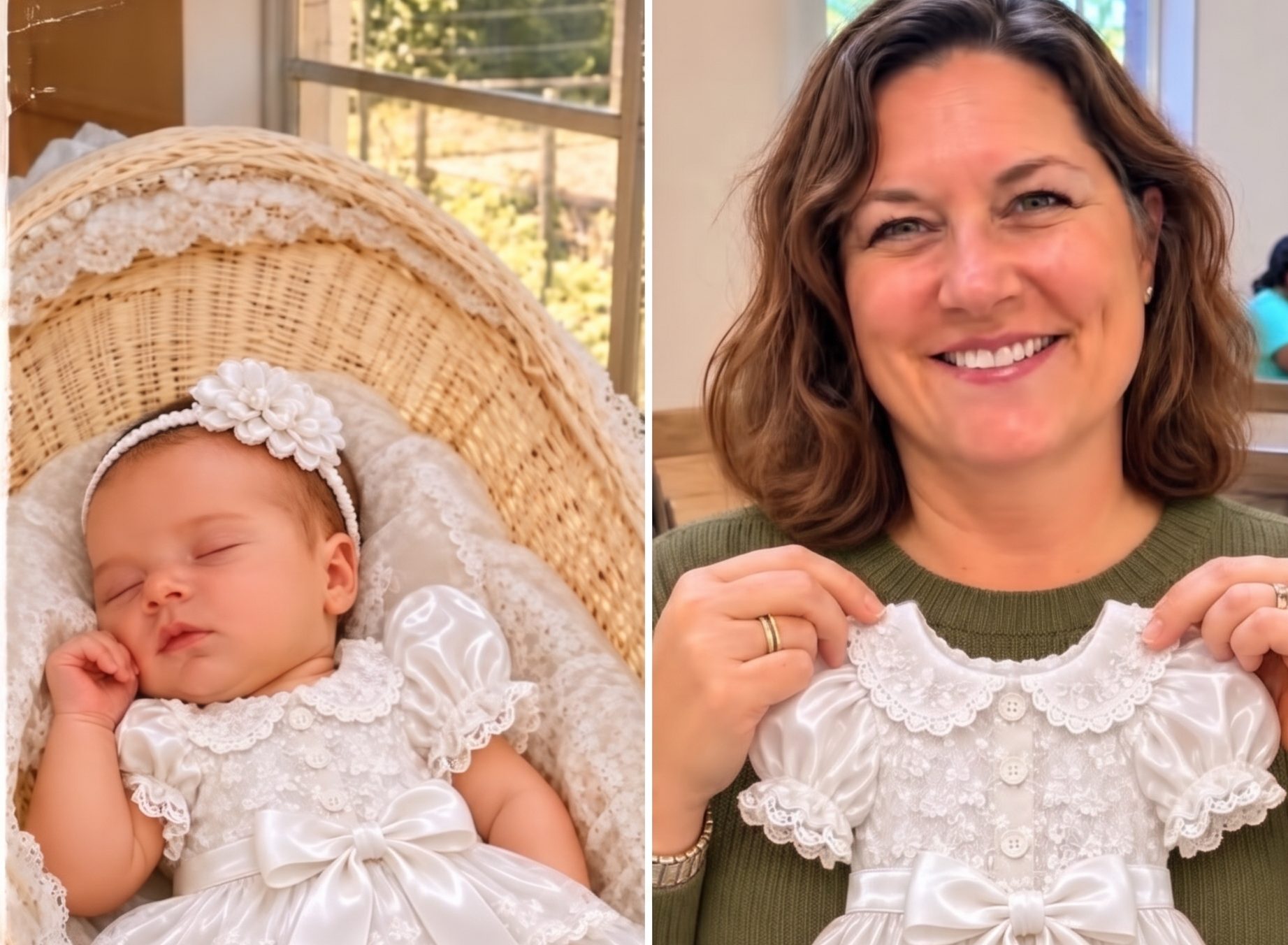
Not wrapped in a christening gown.
But in a church aisle, while her grandmother’s casket waited at the front.
Rebecca wiped her eyes.
Then she read the final lines.
Doll, I know you may hate me.
You have every right.
But please don’t spend the rest of your life believing you were unwanted.
Your baby was wanted.
You were both loved.
I was simply too afraid to let that love happen honestly.
I have left Rebecca’s adoption papers and the original hospital records in the blue box in my bedroom closet.
The little christening gown is there too.
I never could bring myself to throw it away.
I made it from my wedding dress.
I hope you can forgive an old woman who should have told the truth when it still had time to heal you.
I love you, my sweet Doll.
Mama.
The letter slipped from Rebecca’s hands.
I sat very still.
For fifty-five years, I’d believed my baby had died.
For fifty-five years, I’d gone to a little stone behind the church.
For fifty-five years, I’d bought flowers for a child who had grown up somewhere else.
And Mama had known.
She had known every birthday.
Every Christmas.
Every time I stood in that garden.
She had known.
I looked at the coffin.
“Why, Mama?”
The question came out quietly.
It wasn’t a question for Rebecca.
It was for the woman in the casket.
“Why couldn’t you just tell me?”
There was no answer.
Only the sound of the old church clock.
Rebecca took my hand.
“She was wrong, Mama.”
I looked at her.
“Yes, honey. She was.”
We sat together for a while.
Then I remembered something.
“The stone.”
Rebecca looked at me.
“What about it?”
I stood up.
“The stone has no name.”
She nodded.
“I know.”
“Did you know about it?”
“Yes.”
“Have you ever been there?”
She hesitated.
“Once.”
I turned toward her.
“When?”
“About twenty years ago.”
My heart twisted.
“Twenty years?”
She nodded.
“I came to town after my father died. I knew the church from the papers. I found the memorial garden.”
“What did you see?”
She looked down.
“An old woman standing beside the little stone.”
I stopped breathing.
“Was it me?”
Rebecca nodded.
“You had a bouquet of yellow flowers. You were talking to the stone.”
I closed my eyes.
I remembered that day.
It had rained the night before.
The flowers had been a little wet.
I’d told the stone about my husband.
I’d told it how lonely I’d been.
I’d told it I hoped my baby knew I still loved her.
I opened my eyes.
“Why didn’t you come to me?”
Rebecca’s voice was barely above a whisper.
“Because I thought you didn’t want me.”
I shook my head.
“Oh, sweetheart.”
She began crying again.
“I was afraid you’d look at me and see a mistake.”
I pulled her into my arms.
“Listen to me.”
She looked up.
“You were never a mistake.”
Related stories
Emily Carter’s Hospital Room Changed Everything Her Husband Believed
My Daughter Called Me a Leech, But the Next Morning I Walked Into Her Bank With $260 Million

Jenna Turned the Car Around, and Then Thanksgiving Changed Everything
How One Orange Peel in the Mess Hall Brought Down Sergeant Miller
<h1 class="page-title">After my husband shoved me down the stairs, my mother-in-law stood over me and called me “a worthless disgrace.” Then she called my father and said, “Come take your broken daughter. She’s no longer our problem!” My father calmly replied, “Touch her again,</h1>