# My Parents Threw Me Out at 16 and Never Looked
Back—Until My Uncle’s $42 Million Fortune Was at Stake
## Part 1: The Day I Became Nobody
The night my parents threw me out of the house,
it was raining so hard that I could barely see the street in front of me.
I was sixteen years old.
I stood on the front porch with a small backpack, a phone with twelve
percent battery, and thirty-seven dollars in my pocket. My mother
stood behind the open door, her arms folded across her chest.
My father stood beside her, his expression cold and impatient.
“You made your choice,” my father said. “Now live with it.”
I stared at him, waiting for him to say something that would tell me this was a mistake.
He didn’t.
“Dad, please,” I whispered. “It’s freezing outside. Can we at least talk about this tomorrow?”
My mother let out a bitter laugh.
“You should have thought about that before embarrassing this family.”
I hadn’t committed a crime. I hadn’t stolen anything. I hadn’t hurt anyone.
I’d simply refused to lie for my father.
Three days earlier, I had discovered that he had been using money
from my late grandmother’s small inheritance account to cover
gambling debts. When I confronted him, he told me I was too
young to understand family finances. When I threatened to
tell my uncle Daniel, the only person in the family who had ever
treated me like my opinions mattered, my father became furious.
My mother accused me of betraying them.
By the following evening, the argument had become a family crisis.
My parents told me I was disrespectful, ungrateful, and impossible to control.
Then my father pointed toward the door.
“If you think your uncle is such a wonderful man, go live with him.”
I tried calling Uncle Daniel, but his phone went straight to voicemail.
He was traveling for work and wouldn’t return for another two days.
My mother knew that.
She watched me step outside.
Then she closed the door.
I remember standing there for several minutes, staring at the
house where I had lived my entire life. I kept expecting the door to open again.
I thought perhaps my mother would come running out with my coat.
Perhaps my father would realize what he had done.
Neither happened.
That night, I slept on a bench at a bus station until a
security guard found me and helped me contact a youth shelter.
My parents never called the shelter.
They never reported me missing.
They never asked whether I was safe.
And when Uncle Daniel finally returned and discovered what had happened, he was furious.
He drove to my parents’ house that same evening.
I didn’t hear their conversation, but I later learned that he had given them
an ultimatum: either they allowed him to take responsibility for my care,
or he would involve the authorities.
They chose the first option, but not because they wanted me back.
They signed the necessary papers and told Daniel he could do whatever he wanted with me.
Within a week, I was living in his modest home on the other side of the city.
He gave me a bedroom, a desk, and a set of house keys.
On my first night there, he sat beside me at
the kitchen table while I picked at a plate of pasta.
“You don’t have to explain anything tonight,” he said gently. “You don’t have to earn your place here, either.”
I looked down at my food.
“Why are you helping me?”
He seemed genuinely surprised by the question.
“Because you’re my family,” he replied. “And because you’re a child who deserved better.”
Then he paused.
“But I want you to understand something. What happened to you wasn’t your fault.
What you do with the rest of your life, however, is something you get to decide.”
I didn’t know it then, but those words would stay with me for the next eighteen years.
## Part 2: The Uncle Who Became My Father
Uncle Daniel was not a rich man when I moved in with him.
He owned a small commercial construction company that employed twelve people.
He worked long hours, wore the same three jackets in rotation,
and kept a coffee mug on his desk that looked older than I was.
He wasn’t perfect.
Sometimes he forgot to buy groceries. Sometimes he worked through dinner.
And when he was worried, he became quiet instead of talking about what was bothering him.
But he never made me feel like a burden.
He attended my school meetings. He helped me study for exams. When I got my first part-time
job at a grocery store, he drove me there on my first morning because the bus schedule was unreliable.
When I received a scholarship to attend college, he celebrated by taking me
to a restaurant far more expensive than either of us could comfortably afford.
“Today,” he announced as the waiter handed us our menus, “we’re celebrating the fact that you
worked hard and didn’t let anyone convince you that you couldn’t.”
I laughed.
“You know you could have bought me a burger instead.”
He shook his head.
“Burgers are for ordinary Tuesdays. Scholarships deserve proper celebrations.”
For the first time in months, I felt like a normal teenager.
My parents, meanwhile, disappeared from my life.
At first, I waited for them to reach out.
I checked my phone every morning. I looked at unfamiliar numbers,
wondering whether one of them might be my mother calling from a different phone.
On my seventeenth birthday, I left my phone on the kitchen
table while I went to take a shower. When I returned, I had three messages.
All were from classmates wishing me a happy birthday.
My parents had forgotten.
Or perhaps they remembered and simply didn’t care.
On my eighteenth birthday, I stopped waiting.
I went to college, studied business administration, and eventually earned a master’s degree in finance.
Uncle Daniel helped me pay for the expenses my scholarship didn’t cover,
but he never allowed me to believe that I owed him my life.
Whenever I thanked him, he would wave a hand dismissively.
“Don’t thank me for opening a door,” he said. “Just make sure you leave one open for someone else someday.”
Meanwhile, his construction business grew.
He expanded into commercial property development, invested carefully,
and acquired several industrial buildings in areas that later became major business districts.
By the time I graduated, he had become a multimillionaire.
But money didn’t change him.
He still drove an old pickup truck. He still made his own breakfast.
And he still called me every Sunday evening to ask whether I was eating properly.
When I turned twenty-four, he invited me to his office.
On his desk lay a folder containing financial statements, property documents, and a letter from his accountant.
“I want to show you something,” he said.
He explained that his business had grown beyond anything he had imagined when he started it.
“I need someone I can trust to understand the numbers,” he told me.
“Someone who will tell me when I’m being foolish, not just when I’m being generous.”
I looked at him carefully.
“Are you offering me a job?”
“I’m offering you an opportunity. You can say no.”
I accepted.
Over the following years, I helped modernize his company’s financial systems,
evaluate new investments, and restructure several major contracts.
We disagreed often.
He believed in taking calculated risks. I preferred more conservative investments.
He trusted people quickly. I preferred to examine every document before signing anything.
Sometimes he accused me of being too cautious.
Sometimes I accused him of being too stubborn.
But we respected each other.
And slowly, I began to understand that Uncle Daniel wasn’t simply building a business.
He was building something he wanted to leave behind.
Something that would outlast him.
Something he wanted to place in the hands of someone who understood that wealth was not the same thing as worth.
I never assumed I would inherit anything.
I didn’t work for him because I expected a fortune.
I worked for him because he had been there when nobody else was.
Then, when I was thirty-three, he received a diagnosis that changed everything.
The doctors found an aggressive cancer.
He underwent treatment, but his condition worsened over the next year.
I reduced my hours at the company so I could accompany him to appointments.
I learned how to organize his medications, prepare meals he could tolerate,
and recognize when he was pretending to feel better because he didn’t want me to worry.
One evening, while we sat on his back porch, he looked at me and said, “There’s something I need you to promise me.”
I put down my cup of tea.
“What is it?”
“When I’m gone, don’t let anyone turn my death into a war.”
I frowned.
“What are you talking about?”
He looked toward the garden.
“Money brings out things in people that you never knew were there. Sometimes
the people who speak the loudest about family are the ones who have done the least to protect it.”
I thought he was speaking generally.
I had no idea he was already preparing for the battle that would follow his death.
## Part 3: The Forty-Two Million Dollar Question
Uncle Daniel died on a quiet Thursday morning.
I was sitting beside his bed when he took his last breath.
For several minutes, I couldn’t move.
The man who had given me a home, an education, and a reason to believe in people was gone.
I felt as if someone had reached into my chest and removed the one thing that had always made the world feel safe.
His funeral took place four days later.
Hundreds of people attended. Employees stood beside business partners.
Former clients spoke about his integrity. Several young people whose education
he had quietly helped finance came forward to share their stories.
My parents attended, too.
I hadn’t seen them in nearly eighteen years.
My mother looked older, though her hair was carefully styled and her black dress
appeared expensive. My father had more gray in his beard, but he still carried himself with the same confidence I remembered.
They didn’t approach me during the service.
They didn’t offer condolences.
My mother merely glanced at me as she passed, as though I were an acquaintance she vaguely recognized.
I told myself I didn’t care.
After the funeral, Uncle Daniel’s attorney, a man named Richard Hayes, contacted me.
“Your uncle left detailed instructions concerning his estate,” he explained.
“The formal reading will take place next week. I need you to attend, along with the other named parties.”
“Who are the other parties?”
He paused.
“Your parents have been notified.”
I felt a knot tighten in my stomach.
“Why?”
“Your uncle’s will addresses several matters involving the family. I think it’s best that you hear everything at the meeting.”
That evening, I sat alone in Daniel’s house, surrounded by photographs of the life we had shared.
I found one from my high school graduation. I was wearing a blue gown, and Daniel stood beside me with his arm around my shoulders.
My parents were nowhere in the picture.
They hadn’t attended.
Daniel had later told me he didn’t mind. He was proud enough for both of them.
I put the photograph back on the shelf and tried not to think about the will.
By the morning of the meeting, I had almost convinced myself that it didn’t matter what Uncle Daniel had left me.
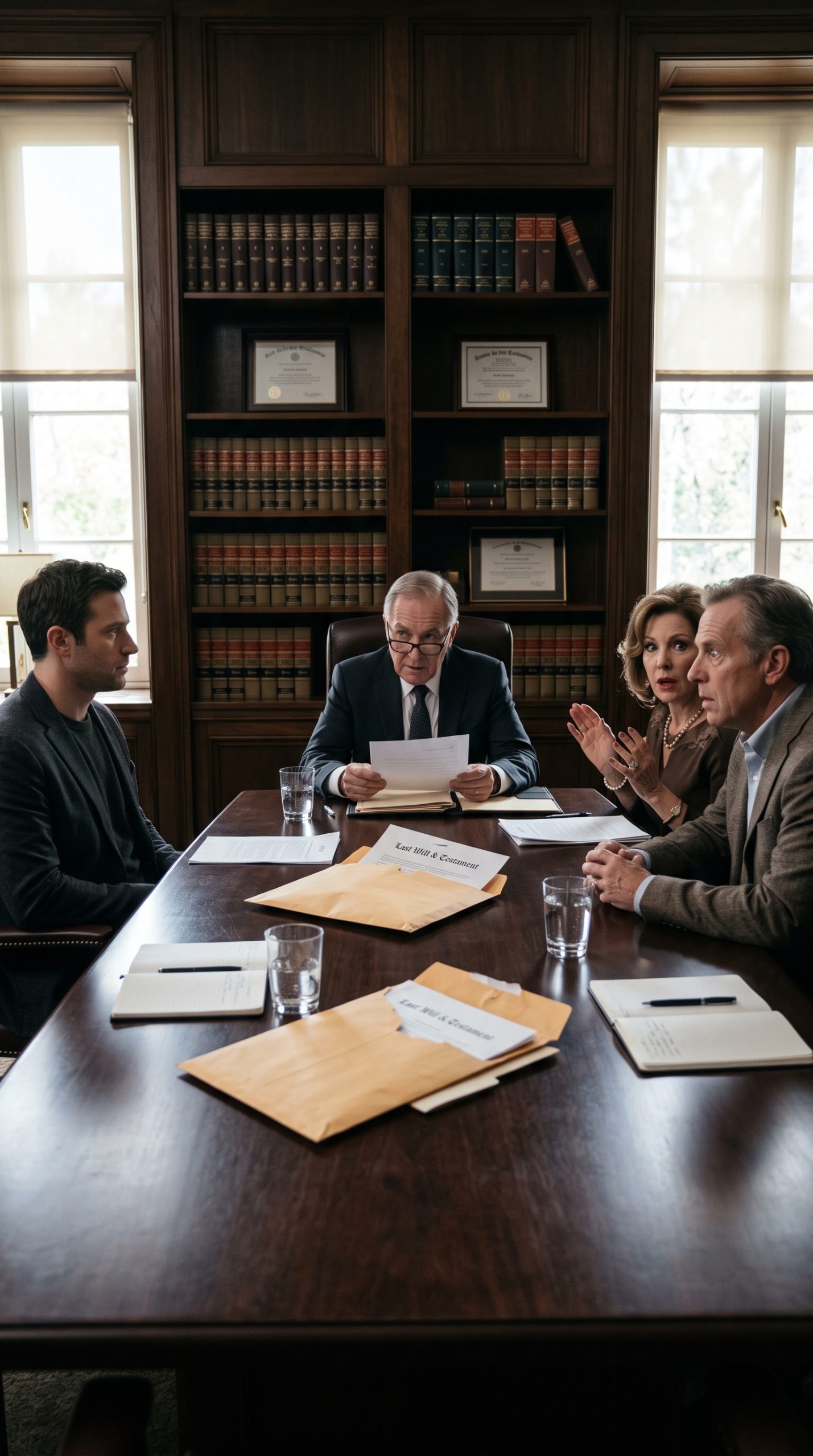
Then I walked into the attorney’s conference room.
My parents were already there.
My mother sat near the head of the table, speaking animatedly with a woman I recognized as my father’s cousin. My father stood beside the window, examining the expensive office furniture.
On the table lay several thick folders.
When my mother noticed me, her face changed.
For one brief moment, she looked uncomfortable.
Then she smiled.
“Well,” she said brightly, “look who’s finally decided to join the family.”
I took the empty chair opposite her.
“Good morning.”
My father gave a small laugh.
“Let’s hope we can put old misunderstandings behind us today.”
Old misunderstandings.
That was what he called throwing a sixteen-year-old out of the house and leaving him to survive without a single phone call for nearly eighteen years.
I said nothing.
My mother leaned toward the woman beside her and whispered something. They both laughed softly.
I knew that laugh.
It was the same laugh she had used when she told me I had made my choice.
Then the attorney entered.
Richard Hayes was in his early sixties, with silver hair, thin glasses, and an expression that suggested he had spent his career dealing with people who believed they could talk their way out of anything.
He placed a leather briefcase on the table.
“Thank you for coming,” he said. “Before we begin, I need everyone to understand that this meeting is being conducted according to Mr. Daniel’s written instructions. Certain documents are to be read in a specific order.”
My mother raised her hand.
“Of course. We’re family. I’m sure Daniel wanted us to share everything fairly.”
My father smiled.
“Daniel always knew family came first.”
I stared at the table.
Neither of them had mentioned Daniel’s name with affection while he was alive.
Now they spoke as though they had been his closest companions.
Richard opened the first folder.
“Mr. Daniel’s estate includes business interests, investment accounts, commercial properties, and other assets. Based on the current valuations, the total estate is estimated at approximately forty-two million dollars, subject to the settlement of liabilities, taxes, and other expenses.”
My mother’s eyes widened.
My father sat straighter.
Forty-two million dollars.
For several seconds, the room was silent.
Then my mother smiled so broadly that I could see the calculations beginning behind her eyes.
“Well,” she said, “Daniel certainly did well for himself.”
My father nodded.
“And naturally, his immediate family should be treated fairly.”
Richard looked at him.
“Of course. That is why we are here to review his actual wishes.”
My mother clasped her hands together.
“I’m sure this won’t take long. We can work out the details afterward.”
Richard didn’t respond.
Instead, he removed a sealed envelope from the bottom of his briefcase.
It was thick, cream-colored, and closed with dark red wax.
Across the front, in Daniel’s unmistakable handwriting, were the words:
TO BE OPENED ONLY AFTER ALL NAMED PARTIES ARE PRESENT.
Below that was another instruction.
READ ALOUD BEFORE ANY DISTRIBUTION OF ASSETS IS DISCUSSED.
My mother frowned.
“What is that?”
“A separate letter written by your brother,” Richard replied. “He instructed me to keep it sealed until this meeting.”
My father leaned forward.
“Is it part of the will?”
“It is a document that must be considered alongside the estate instructions. I will explain its legal status after I have read it.”
My mother waved her hand.
“Fine. Go ahead. We have nothing to hide.”
Richard broke the seal.
He unfolded the first page and began reading.
“To those gathered here today: If you are hearing these words, I am no longer alive to speak for myself. I have spent many months considering what I should leave behind, and to whom.”
He paused, adjusting his glasses.
“I know that some of you have already begun calculating what my estate will mean for your future. Before you do, I ask you to remember one thing: an inheritance is not a reward for sharing someone’s blood. It is a responsibility entrusted to those who have demonstrated what they will do with it.”
My father shifted in his chair.
Richard continued.
“I also know that some of you believe you are entitled to my money because of the family into which you were born. If that is your belief, I suggest you listen very carefully to what follows.”
My mother stopped smiling.
Richard turned the page.
Then he read the first sentence of the next paragraph.
“To my sister, Margaret, and her husband, Robert, I leave neither an apology nor a promise of reconciliation. Instead, I leave you the opportunity to explain why, eighteen years ago, you abandoned your sixteen-year-old son—and why you have never once attempted to discover what became of him.”
The room went completely still.
My mother stared at the attorney.
My father opened his mouth, then closed it.
Richard slowly lifted his eyes from the page.
He looked directly at them.
Then, for the first time since the meeting began, he looked at me.
And I understood that this letter was about far more than money.
## Part 4: The Letter My Uncle Left Behind
Richard continued reading.
“Before anyone attempts to dismiss this matter as a private disagreement between parents and a child, I want the facts placed on the record.”
My mother interrupted him.
“That’s ridiculous. Daniel never understood what happened in our household.”
Richard held up one hand.
“Please allow me to finish.”
She fell silent, though her expression suggested she was not accustomed to being told no.
Richard returned to the letter.
“When my nephew was sixteen, his parents forced him out of their home after he discovered financial misconduct involving money entrusted to the family. Rather than address his concerns, they punished him for raising them.”
My father stood abruptly.
“That is an outrageous accusation.”
“Please sit down, Mr. Robert.”
“You cannot allow a dead man’s personal grievances to destroy our reputation.”
Richard looked at him calmly.
“The letter is one part of the record. I have not yet reached the supporting documents.”
My father slowly sat.
I felt my hands trembling beneath the table.
I had told Uncle Daniel what happened that night, but I had never given him every detail. Some memories were too humiliating to revisit.
Yet he had remembered enough.
Richard continued.
“I subsequently learned that my nephew had spent his first night away from home in a youth shelter. I also learned that neither parent made any meaningful effort to locate him or ensure his welfare.”
My mother’s face turned red.
“We knew he was with Daniel!”
Richard glanced at her.
“Then perhaps you can explain why you made no contact with him for the following eighteen years.”
She stared at him.
“We were giving him space.”
I almost laughed.
Eighteen years of silence, and that was the explanation she had chosen.
Richard read the next paragraph.
“My nephew never asked me to punish his parents. He never asked me to disinherit anyone. He asked only to be treated with dignity and to have a safe place to live.”
The attorney paused.
“That concludes the personal history portion of the letter.”
My father exhaled loudly.
“Good. Now we can move on to the actual estate.”
Richard did not move to another folder.
Instead, he turned another page.
“There is more.”
He read:
“Margaret and Robert, you will remember that after the dispute with your son, you signed documents allowing me to assume responsibility for his care. You may also remember that, at the time, you insisted you wanted nothing further to do with him.”
My mother shook her head.
“We never said that.”
Richard opened a second folder.
“These are copies of the documents signed at the time, along with correspondence retained by Mr. Daniel.”
He placed several pages on the table.
My mother’s eyes moved across the signatures.
My father’s jaw tightened.
I recognized the documents. Daniel had shown them to me once when I was twenty-one, explaining that he had kept them in case my parents ever attempted to claim I had been taken away without their permission.
He had never wanted to use them against anyone.
He simply wanted the truth preserved.
Richard set the pages aside and continued reading.
“During the years that followed, I watched my nephew become an educated, responsible, and compassionate man. I watched him build a career. I watched him help my company through difficult times without demanding ownership or special treatment.”
He looked at me briefly.
“And I watched his parents remain absent.”
My mother lowered her eyes.
For the first time, I wondered whether she was feeling shame.
Then she spoke.
“Daniel was always overly attached to that boy. He spoiled him. He made him believe he was better than everyone else.”
Richard’s expression hardened.
“Mrs. Margaret, your son has not said a word throughout this meeting. I suggest you consider doing the same until the letter is finished.”
The woman who had laughed with my mother earlier shifted uncomfortably in her chair.
My father rubbed his forehead.
“Let’s be reasonable. Whatever happened years ago, we can resolve it privately. There’s no reason to turn this into a public spectacle.”
Richard nodded.
“Your brother anticipated that you might say something similar.”
He reached into the briefcase and removed another document.
“This is a record of communications Mr. Daniel attempted to make with you after taking responsibility for your son. It includes letters, delivery records, and responses.”
My mother’s face went pale.
Richard placed the first letter in front of her.
“On three occasions, Mr. Daniel invited you to attend school events. On two occasions, he informed you that your son had achieved significant academic milestones. On one occasion, he contacted you when your son was hospitalized with a severe case of pneumonia during his first year of college.”
I looked at Richard sharply.
I had never known Daniel had contacted them when I was sick.
He continued.
“According to the records, none of those invitations received a meaningful response.”
My father stared at the documents.
“That doesn’t prove we didn’t care.”
“No,” Richard replied. “It proves that your brother gave you opportunities to demonstrate that care, and you did not take them.”
My throat tightened.
For eighteen years, I had told myself that my parents had simply forgotten about me.
Now I wondered whether they had remembered me all along and chosen, repeatedly, not to act.
Richard unfolded the final page of the letter.
“Now that the facts have been stated, I will address the matter of my estate.”
My mother leaned forward.
At last, she seemed to remember why she had come.
Richard began reading again.
“I have established my will and related estate documents with independent legal advice. I have made provisions for my employees, charitable causes, and the continued operation of my business.”
He paused.
“My nephew is the person I have chosen to inherit the controlling interest in my company and the principal share of my remaining estate.”
My mother’s chair scraped against the floor.
“What?”
My father stared at Richard.
“You mean the boy gets everything?”
“I did not say that,” Richard replied. “The will contains specific gifts and conditions, which I will explain in due course.”
My mother looked at me as though she were seeing me for the first time.
I remained silent.
Richard continued reading.
“I made this decision not because my nephew is my favorite relative, but because he has demonstrated the qualities I believe a steward of this estate must possess: competence, honesty, patience, and a willingness to take responsibility.”
He closed the letter halfway.
“However, there is one final instruction.”
My father’s eyes narrowed.
“What instruction?”
Richard looked at him.
“Your brother requested that before any distribution takes place, each of you be given an opportunity to respond to the facts described in this letter. He wanted the truth heard before anyone discussed money.”
He placed the letter on the table.
“So I will ask you both one question.”
He turned toward my parents.
“Why did you abandon your son?”
Neither answered.
For the first time in my life, my father had no explanation ready.
## Part 5: The Excuses Finally Came Out
My mother spoke first.
“We were under a tremendous amount of pressure back then.”
She looked around the room, as if expecting someone to agree.
“Robert’s business was struggling. We had bills. We had problems. Our son was rebellious, and Daniel encouraged him to question everything we did.”
I looked at her.
“I was sixteen.”
She ignored me.
“He was old enough to understand consequences.”
“No,” I said quietly. “I was old enough to understand that my parents didn’t want me.”
My mother flinched.
My father leaned forward.
“Don’t twist this into something it wasn’t.”
I met his eyes.
“You threw me out in the rain.”
“You threatened to expose private family matters.”
“I asked why you were taking money from Grandma’s account.”
“That money was meant to help the family!”
“Then why did you tell me it was none of my business?”
My father opened his mouth.
No answer came.
Richard watched the exchange without interrupting.
My mother began to cry.
At first, I thought the tears might be genuine.
Then she said, “You have no idea what it was like to raise you.”
I stared at her.
For eighteen years, I had imagined what I might say if I ever saw my parents again. I had rehearsed arguments in my head. I had imagined shouting, crying, and demanding answers.
But sitting there, listening to my mother explain how difficult I had been, I felt something unexpected.
Exhaustion.
I was tired of trying to persuade people to acknowledge what they had done.
“You didn’t raise me after I was sixteen,” I said. “Daniel did.”
My mother wiped her cheeks.
“And now you’re going to take everything he left us?”
I looked at Richard.
He answered before I could.
“The estate will be distributed according to the valid will and applicable law. No one in this room has the authority to rewrite Mr. Daniel’s instructions based on personal expectations.”
My father pointed at the attorney.
“You’re acting as though we aren’t family.”
“Family relationships do not automatically establish a right to inherit every asset,” Richard replied.
My mother turned to me.
“You could at least do something for us. You have more money than you’ll ever need.”
I almost smiled at the sudden change in her tone.
Only twenty minutes earlier, she had spoken as though she and my father were entitled to the entire fortune.
Now she was asking me to be generous.
“I haven’t received anything yet,” I said.
“But you will,” she replied quickly. “Daniel always loved you.”
There it was.
Not an apology.
Not an acknowledgment.
A demand disguised as affection.
My father folded his hands on the table.
“Look, we’re willing to admit that mistakes were made. We were young. We were angry. Things got out of hand.”
He was nearly sixty.
He had spent almost eighteen years refusing to call me.
And now he wanted the word mistakes to erase all of it.
I took a slow breath.
“If Uncle Daniel had left me nothing, would you have contacted me?”
My mother stared at me.
My father looked away.
I repeated the question.
“If there were no forty-two million dollars, no company, no properties, and no inheritance—would either of you have come looking for me?”
Silence.
I nodded.
“That answers it.”
My mother began speaking rapidly.
“You can’t judge us by one period in our lives. We had our reasons. And surely, after all these years, you can understand that people change.”
“People can change,” I said. “But change requires more than showing up when there’s money involved.”
Richard cleared his throat.
“Before we proceed, I need to clarify an important point. Mr. Daniel’s estate plan does not give me discretion to distribute assets according to anyone’s emotional demands. The documents will control.”
My father sat back.
For the first time that morning, he looked genuinely worried.
And I realized something else.
My parents had walked into that office believing the inheritance was already theirs.
They had not come to grieve Daniel.
They had come to collect.
## Part 6: What the Will Actually Said
Richard opened the formal will.
He read through the initial provisions, including gifts to several employees who had worked for Daniel for more than twenty years, contributions to a children’s education foundation, and funds reserved for the company’s long-term obligations.
Then he reached the estate distribution.
“Subject to the administration of the estate, taxes, liabilities, and the other terms set out in this will, the controlling interest in Daniel Construction and Development shall pass to my nephew.”
He read my full name.
I sat motionless.
I had expected Daniel to leave me something. Perhaps his house. Perhaps a portion of his savings.
I had never imagined becoming the controlling owner of the company I had helped him manage.
Richard continued.
“The remaining assets shall be distributed according to the schedules attached to the will. Certain gifts are subject to independent valuation and the completion of the estate administration process.”
My mother interrupted.
“What about us?”
Richard checked the document.
“Your brother did not leave you a direct cash bequest under this will.”
My mother stared at him.
“Nothing?”
“There is no direct inheritance for either of you in the distribution provisions I have just read.”
My father stood again.
“This is absurd. We’re his only siblings.”
“He was legally entitled to make his own estate plan,” Richard replied, “subject to applicable law and any valid claims that may be brought.”
My mother turned to me.
“You knew about this, didn’t you?”
“No.”
“You must have influenced him.”
“I didn’t even know he had written this letter.”
“Then why did he leave you everything?”
Richard interrupted.
“He did not leave him literally everything. The estate includes charitable gifts, employee benefits, business obligations, and other provisions. Please do not misrepresent the document.”
My father paced toward the window.
“This will be contested.”
“You are entitled to seek independent legal advice,” Richard said. “I would advise you to do so before making any assumptions.”
My mother was shaking now.
“He can’t just cut us out because he had a disagreement with us.”
Richard looked at her steadily.
“The will does not state that your brother made this decision because of one disagreement. It reflects his considered estate plan. His reasons are documented, and the relevant records will be preserved.”
He then handed each of them a copy of the will’s relevant provisions.
My father scanned the pages.
His face grew darker with every paragraph.
I watched him and felt no satisfaction.
I had not wanted my parents to be punished.
I had wanted them to care.
Those were different things, and the distinction mattered more than ever.
Richard closed the folder.
“There is one more matter. Mr. Daniel left instructions concerning any attempt to challenge the estate plan. The documents were prepared with independent counsel, and the estate file contains records of his decision-making process.”
My father looked up.
“So he expected us to fight him.”
“He expected that there might be disagreement,” Richard replied. “He took steps to ensure his wishes would be documented.”
My mother looked at me with a mixture of anger and desperation.
“You’re really going to let this happen?”
I answered honestly.
“I’m not making the will happen. Daniel did that himself.”
She looked away.
For several seconds, nobody spoke.
Then Richard gathered the documents and said the meeting was concluded for the day.
My parents left without saying goodbye.
I remained in my chair long after the door closed.
Richard sat across from me.
“You all right?”
I looked at the sealed envelope, now lying open beside the will.
“I don’t know.”
He nodded.
“That is an understandable answer.”
“Did Daniel really expect this?”
“He expected that people might react emotionally. He also wanted you to know that his decision was deliberate.”
I swallowed hard.
“Why didn’t he tell me?”
“Because he didn’t want your relationship to become a negotiation over money. He wanted you to continue living your life without the burden of knowing what he planned to leave you.”
I looked down at my hands.
That sounded exactly like Daniel.
Even in death, he had tried to protect the one relationship I had never needed to question.
## Part 7: The Price of Coming Back
The weeks after the will reading were difficult.
My parents hired a lawyer.
They challenged aspects of the estate, questioning whether Daniel had been unduly influenced and whether he had fully understood the implications of his decisions.
Their claims were reviewed through the proper legal process. Daniel’s independent legal advice, medical records relevant to his capacity, and documented estate-planning history became important evidence.
I did not interfere with the legal proceedings.
I provided the information requested of me and allowed the estate’s lawyers to handle the matter.
Eventually, the central challenge to the will was unsuccessful, and the estate proceeded according to the documents and the court’s directions.
The process was expensive and emotionally draining.
But it also gave me time to consider what I wanted my life to look like.
The company was worth a great deal, but it was not a pile of cash waiting to be divided. It employed hundreds of people, managed active projects, and carried obligations that would not disappear simply because Daniel had died.
I worked with the company’s leadership and independent financial advisers to preserve its operations.
We reviewed every major contract, strengthened oversight, and created a clearer succession structure.
I also established an education fund in Daniel’s name for young people who had experienced family instability and needed help completing school or entering college.
I remembered the teenager I had been: frightened, embarrassed, and convinced that being rejected by my parents meant something was fundamentally wrong with me.
I wanted those young people to have access to the opportunities Daniel had given me.
Meanwhile, my parents continued trying to contact me.
At first, the messages were angry.
My father accused me of turning the family against him. My mother wrote that Daniel had been manipulated and that I was benefiting from a tragedy.
Then the messages changed.
My mother began sending photographs from my childhood.
There was one of me holding a birthday cake. Another showed me sitting on my father’s shoulders at a park.
Her messages became softer.
I miss those days.
We should not have let so much time pass.
Life is short. We need to forgive one another.
I read every message.
I did not reply.
A month later, my father called.
I almost let it go to voicemail, but something made me answer.
“Hello?”
He sounded older than I remembered.
“It’s your father.”
“I know.”
There was a pause.
“I think we should meet.”
“Why?”
“Because we’re family.”
I closed my eyes.
That phrase again.
“What do you want to talk about?”
He hesitated.
“Your mother and I have been through a difficult time. The legal fees have been substantial. We have some financial concerns.”
I felt a familiar coldness settle in my chest.
“Are you asking me for money?”
“I’m asking you to help your parents.”
I looked out the window at the street below.
For eighteen years, I had wondered what it would feel like to hear his voice again.
I had imagined an apology.
Instead, I was listening to a financial request.
“I need to ask you something,” I said.
“Go ahead.”
“If Daniel had left me nothing, would you have called?”
He sighed.
“You keep bringing up the past.”
“Because you keep avoiding the question.”
“We were under pressure. You were difficult to manage. We thought you would come back eventually.”
“I was sixteen.”
“You were old enough to understand that families have arguments.”
“Arguments don’t last eighteen years unless someone chooses to keep them going.”
He said nothing.
I continued.
“I don’t hate you, Dad. But I won’t pretend that what happened was harmless. And I won’t give you money simply because you have finally decided to remember that I’m your son.”
His voice hardened.
“So that’s it? You’re going to abandon us the way you think we abandoned you?”
The irony was so painful that I couldn’t respond immediately.
Finally, I said, “I’m not abandoning you. I’m refusing to buy a relationship that you should never have made conditional in the first place.”
Then I ended the call.
For the first time, I didn’t spend the rest of the day wondering whether I had done something wrong.
I simply returned to work.
## Part 8: The Apology I Never Expected
Six months after the will reading, my mother sent me a letter.
It arrived at my office in a plain white envelope.
There was no demand for money, no reference to the estate, and no request for a meeting.
Just several handwritten pages.
I read them alone in my office.
She began by acknowledging that she had spent years telling herself I would eventually return home.
She had convinced herself that I needed to learn a lesson, that I would apologize, and that everything would return to normal.
But I had never returned.
And eventually, she admitted, the silence had become easier than confronting what they had done.
She wrote that my father had been angry about the money I discovered and that she had supported him because she was afraid of what would happen if she challenged him.
She acknowledged that they had chosen their own comfort over my safety.
Then came the sentence I had waited almost eighteen years to hear.
You were a child, and we should never have made you believe that you had to earn the right to be our son.
I read that sentence several times.
I wanted it to make everything better.
It didn’t.
An apology could not give me back the birthdays they had missed, the school events they had ignored, or the years I had spent wondering why I wasn’t worth a phone call.
But it was the first time my mother had acknowledged the truth without immediately defending herself.
At the end of the letter, she wrote:
I know I have no right to ask you to forgive me. I only wanted you to know that I am sorry.
I placed the letter in my desk drawer.
For several days, I thought about whether to respond.
Eventually, I wrote back.
I thanked her for acknowledging what happened. I told her that I was willing to consider a conversation, but only if it took place without discussions about the inheritance or requests for financial assistance.
She agreed.
We met at a small café on a Saturday morning.
My mother arrived early. She was wearing a simple sweater and had no jewelry except her wedding ring.
For the first ten minutes, we talked about ordinary things.
The weather.
The café.
The neighborhood.
Then she put down her cup.
“I don’t know how to fix this,” she said.
I looked at her.
“You can’t fix eighteen years.”
She nodded, tears gathering in her eyes.
“I know.”
“But you can stop pretending it didn’t happen.”
She wiped her face.
“I am sorry.”
This time, she did not follow the apology with an excuse.
I believed that she felt remorse.
I also understood that remorse was not the same thing as change.
We did not hug dramatically or promise to become a happy family again.
We talked for another forty minutes, then said goodbye.
It was not a reconciliation.
It was a beginning.
And for now, that was enough.
My father did not attend that meeting.
He sent a message afterward saying he was not ready to discuss the past.
I accepted that he was not ready.
But I did not make his readiness my responsibility.
## Part 9: What Forty-Two Million Dollars Could Never Buy
A year after Uncle Daniel’s death, the company held a memorial event in his honor.
Employees gathered in the main conference room. Former colleagues told stories about his generosity, his stubbornness, and his habit of remembering the names of people’s children.
I stood at the front of the room and spoke about the man who had changed my life.
I told them about the rainy night I arrived at his house with a backpack and almost nothing else.
I told them about the scholarship dinner, the Sunday phone calls, and the lessons he had taught me about responsibility.
I did not discuss the inheritance.
It wasn’t the most important thing he had given me.
After the event, I returned to his house.
I had kept it much as he left it, though I had arranged for necessary repairs and updated the old heating system.
In his study, I found a small wooden box I hadn’t seen before.
Inside were photographs, business cards, and several envelopes labeled with dates.
One contained a letter addressed to me.
I sat at his desk and opened it.
If you’ve found this, I suppose you’ve finally had time to go through the things I left behind.
I laughed through my tears.
Even in a letter, Daniel sounded like Daniel.
He wrote that he hoped I would never confuse money with proof of love.
He reminded me that the company was an opportunity to build something meaningful, not a reason to spend my life fighting people who had hurt me.
Then he wrote something that made me stop reading.
You may decide one day to forgive your parents. You may decide not to. I cannot make that decision for you, and neither can the money I leave behind.
I wiped my eyes.
But remember this: forgiveness does not require you to pretend that nothing happened. And compassion does not require you to place yourself back in the hands of people who have not learned how to treat you well.
At the bottom of the letter, he had added one final paragraph.
I did not give you a future because I felt sorry for you. I gave you one because I have watched you build it yourself. The inheritance is simply a tool. What matters is the person you choose to become while using it.
I folded the letter carefully.
For a long time, I sat in his study, listening to the quiet house.
Then I placed the letter in the wooden box and closed the lid.
I understood, finally, that Daniel had never wanted me to spend my life proving my parents wrong.
He wanted me to live a life so full that their rejection would no longer be the defining story of who I was.
And that was what I intended to do.
## Part 10: The Last Conversation
Nearly two years after the will reading, my father contacted me again.
This time, he did not mention money.
His message was short.
I’d like to speak with you. Not about the estate. Just about what happened.
I stared at the screen for several minutes before replying.
We can meet for coffee. One conversation. No money discussions.
He agreed.
We met at the same café where I had met my mother.
My father looked smaller than I remembered. He had lost weight, and the confidence he once carried like armor seemed to have worn thin.
For a while, neither of us spoke.
Finally, he looked at me.
“I was wrong.”
I waited.
He rubbed his hands together.
“I thought if I made you leave, you’d realize you needed us. I thought you’d come back and apologize. Then time passed, and I didn’t know how to undo it.”
“Why didn’t you call?”
He stared into his coffee.
“Pride.”
The answer was so simple that it almost hurt.
“Eighteen years?” I asked.
He nodded.
“I kept telling myself that you would contact us first. Every year, it became harder to explain why I hadn’t called. Eventually, I convinced myself that you were better off without us.”
“Were you?”
He looked up.
“Was I what?”
“Better off without me?”
His eyes filled with tears.
“No.”
For a moment, I saw the man who had once carried me on his shoulders through a park.
Then I remembered the same man pointing toward the door and telling me to leave.
Both memories were real.
“I can’t give you those years back,” he said.
“No, you can’t.”
“I know an apology doesn’t fix everything.”
“No, it doesn’t.”
He nodded slowly.
“I don’t expect you to forgive me today.”
I studied him.
For the first time, he wasn’t asking me to make his discomfort disappear. He wasn’t blaming my uncle, the estate, or the circumstances of the past.
He was simply acknowledging what he had done.
“I don’t know what our relationship will look like,” I said. “I don’t know if we’ll ever be close. But if we have any kind of relationship from here, it has to be honest.”
“I understand.”
“And it cannot be about the inheritance.”
He looked directly at me.
“It won’t be.”
I believed that he meant it in that moment.
Whether he could live up to it over time remained to be seen.
We finished our coffee and said goodbye.
There was no dramatic embrace.
No promise that everything would be different.
Just two people who had finally spoken honestly about something that had been left unspoken for far too long.
I walked to my car feeling lighter than I had expected.
Not because I had forgiven everything.
Not because my childhood had somehow been repaired.
But because I no longer needed my father’s apology to determine my worth.
I had survived without him.
I had built a life without him.
And now, if he wanted a place in that life, he would have to earn it through actions rather than promises.
## Epilogue: The Fortune Was Never the Point
Three years after Uncle Daniel died, his company was still operating successfully.
We expanded the education fund and established a program to help young people leaving foster care or unstable homes find apprenticeships and secure housing.
I visited one of the program’s first participants, a nineteen-year-old named Marcus, who had recently completed his first year of training as an electrician.
He showed me his small apartment and the tools he had saved to buy.
“I never thought I’d have something like this,” he said.
I smiled.
“Someone helped me when I needed it, too.”
As I drove home that evening, I thought about the rainy night I had stood outside my parents’ house.
For years, I had believed that moment was the beginning of my life falling apart.
Now I understood that it had also been the beginning of a different life—one in which I learned that family could be built through loyalty, patience, and love rather than demanded through blood.
My parents and I continued to have limited contact.
My mother and I spoke occasionally. My father and I met a few times a year. There were awkward moments, old disagreements, and days when the past felt closer than I wanted it to.
We did not become the family we might have been if they had never thrown me out.
Some things could not be restored.
But I no longer spent my days waiting for them to become different people.
I had learned to set boundaries without hatred, to accept apologies without pretending they erased the past, and to offer compassion without sacrificing my own peace.
Sometimes people asked whether I was happy that Uncle Daniel had left me such a large inheritance.
I always gave them the same answer.
“The money changed my opportunities. It didn’t change what mattered most.”
Because the greatest gift my uncle gave me wasn’t a share of a forty-two-million-dollar estate.
It was the knowledge that being rejected by the people who were supposed to love me did not make me unworthy of love.
My parents had thrown me out at sixteen.
For nearly eighteen years, they had never called, never helped, and never asked whether I was alive.
Then they walked into a lawyer’s office expecting a fortune.
They left without the inheritance they had imagined was theirs.
But I left with something far more valuable than revenge.
I left knowing that I no longer had to prove I deserved a place in anyone’s life.
I already had one.
And I had built it myself.
THE END. ❤️