“I Need a Cook Your Kids Need a Home,
the Old Mountain Man Said—By Winter the Widow Revived
His Ranch Cora had three silver dollars left from her husband’s life.
That was what the mining company called consolation
after the tunnel collapsed and buried Arthur Dotson under a mountain of rock.
Three dollars for a widow. Three dollars for
an eight-year-old boy with newspaper stuffed in his boots.
Three dollars for a little girl shivering
so hard her mittens shook. Oak Haven did not make room for women like Cora.
She was large, broad-shouldered, thick-waisted,
too heavy for the town’s pity and too poor for its respect.
People looked around her, over her, through her—never at her.
Not until Harlan crossed the muddy street.
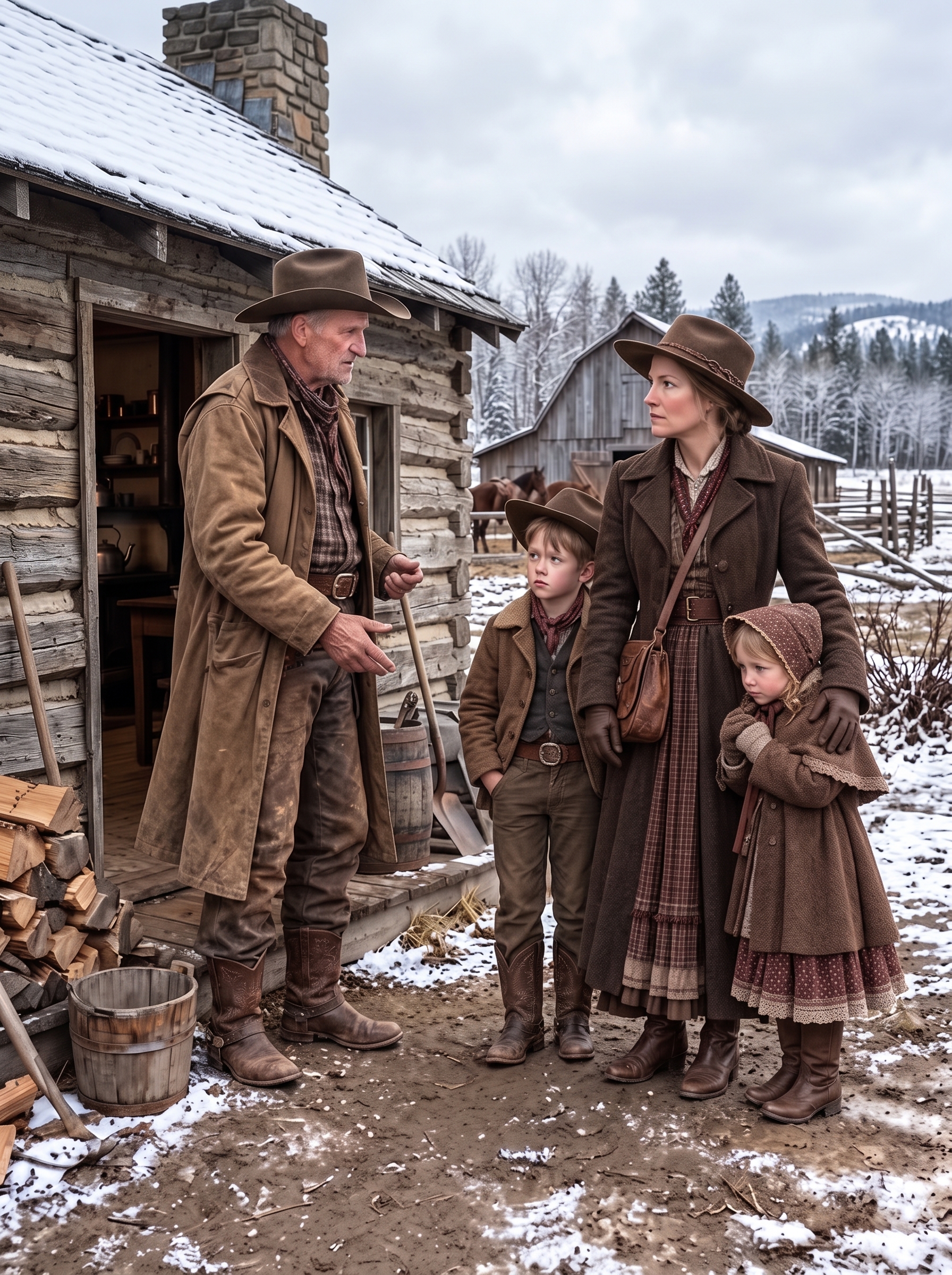
He was old for the frontier, iron-gray, limping on
a leg that had never healed right after a mule shattered it.
He smelled of wood smoke and wet wool, and his eyes were the color of a winter bruise.
“You’re Arthur’s widow,” he said. Cora lifted her chin.
“If you’re here to offer charity, keep it.”
“Good,” Harlan said. “Ain’t got any.” Then he told her the truth. He had
a ranch four hours up Pine Ridge, a good herd, a tight cabin,
and no strength left to keep himself alive through another winter.
His stove was cold most nights. His floors were filthy.
His bad leg was failing him. “I need a cook,” he said.
“Your kids need a home.” The words were not soft.
They were not romantic. They were a bargain, plain and hard as axed wood.
Cora looked down at Will rubbing his frozen ears,
and Bessie leaning into her side for warmth.
Pride did not fill a child’s belly. So she said,
“Let me get my trunk.” The cabin on Pine Ridge was worse than she expected.
Grease-black stove. Sour blankets. Mud-chinked walls.
Dirty plates stacked like neglect had grown roots.
Harlan looked ashamed for one flicker of a second, then fled outside to check the cattle.
Cora tied on her apron. “Will, fetch water. Bessie,
sit on that trunk and don’t touch anything.”
For five hours, she went to war. She scrubbed floors until her knees screamed.
Hauled water until her shoulders burned.
Scraped old grease with a rusted knife. Fed the stove until the whole cabin breathed heat again.
By dusk, the place smelled of salt pork, apples, hot biscuits, and survival.
When Harlan came in frozen and dragging his bad leg,
he stopped at the door like he had stepped into someone else’s life.
“Wash your hands,” Cora said. “Supper’s in five minutes.”
For the first time in years, Harlan obeyed.
Winter came hard after that. Snow sealed the windows.
Roof nails snapped like pistol shots.
Harlan’s leg turned cruel in the deep cold, but Cora
kept willow-bark tea boiling, kept the children busy,
kept the fire red, and kept fear from entering the house.
Then one Tuesday, Harlan saw the cattle shed roof sagging under three feet of wet snow.
“I got to clear it,” he said. Cora looked at his leg.
“It’ll hold long enough,” he lied.
Two hours later, he had not come back. Cora stood at the frosted window,
staring into a whiteout so thick she could not see the woodpile ten feet away.
The wind had erased Harlan’s tracks almost as soon as he made them. She turned to her son.
“Will, lock the door behind me. Don’t open it unless you hear my voice.” His face went pale.
“Ma—” “Keep Bessie by the stove.” That was all she gave herself time to say.
Cora wrapped a blanket around her heavy waist with ROPE, pulled on her coat,
grabbed the iron fire poker, and opened the door.
The storm hit her like a wall. Snow drove sideways into her eyes.
The cold struck her lungs like a fist, and within yards the cabin vanished behind her.
She could no longer see home. She could only remember where the cattle shed ought to be and keep moving toward it.
She drove the poker into the snow ahead of every step,
testing for ditches hidden beneath the drifts.
Again and again she shouted Harlan’s name.
The wind stole it from her mouth. Still she kept going.
Because months earlier, an old mountain man had crossed a muddy street when everyone else looked through her.
He had not offered pity. He had offered her children a roof and asked for work in return.
Now somewhere inside that whiteout, he was missing on the land that had become their home.
Cora tightened the ROPE around her waist, lowered her head against the storm, and pushed toward the sagging cattle shed.
Then, beneath the roar of the wind, she heard something. Not a voice. Three hard knocks.
Metal against wood.”
Cora stopped breathing.
There.
Three more.
Knock.
Knock.
Knock.
Faint.
Buried.
She turned toward the sound and plunged forward, driving the poker into
the drift before each step until the iron struck something solid beneath the snow.
Wood.
The cattle shed.
Or what was left of it.
One side of the roof had folded inward. Heavy pine rafters disappeared beneath
a white mound, and loose boards snapped in the wind like broken ribs.
“Harlan!”
Nothing.
Then three knocks answered from beneath her boots.
Cora dropped to her knees.
“Harlan!”
A muffled sound came from below.
“Don’t—”
The rest vanished beneath the storm.
Cora clawed at the snow with her gloved hands.
The wet weight packed against her wrists. Ice worked inside her sleeves.
Her fingers began to burn, then ache, then lose sensation.
She kept digging.
A corner of Harlan’s coat appeared beneath a broken plank.
His shoulder.
Then the side of his face.
His beard was white with ice.
His lips had gone blue.
A roof beam pinned him from the hip down.
His eyes opened when Cora brushed snow from his mouth.
“Thought I told you,” he whispered, “roof would hold.”
Cora stared at him.
Even half-frozen, the old fool was trying to lie.
“You’re going to die making jokes nobody laughs at.”
His mouth twitched.
“Wouldn’t be first bad habit.”
She wedged the fire poker beneath the beam.
It did not move.
Harlan sucked in a breath through his teeth.
“Cora.”
“Quiet.”
“Listen to me.”
“I said quiet.”
“Beam’s got my leg.”
“I can see that.”
“The good one.”
That stopped her.
For half a second.
Only half.
Then she pulled the rope from around her waist, wrapped it twice around the exposed end of the beam, and knotted it with hands that barely worked.
Harlan watched her through narrowed eyes.
“What’re you doing?”
“Being too heavy for everybody’s pity.”
His brow creased.
Then he understood.
Cora looped the other end of the rope around her body, planted both boots against the remains of a fence post, and leaned backward.
The rope snapped tight.
The beam groaned.
Nothing else happened.
Her boots slipped.
She crashed onto one knee.
Pain shot through her leg.
Harlan made a sound.
Not fear.
Anger.
“Stop.”
Cora rose again.
“No.”
“You got two children in that house.”
“So do you.”
His face changed.
Just slightly.
The hard lines around his mouth loosened.
Cora leaned back again.
Every muscle across her shoulders caught fire.
The rope cut through the blanket around her waist.
The beam shifted perhaps half an inch.
Harlan cried out.
Cora stopped.
His gloved hand struck the snow.
Once.
Hard.
Then he looked at her.
“Again.”
This time they moved together.
Cora pulled.
Harlan twisted.
The roof creaked above them.
Snow slid down in a rushing sheet.
The beam rose.
An inch.
Two.
“Now!”
Harlan dragged his leg free.
The beam slammed down behind him with a crack that shook the shed.
Cora fell backward into the snow.
For several seconds neither moved.
The wind screamed over them.
Harlan rolled onto his side, breathing in broken little gasps.
Cora crawled to him.
“Can you stand?”
“No.”
“Can you complain?”
“Apparently.”
“Good. Means you’re not dead.”
She pulled his arm over her shoulders.
He was heavier than he looked.
Bone, wool, stubbornness.
His injured leg dragged uselessly.
Together they staggered into the white.
Ten feet.
Twenty.
Then the cattle shed disappeared behind them.
There was nothing left in the world except snow.
Cora could no longer tell where the cabin was.
She stopped.
Harlan sagged against her.
“What?”
“I can’t see.”
“Wind’s from west.”
“I know that.”
“Cabin’s southeast.”
“I know that too.”
“Then why’d you stop?”
Cora looked down.
The rope.
One end was still tied around her waist.
The other trailed behind them through the snow.
She stared at it.
Then remembered.
When she had left the cabin, she had looped the rope once around the porch rail before feeding it behind her into the storm.
Not courage.
Not instinct.
Fear.
A widow’s fear of leaving her children motherless.
Her hands found the rope under the snow.
She pulled.
It tightened toward home.
Cora closed her eyes for one heartbeat.
“Found it.”
They followed the rope.
Step by step.
Harlan stumbled twice.
The second time he nearly pulled her down.
Then, through the whiteness, a square of amber appeared.
The cabin window.
Will was standing behind it with both palms pressed to the glass.
When he saw them, his mouth opened.
He disappeared.
The door flew wide.
“Ma!”
“Stay inside!”
Will froze.
Cora dragged Harlan the last few yards.
The boy grabbed Harlan’s coat as soon as they crossed the threshold.
Bessie was crying beside the stove, silently, with both hands over her mouth.
The door slammed shut.
The storm vanished into a dull roar.
For one strange second nobody spoke.
Water hissed from Cora’s clothes onto the hot stones.
Harlan collapsed against the table.
Will stared at his leg.
Bessie stared at the blood darkening Harlan’s trouser cuff.
Then Cora became motion again.
“Will, blankets.”
He ran.
“Bessie, kettle.”
The little girl wiped her face with both mittens.
“The big one?”
“The big one.”
She ran too.
Harlan watched them.
His breathing trembled.
“You trained an army.”
“I raised children.”
“Same thing.”
Cora knelt and cut his trouser leg open.
The leg was swollen badly, but no bone showed.
She touched his ankle.
Harlan flinched.
“Feel that?”
“Unfortunately.”
“Good.”
She touched his toes.
“Those?”
“Most of ’em.”
“Better.”
When she looked up, Harlan was staring at her with an expression she could not read.
Not pain.
Not gratitude.
Something heavier.
He looked toward the children.
Then back at Cora.
“Should’ve told you.”
Her hands stopped.
“Told me what?”
Harlan’s jaw tightened.
The storm pressed against the walls.
A nail somewhere in the roof gave a long metallic squeal.
“Harlan?”
His eyes moved to the wooden trunk near the bed.
Cora’s trunk.
The one she had carried from Oak Haven.
The one that held Arthur’s spare shirt, a broken shaving razor, two letters, his Bible, and all the little remnants of a man the mountain had refused to give back.
Harlan closed his eyes.
“Arthur knew.”
Cora felt something cold enter the room that had nothing to do with winter.
“Knew what?”
“The tunnel.”
She stood slowly.
Will came back carrying blankets.
He stopped when he saw his mother’s face.
Cora took them without looking at him.
“Harlan.”
The old man swallowed.
“Arthur knew the south tunnel was failing.”
Cora did not move.
“He told the superintendent,” Harlan continued. “Three days before the collapse.”
The kettle slipped from Bessie’s hands.
It hit the floor with a clang.
Will caught his sister by the shoulders.
Cora heard herself breathe.
Once.
Twice.
“That’s not true.”
“It is.”
“No.”
“I wish it weren’t.”
“No.”
Harlan opened his eyes.
“He wrote it down.”
Cora stared at him.
“Arthur could barely make numbers straight when he was tired.”
“He could write his name.”
Silence.
“And he did.”
Cora took one step backward.
The edge of the table struck her hip.
“What are you saying?”
“I hauled timber for the mine before my leg went bad. Arthur found splitting in the south braces. Water coming through the rock. Told Silas Mercer they needed to shut that section down.”
The name meant something.
Cora had seen it printed at the bottom of the mining company’s condolence notice.
Silas Mercer.
Superintendent.
The man who had shaken her hand without meeting her eyes.
The man who had placed three silver dollars into her palm.
“The company said there was no warning.”
“I know.”
“They said nobody could have known.”
“I know.”
“They said Arthur died in an accident.”
Harlan’s face folded inward.
“I know.”
Cora crossed the room before she realized she had moved.
Her palm struck the table so hard the tin cups jumped.
“Then why do you know?”
Bessie began crying again.
Will pulled her against him.
Harlan stared at the floor.
“Because I delivered Arthur’s warning.”
Cora went still.
Every sound in the cabin sharpened.
The ticking stove.
The whistle of wind through a roof seam.
The soft hitch in Bessie’s breathing.
“Harlan.”
“I carried it myself.”
“To Mercer?”
“Yes.”
“And?”
“He read it.”
Cora’s voice became almost inaudible.
“And?”
“He laughed.”
Harlan looked up.
“He said shutting the south tunnel for repairs would cost three weeks of production. Said men who wanted safe work could go sell ribbons in Denver.”
Cora’s mouth opened.
Nothing came out.
“Arthur argued with him next morning. Half the shift heard it.”
“Then somebody would’ve told.”
“Somebody tried.”
Harlan’s eyes shone now.
“Company fired two men that afternoon. Told everybody else any miner spreading panic would lose his wages and his bunk.”
Cora looked toward her children.
Will’s face had changed.
Eight years old.
And already old enough to understand that his father had not simply died.
His father had been sent somewhere men knew could kill him.
Cora turned back.
“Why didn’t you tell me?”
Harlan did not answer.
Her voice rose.
“Why didn’t you tell me?”
“Because I was a coward.”
The words landed harder than an excuse would have.
Harlan did not look away.
“I had a copy.”
Cora’s fingers curled.
“What?”
“Arthur wrote two. Gave one to Mercer. Gave one to me.”
“Why?”
“He said if anything happened, I was to make sure his family knew he tried.”
Cora stared at him.
A sound came from her throat.
Small.
Broken.
“You had it.”
“Yes.”
“All this time.”
“Yes.”
“You watched me stand in that street with three dollars.”
His face twisted.
“Yes.”
“You crossed that street knowing.”
“Yes.”
“And you said nothing.”
Harlan’s eyes dropped.
“I thought a roof would do you more good than revenge.”
Cora slapped him.
The sound cracked through the cabin.
Will flinched.
Harlan did not.
His head turned with the blow.
A red mark appeared across his cheek.
Cora’s hand shook violently.
“So you decided for me.”
“I did.”
“You decided what I could bear.”
“Yes.”
“You decided my children didn’t deserve to know why their father died.”
“Yes.”
Cora’s eyes filled.
She hated that.
Hated crying in front of him.
Hated that grief could still make her feel weak after everything she had carried.
She turned away.
Behind her, Harlan said, “There’s more.”
She laughed once.
There was nothing amused in it.
“Of course there is.”
“The copy’s still here.”
Cora looked over her shoulder.
“Where?”
“Inside the north wall.”
He nodded toward the stove.
“Loose board behind the flour bin.”
Will moved first.
“Will.”
The boy stopped.
Cora wiped her face.
“I’ll do it.”
She crossed to the wall, moved the flour bin, and found the board.
One edge had been worked smooth by hands.
She pried it loose.
Inside was a narrow tin box.
Her fingers froze around it.
Arthur’s initials had been scratched into the lid.
A.D.
Cora sat down on the floor.
She opened it.
Inside lay a folded page.
Yellowed.
Creased.
Arthur’s handwriting slanted across it.
She knew the shape of his A.
The way his T leaned too far.
The blot he always made when his pen first touched paper.
Cora read.
Then read it again.
South braces splitting.
Water seepage increasing.
Stone shifting after blasts.
Immediate closure recommended.
At the bottom:
Arthur Dotson.
And beneath his name were six others.
Six miners.
Six dead men.
Cora pressed the paper against her mouth.
Will knelt beside her.
“Is that Pa’s?”
She nodded.
“Did he know?”
Her son’s voice cracked.
Cora lowered the paper.
“He knew something was wrong.”
“Was he scared?”
Cora looked at Arthur’s name.
Then at Will.
“Yes.”
The boy’s face crumpled.
She caught him before he could turn away.
“But he went back because the men beside him had families too.”
Will buried his face against her shoulder.
“Why?”
“I don’t know.”
It was the first honest answer she had ever given him about Arthur’s death.
She held him tighter.
“Maybe because he thought grown men would finally do what was right.”
Across the room, Harlan covered his face with both hands.
The knock at the door came just before dawn.
Three hard blows.
Cora’s head snapped up.
Nobody on Pine Ridge visited in a storm.
Harlan went pale.
Another knock.
“Open up!”
A man’s voice.
Harlan whispered one word.
“Mercer.”
Cora looked at him.
“How?”
Harlan’s face tightened.
“He knows about the letter.”
The door shook under another blow.
“Crowley! I know you’re in there!”
Will whispered, “Who’s Crowley?”
“My last name,” Harlan said.
Cora stood.
“You never mentioned it.”
“Nobody asks mountain men for surnames.”
Under any other circumstances, she might have laughed.
Instead she folded Arthur’s warning and slid it inside her dress.
Harlan saw.
“Cora.”
“What?”
“Don’t give it to him.”
“I wasn’t planning to.”
She crossed to the door.
Harlan tried to rise.
His damaged leg folded beneath him.
He hit the chair.
“Damn it.”
“Sit down.”
“Cora—”
“Sit.”
He did.
Cora opened the door.
Silas Mercer stood on the porch in a buffalo coat crusted with snow.
Two men stood behind him.
One was the mine’s bookkeeper, Edwin Pike.
The other Cora recognized immediately.
Sheriff Hale.
Mercer looked past her.
Then back.
His eyes narrowed.
“Mrs. Dotson.”
“Mr. Mercer.”
A flicker.
He had not expected recognition to sound like a threat.
Sheriff Hale removed his hat.
“Ma’am.”
“What brings the mine superintendent and the sheriff four hours up a mountain in weather that kills cattle?”
Mercer smiled.
It was the same smile he had worn when he gave her three dollars.
“I’m here on company business.”
“At Harlan’s kitchen?”
“Harlan Crowley possesses stolen company documents.”
Behind Cora, the chair scraped.
Harlan said, “Liar.”
Mercer’s smile disappeared.
Sheriff Hale looked between them.
“You told me it was a payroll ledger.”
“It is.”
“It’s a dead man’s warning,” Cora said.
The sheriff’s eyes moved to her.
Mercer’s face did something tiny.
Almost nothing.
But Cora saw it.
Fear.
Just once.
Then gone.
“I don’t know what she’s talking about.”
“Yes, you do.”
Cora stepped onto the porch.
Snow blew around her skirt.
Mercer lowered his voice.
“Mrs. Dotson, grief makes people vulnerable to stories.”
“You gave me three dollars.”
His jaw tightened.
“I beg your pardon?”
“Three silver dollars for Arthur’s life.”
“That was the standard widow’s relief.”
“Standard.”
Cora repeated the word.
Behind Mercer, Pike looked down.
Cora noticed.
“So how much did you pay yourself the week Arthur died?”
Mercer stared.
Pike looked even farther away.
Sheriff Hale slowly turned toward the bookkeeper.
Mercer’s voice sharpened.
“This is irrelevant.”
“No,” Pike said.
Nobody moved.
Mercer turned.
“What did you say?”
Pike’s lips had gone white.
“I said it isn’t irrelevant.”
Mercer stepped toward him.
“Think very carefully.”
Pike looked at Cora.
Then at the children standing in the doorway.
Bessie clutched Will’s sleeve.
Pike swallowed.
“I kept the ledgers.”
Mercer’s expression hardened.
“You will shut your mouth.”
Sheriff Hale said, “Mr. Mercer.”
But Mercer was already losing control.
“That document belongs to the company.”
Cora felt Arthur’s paper against her chest.
“You said you didn’t know what document I meant.”
Silence.
Even the wind seemed to drop for half a second.
Sheriff Hale’s gaze sharpened.
Mercer realized it too late.
His face changed.
Pike closed his eyes.
Harlan laughed from inside the cabin.
Low.
Painful.
But unmistakable.
Mercer spun toward the sound.
“You think this is funny, old man?”
“No.”
Harlan dragged himself upright against the table.
“I think Arthur would.”
Mercer stepped into the cabin without invitation.
Cora blocked him.
He tried to move around her.
She moved too.
He finally looked directly at her.
Really looked.
For perhaps the first time.
And discovered that the woman Oak Haven had considered too large, too poor, too awkward to notice was standing between him and the only thing he feared.
“Move.”
“No.”
His voice dropped.
“You have no idea what you’re interfering with.”
Cora’s breathing slowed.
“That sentence must work better on miners.”
Pike made a sound.
Almost a laugh.
Mercer turned on him.
“You signed the revised inspection sheets.”
Pike went rigid.
There it was.
The hidden blade.
Mercer heard himself too.
Sheriff Hale’s face changed.
“Revised?”
Pike looked at the sheriff.
Then at Mercer.
Years of obedience seemed to fight across his face.
His mouth trembled.
Finally he reached inside his coat.
Mercer lunged.
Sheriff Hale caught his arm.
“Enough.”
Pike pulled out a leather packet.
“I brought these because I thought he was coming here to destroy the Crowley copy.”
Mercer struggled.
“You miserable little—”
“Because you told me to burn the originals.”
Pike’s voice broke.
“But I didn’t.”
He opened the packet.
“Arthur Dotson’s warning was entered into the safety register three days before the collapse.”
Sheriff Hale took the papers.
Mercer stopped struggling.
Pike continued.
“You ordered me to rewrite the inspection sheet after the bodies were sealed in.”
Will made a small choking sound.
Cora put one hand behind her without looking.
Her son reached for it.
Their fingers locked.
Pike’s eyes filled.
“I told myself I had a wife.”
Mercer stared at him with contempt.
Pike nodded.
“Yes. I did. I had a wife. And those men had wives too.”
His voice failed.
He looked at Cora.
“I am sorry.”
Cora did not forgive him.
Not then.
Maybe not ever.
But she nodded once because he had finally chosen to speak while speaking still cost him something.
Sheriff Hale unfolded the inspection sheet.
His eyes moved down the page.
Then stopped.
“Mercer.”
No answer.
“You signed this.”
Mercer’s nostrils flared.
“The mine employs half this county.”
“That ain’t an answer.”
“You arrest me, you shut that mine, and a hundred families go hungry.”
Harlan’s voice came from behind Cora.
“There.”
Everyone looked at him.
He leaned against the table, face gray with pain.
“That’s how men like him do it.”
Mercer sneered.
Harlan continued.
“They make you think their crime is the rope holding everybody over the cliff.”
He shifted his weight.
Winced.
“Then they dare you to cut it.”
Mercer looked at Cora.
“Your husband knew the risk.”
Cora’s hand tightened around Will’s.
Mercer saw the reaction.
And mistook pain for weakness.
“He chose to go underground.”
Harlan’s face went murderous.
But Cora lifted one hand.
“No.”
She stepped forward.
Mercer stopped.
Cora’s voice was quiet.
“You don’t get to use Arthur’s courage to excuse your cowardice.”
Mercer’s mouth tightened.
“He was paid.”
“So were you.”
“He understood mining.”
“He understood rotten timber.”
“He could have walked away.”
“And left six men behind?”
Mercer said nothing.
Cora pulled Arthur’s warning from her dress.
She unfolded it.
The paper trembled in her hands.
Not from fear.
From fury held so tightly it had become almost calm.
“He signed this.”
She held it toward Sheriff Hale.
“Six others signed it.”
The sheriff took it.
Mercer moved suddenly.
Fast.
He tore one arm free and reached for the page.
The porch erupted.
Pike shouted.
Will pulled Bessie backward.
Harlan grabbed the table.
Sheriff Hale twisted Mercer around and slammed him against the doorframe.
Mercer’s shoulder struck wood.
The sound was hard.
Final.
His hat fell into the snow.
For several seconds all anyone could hear was his breathing.
Sheriff Hale locked iron cuffs around his wrists.
Mercer stared at them.
As though metal had never touched him before.
Then he looked outside.
Three riders had appeared through the thinning storm.
Neighboring ranchers.
Men from lower Pine Ridge who had come after seeing part of the cattle shed roof scatter down the ravine.
One of them was Abel Finch.
Arthur’s former shift partner.
He dismounted slowly.
His face went white when he saw Mercer in cuffs.
“What happened?”
Sheriff Hale held up Arthur’s warning.
Abel stared at the signatures.
He recognized them.
His brother’s was third.
A strange sound left him.
He stepped toward Mercer.
Mercer backed into the sheriff.
Abel’s eyes filled with tears.
“You said Tom never complained.”
Mercer looked away.
“You told my mother he never complained.”
No answer.
Abel moved closer.
“My brother’s name is on that paper.”
Pike whispered, “They all warned him.”
The other ranchers heard.
Nobody spoke.
Nobody needed to.
Mercer finally understood what public disgrace looked like.
It was not shouting.
It was men who had once tipped their hats to him refusing to meet his eye.
It was a widow standing upright.
It was a bookkeeper no longer afraid.
It was the brother of a dead miner crying openly in the snow.
It was a sheriff fastening the second cuff.
It was the complete disappearance of obedience.
Mercer’s voice cracked.
“You need that mine.”
Abel wiped his face.
“Not enough to bury our sons for it.”
The sheriff led Mercer toward the horses.
At the porch steps, Mercer looked back at Cora.
For one last moment he seemed to search for the woman he remembered.
The woman with three coins.
The widow who had stood numb beneath Oak Haven’s gray sky.
He could not find her.
Cora closed the door.
Inside, the cabin felt enormous.
Nobody moved for several seconds.
Then Bessie walked to Harlan.
She stood between his knees.
Her eyes were swollen from crying.
“You lied to Mama.”
Harlan’s face crumpled.
“Yes.”
“Bad?”
“Yes.”
Bessie considered this.
“Are you sorry?”
Harlan looked at Cora.
“More than I know how to say.”
Bessie nodded gravely.
Then she climbed onto the chair beside him and leaned against his arm.
Not forgiveness.
Not yet.
Just a child refusing to let someone be alone while they hurt.
Harlan closed his eyes.
His chin trembled.
Cora saw it.
She looked away to give him dignity.
By afternoon, the storm weakened.
The ranchers repaired the worst of the cattle shed while Sheriff Hale took Mercer down the ridge.
Pike went with them voluntarily.
Before leaving, he stopped beside Cora.
“I can testify.”
“You should.”
“I will.”
She studied him.
“Not for Arthur.”
He frowned.
“For yourself.”
His eyes lowered.
Cora continued.
“If you do it because you think it buys forgiveness, you’ll quit the moment forgiveness doesn’t come.”
Pike swallowed.
“What should I do it for?”
“The next man who tells a superintendent the roof is cracking.”
Pike looked at her for a long moment.
Then nodded.
“Yes, ma’am.”
When darkness returned, the cabin grew quiet.
Will and Bessie slept beneath quilts near the stove.
Harlan lay in his bed with his injured leg splinted between boards.
Cora sat at the table.
Arthur’s warning rested before her.
Beside it lay the three silver dollars.
She had carried them all winter.
Not because she needed them anymore.
Because she had not known what else to do with the last thing the company gave her in exchange for her husband.
Harlan’s voice came from the darkness.
“You should hate me.”
Cora did not turn.
“I did.”
He was quiet.
“Past tense?”
“Don’t get hopeful.”
A breath that might have been a laugh.
Then silence.
After a while she said, “Why did you really cross that street?”
Harlan stared at the ceiling.
“You know.”
“No.”
He swallowed.
“You knew what happened to Arthur. You had his paper. Fine.”
She looked at him.
“But that doesn’t explain why you offered your home.”
Harlan did not answer.
Cora waited.
Finally he said, “There’s another paper.”
She nearly laughed.
“Harlan.”
“Last one.”
“I swear to God, if another document comes out of one of your walls—”
“Your trunk.”
Cora stopped.
“My what?”
“Bottom panel.”
She stared at him.
Harlan looked uncomfortable.
“Arthur built that trunk.”
“I know.”
“He built it here.”
Cora’s breath caught.
“What?”
Harlan shifted painfully.
“Before you knew him.”
The room seemed to tilt.
“He worked this ranch?”
“One summer. Seventeen years old. Skinny as fence wire. Ate enough for four men.”
Cora stared at him.
“Harlan.”
“Saved my life.”
Her expression changed.
“Mule accident?”
Harlan looked down at his ruined leg.
“No.”
He touched the scar beneath his blanket.
“The mule broke the leg years later. Arthur saved me before that.”
He breathed slowly.
“Spring flood. Pine Creek came over its bank. Took me downstream. Arthur went in after me.”
Cora looked toward her sleeping children.
Will had Arthur’s stubborn mouth.
Bessie had his habit of curling one hand beneath her cheek.
Harlan continued.
“I told him I owed him.”
“What did he say?”
A faint smile appeared.
“Said if I ever saw somebody colder or hungrier than me, I could pay him back that way.”
Cora’s eyes filled.
Harlan looked at the trunk.
“He made the thing that summer. Said one day he’d have a wife worth giving it to.”
Cora stood so quickly the chair scraped.
She crossed the room.
Kneeling beside the trunk, she emptied it carefully.
Arthur’s shirt.
The Bible.
Bessie’s baby blanket.
A bundle of letters.
Then she felt along the bottom.
One board gave beneath her thumb.
Cora lifted it.
Inside lay a strip of wood no wider than her hand.
Something had been carved into it.
She carried it toward the stove.
The firelight found the words.
For the home I mean to build.
A.D.
Cora covered her mouth.
Behind her, Harlan said quietly, “That trunk was the first piece.”
Her shoulders began to shake.
She sat on the floor.
Not because she was weak.
Because her legs would not hold the weight of tenderness.
All winter she had believed that she had dragged the remains of her old life into Harlan’s cabin.
She had been wrong.
Arthur had carried a piece of this place toward her before they ever met.
The trunk had not brought her backward.
It had brought her home.
Will stirred.
His eyes opened.
“Ma?”
Cora wiped her face.
“Come here.”
He crawled from beneath the quilt.
Bessie woke too and followed because Bessie followed everyone she loved.
Cora showed them the carving.
Will traced his father’s initials with one finger.
Bessie whispered, “Pa made that?”
“Yes.”
“For us?”
Cora looked at the words again.
“For the home he meant to build.”
Will looked around the cabin.
At Harlan.
At the stove.
At the patched curtains his mother had sewn.
At Bessie’s little wooden horse resting on the shelf.
Then he asked, “Is this it?”
Cora could not speak.
Harlan turned his face toward the wall.
His shoulders shook once.
Cora reached for both children.
“Yes,” she whispered.
“I think maybe it is.”
Morning came clear.
The storm had washed the entire world clean.
Sunlight broke across Pine Ridge so brightly that every snow-covered branch seemed edged in silver.
Cora stood on the porch with a mug warming her hands.
Behind her came the uneven thump of Harlan’s crutch.
She did not turn.
“You should be in bed.”
“Been ordered around enough for one winter.”
“You want me to put you back?”
“No.”
He stood beside her.
They watched Will and Bessie near the fence.
Will was showing his sister how to make a snow rabbit.
It looked like a deformed loaf of bread.
Bessie loved it.
Harlan cleared his throat.
“Cora.”
She looked at him.
His fingers tightened around the crutch.
“I can’t undo what I kept from you.”
“No.”
“I can’t make Arthur come home.”
“No.”
“I can’t promise you I won’t make another damn fool decision.”
“That I believe.”
The corner of his mouth lifted.
Then faded.
“But if you stay…”
He stopped.
Cora waited.
Harlan looked toward the ranch.
The cattle shed.
The cabin.
The chimney sending smoke into a blue morning.
“If you stay, I don’t want it because you owe me cooking.”
Her expression softened.
“I never owed you cooking.”
“Could’ve fooled me.”
“You’d have poisoned yourself by Christmas.”
“Probably.”
He reached inside his coat.
For one terrible second Cora expected another folded paper.
Instead he held out a small iron key.
She frowned.
“What’s that?”
“Front door.”
“It doesn’t lock.”
“Cellar.”
“Harlan.”
“Also the deed box.”
She stared at him.
“No.”
“Wasn’t asking.”
“I won’t take your ranch.”
“Ain’t giving it to you.”
He nodded toward the children.
“Giving them a share.”
Cora opened her mouth.
He raised one hand.
“Before you start.”
She closed it.
Barely.
Harlan continued.
“This place was dying before you came.”
His eyes moved toward the cabin window.
“You didn’t save it by cleaning the stove.”
Cora said nothing.
“You made noise in it again.”
His voice roughened.
“Footsteps. Arguments. Somebody dropping spoons. Somebody singing badly.”
From the yard Bessie shouted, “I HEARD THAT!”
Harlan shouted back, “GOOD!”
Cora laughed.
A real laugh.
It surprised her so much she pressed a hand against her chest.
Harlan watched her.
The old man’s face softened.
“There.”
“What?”
“That.”
He looked away quickly.
“House needs that.”
Cora studied him.
Then she took the key.
Not as charity.
Not as payment.
Not as rescue.
As belonging.
Will came running toward them.
“Ma! Bessie put a carrot in the snow rabbit’s back end.”
“I thought it was his face!” Bessie shouted.
Harlan began laughing so hard he had to lean against the porch post.
Cora shook her head.
Sunlight spilled across the boards.
Somewhere down the ridge, snow slid from a pine branch with a soft rushing sound.
Will took Cora’s free hand.
Bessie grabbed Harlan’s coat.
And for a moment the four of them simply stood there beneath the clear winter sky—an old man who had carried guilt too long, a widow who had survived being made invisible, and two children learning that a home could be built twice.
Cora looked down at the iron key in her palm.
Then through the open doorway she saw Arthur’s trunk beside the warm stove, its hidden carving facing the light.
For the home I mean to build.
She closed her fingers around the key.
And when Bessie reached for her other hand, Cora took it, stepped inside with all of them, and left the door open long enough for the winter sunlight to follow them home.