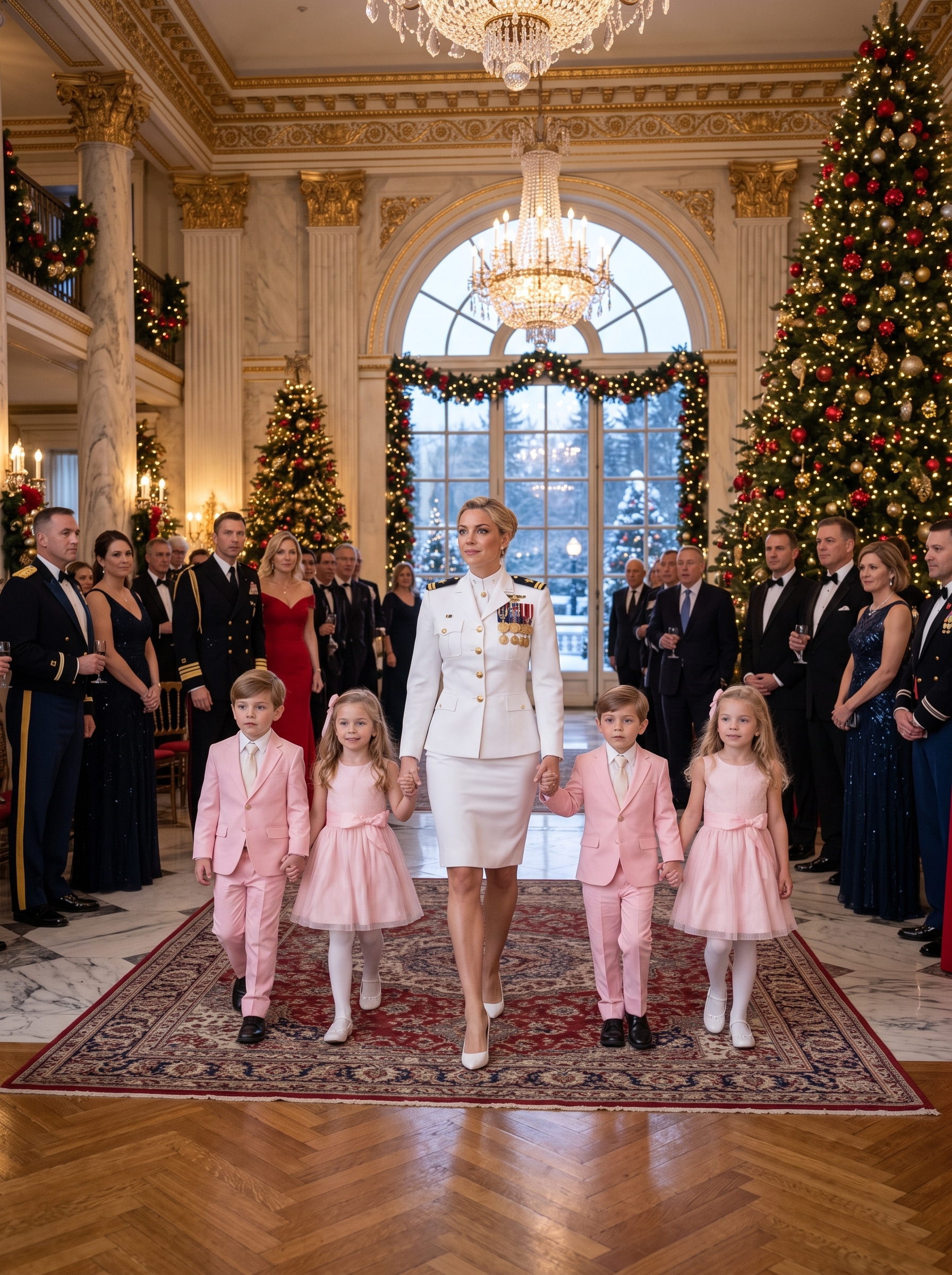
The grand hall was so quiet I could hear the fire popping.
Noah stood in front of the towering Christmas tree with his miniature officer’s
cap in his hand, looking up at the man who had given him his gray eyes.
He had asked his question the way eight-year-olds ask everything, without cruelty and without fear.
*Are you the daddy who told everyone we didn’t exist?*
Daniel’s mouth opened. Nothing came out.
“Daniel,” the blonde woman beside him said slowly. Her hand had slipped off his arm. “What does he mean?”
“Vanessa, this isn’t what it looks like.”
“Then tell me what it looks like.” She stared at four small faces,
all with his crooked smile, then back at him. “Because it looks like you told me you had no children.”
A glass clinked somewhere. An old general in the corner suddenly became very interested in his drink.
“Kesha,” Daniel said at last, his voice low and tight, the voice he used on subordinates.
“This is not the place. We should discuss this privately.”
“You invited me here, Daniel,” I said calmly. “In writing. *Make sure you’re there.* So I made sure.”
—
I had planned this day for three weeks, and I had planned it carefully,
because careful is what I do for a living.
The flight hadn’t been a stunt. The department had a scheduled liaison
transport to Peterson Space Force Base that morning, and I had reimbursed
the department for the extra seats and cleared everything with my deputy director.
I wasn’t going to give Daniel the satisfaction of calling me reckless. Every form was filed. Every dollar was accounted for.
What I wanted was simpler than revenge. I wanted my children to see where
they came from, and I wanted the people who had whispered about me to see my children.
I put a hand on Noah’s shoulder. “Nobody here has to say anything yet.
Kids, this is the house where your father grew up. These are his family.
I want you to be polite and stay close.”
“Yes, Mom,” four voices said together.
Margaret Reynolds still stood near the entrance, one hand pressed to her chest.
Shards of her champagne flute glittered at her feet. For forty years,
she had been the picture of composure, and now her face was crumpling.
“Daniel,” she said hoarsely. “You told me she lost the baby.”
The hall went still.
“Mother, please…”
“You told me,” Margaret repeated, louder, “that Kesha miscarried.
That she’d left the state and wanted no contact. You said it was kinder to leave her alone.”
I looked at Daniel. He wouldn’t meet my eyes.
“Is that what you told them?” I asked quietly.
He said nothing.
“Eight years ago,” I said, to the room more than to him,
“I told my husband I was pregnant. He said I was inventing
it to keep him from leaving. A week later, he filed for divorce.
A month after that, he was on a plane to Germany with a new phone number.”
“That isn’t fair,” Daniel said weakly.
“I carried four babies, Daniel. At thirty-one weeks, I was on bed rest.
At thirty-four, they came early, all four, in one night. I wrote to you.
Twice, by certified mail, to your base address.”
I reached into the leather folder at my side and took out a small bundle.
Two envelopes, each stamped with a red *RETURN TO SENDER* and a signature line.
Margaret moved toward me as if in a dream.
“That’s his unit’s postmark,” she whispered. “Daniel, you *signed* for these?”
His jaw worked. “I didn’t open them. I thought…”
“You thought if you didn’t read it, it wasn’t real.
” My voice stayed even. I had practiced that, too.
“That’s the difference between us. I couldn’t afford to look away.
There were four of them.”
—
Vanessa took off her engagement ring first.
It wasn’t on her finger yet. She had been holding the open velvet box,
which Daniel had been about to present, and now she gently put it on the mantel,
closed the lid, and turned to him.
“I asked you, three months ago,” she said, “whether there was anything in
your past I should know. You said no. I asked you about your marriage.
You said it ended because she was cold.”
“Vanessa, I can explain.”
“You’ve been *explaining* for five minutes and
I haven’t heard a single true sentence.” Her voice shook.
She turned to me, and I was surprised by the shame in her face.
“I’m so sorry. I had no idea. I wouldn’t have come.”
“It’s not your fault,” I said, and meant it.
She took her coat from the rack and walked out of the front doors into the snow, and nobody tried to stop her.
Daniel watched her go. I think it was the first moment that day when he understood how much this was going to cost him.
—
“Mom?” Olivia tugged my sleeve. “Is the lady sad?”
“A little, sweetheart. But she’ll be okay.”
“Is *he* sad?”
I looked at Daniel, who was standing very still,
a decorated colonel in a perfect uniform, looking like a boy who had broken something he couldn’t fix.
“I think he might be,” I said.
Margaret Reynolds crossed the marble floor and stopped
in front of my daughter. Slowly, with the careful movements of
a woman who didn’t trust her own legs, she knelt, her silk dress pooling on the cold stone.
“Hello,” she said. Her voice was nearly gone. “My name is Margaret.”
“I’m Olivia,” my daughter said politely. “I’m eight. Are you our grandma?”
Margaret’s face broke open.
“I would very much like to be,” she whispered. “If you’ll let me.”
Olivia glanced up at me. I nodded.
Olivia stepped forward and put her small mittened hand on Margaret’s cheek.
“You have dimples too,” she said, matter-of-fact. “They’re on the *whole* family.”
Margaret began to cry, quietly, with her eyes closed.
Behind her, I heard a cough. The old general in the corner had set down his glass.
He was staring at the four children with something I could only call grief,
and as he took a step forward, I realized who he was: Daniel’s uncle, Colonel Reynolds’s
older brother, the man who had delivered the eulogy at the general’s funeral.
“Young lady,” he said gruffly, to nobody in particular, “I’ve been in this family
sixty-eight years, and I’ve never seen a Reynolds with a straighter spine than that boy.
” He nodded at Noah. “Come here, son. Let me see that cap.”
Noah looked at me. I smiled. He marched across the hall and saluted,
and the old man returned it with a hand that trembled.
—
Daniel found me by the window while Margaret was showing the girls the ornaments on the tree.
“Kesha.” His voice was rough. “I made a terrible mistake.”
“You made eight years of them,” I said.
“I was afraid.” He pressed his fingers against his eyes. “I thought
if I had children, I’d be trapped. I thought I’d lose my command, my career,
everything my father built. I told myself you’d manage. I told myself you’d be better off without me.”
“And I was.”
He flinched.
“I’m not saying it to hurt you,” I said. “It’s just true. I made a family.
I made a life. It wasn’t easy, and it wasn’t free, but it was *mine*. I didn’t need you to fix anything.”
“Then why did you come?” It was almost a plea.
“Because your mother asked to see me. Because my children have
been asking about their grandparents since they were old enough to talk.
And because you needed to know that they exist, and they’re extraordinary, and you missed it.”
His eyes were bright. “Can I… would it be possible for me to know them?”
I took a long breath, and I thought about how to say it.
“That’s not up to me,” I said finally. “It’s up to them. I’ll never stand between
my children and a father who genuinely wants to earn his place. But you don’t
get to walk in as if nothing happened. You start by telling the truth, to
your family, to your command if it comes to that, and to them. You don’t ask for
forgiveness. You show up, over and over, for years, and you let them decide.”
“I’ll do it,” he said. “Whatever it takes.”
“We’ll see.” It wasn’t unkind. “I’d like to believe you, Daniel. But belief has to be earned now.”
He nodded slowly, the way a man nods when he understands that the sentence is fair.
—
We stayed for dinner.
I hadn’t planned to, but Margaret begged, and the children had never
seen a table that long. They sat between their grandmother and their great-uncle,
passing rolls and asking questions that no adult dared ask. Why did Grandpa have
so many medals? What was the biggest thing the general ever flew? Did anybody else
in the family like pickles on pancakes? (Noah, it turned out, was not alone. Margaret did, too.)
Daniel sat at the far end of the table and said almost nothing. At one point,
Sophia, who has never been afraid of silence, turned to him and said, “Do you want to see my drawing?”
He blinked. “I’d love to.”
She slid a folded paper down the table. He opened it with shaking hands.
It was a crayon picture of five stick figures in blue coats, standing in front of a helicopter.
“That’s us,” she said. “I drew it on the way here. I left a space for you, in case.”
Daniel looked at the page for a very long time. At the edge of the paper,
between the tallest figure and the smallest, there was a gap about the size of a man.
He didn’t speak. He just folded the drawing carefully and slipped it inside his uniform jacket, over his heart.
—
By the time the helicopter lifted off that night,
snow was falling thick and slow, and the lights of the estate glowed behind us like a lantern.
The children were asleep before we cleared the tree line,
heads leaning together, hands still tangled in their coats.
Margaret had pressed a small box into my hand at the door. Inside were
four old brass compasses, each engraved with a child’s name, identical to the one her husband had carried in the Gulf.
*So they can always find their way home,* she had written on the card.
I looked down at the lights fading into the snow.
For eight years, I had imagined this day as a victory.
A grand entrance. A man left speechless. A family forced to look at the truth.
It had been all of those things. But what I felt now,
watching my children sleep, wasn’t triumph. It was something quieter and much better.
Peace.
Noah stirred against my shoulder and murmured, half-awake, “Mom? Was that a good Christmas?”
I kissed the top of his head.
“It was the best one yet,” I whispered. “And I think there are a lot more coming.”
**The End**
—
I can also write a hook and thumbnail text for this one, or a shorter Facebook version.