# The Folder on the Coffee Table
I came home early on a Wednesday because
my last meeting was cancelled
and I wanted to surprise my family with dinner.
I had grocery bags in both hands.
I had been quietly happy all afternoon,
thinking about the pasta I’d make and how my daughter,
Lily, would steal the garlic bread off the tray.
The front door was unlocked. I heard voices in the living room,
and the low, easy laugh of my husband, Ethan,
which I had once believed was the best sound in the world.
I was halfway down the hall when I heard what he said.
“Take a page from my book, guys. I married my ugly wife
for the housework and the kids. And I take the pretty ones
on vacation without her knowing.” Another laugh, and the clink of beer bottles.
“Her parents bought us the house and the car. I’m just living the good life.”
One of his co-workers, Marcus, gave a nervous chuckle. The other,
Dave, said nothing.
I stood in the hallway with a bag of onions cutting into my fingers.
I didn’t drop anything. I didn’t scream. Something inside me went very,
very still, like a pond freezing over.
I set the groceries down without a sound.
I walked back out the front door, closed it gently,
and sat in my car for twenty minutes.
Then I took out my phone and,
for the first time in eleven years of marriage,
I began to think about myself.
—
I did not confront him that night.
I came home an hour later with the groceries, smiled,
and made the pasta. Ethan kissed my cheek and said, “Smells great,
babe.” Lily told us about her spelling test. I laughed in all the right places.
And the whole time, a calm, clear voice in my head kept asking questions.
*How long?*
*How many?*
*What else has he lied about?*
When the house was asleep, I opened the laptop and started looking.
I wasn’t looking for hidden evidence, because Ethan had never needed
to hide anything from a wife he didn’t think was paying attention.
It was all sitting in plain sight, in the joint accounts I had never checked because I trusted him.
Hotel charges in Cancún. Dinner for two in Charleston on a weekend he’d called a
“work conference.” A jewelry store receipt for a necklace I had never seen. A restaurant
in Napa, a spa in Scottsdale, and a recurring payment to an apartment rental in the city,
eight hundred dollars a month, for almost two years.
Three different women. I found them by name,
because he had been careless enough to tag one in a
photo on a public account.
I wrote everything down. Dates, amounts, addresses.
By 3 a.m., I had a spreadsheet and a headache and a very steady hand.
At 6 a.m., I called my mother.
“Mom,” I said. “I need you and Dad this evening. Can you come over, and keep it quiet?”
She was silent for a moment. Then she said, “What did he do?”
“I’ll tell you when you get here.”
I should explain something about my parents. They are not rich people.
They are retired schoolteachers who saved for forty years. When Ethan
and I got married, they sold their second property and gave
us the down payment on our house, because they wanted us
to start on solid ground. They put the car in my name,
as a wedding gift. They never asked for anything back.
They never even mentioned it.
Ethan had been mocking that generosity behind my back for years.
—
The next call was harder.
I phoned Marcus at his office. “I know you were at my house yesterday,
” I said. “I came home early. I heard what Ethan said.”
A long, awful pause. “Mrs. Reyes, I’m so sorry. I should have said something.”
“You’re not in trouble,” I said. “But I’m asking you and Dave to come over
tonight at six. You don’t have to say a word. I just need you to be there.”
“Why?”
“Because I’m going to need witnesses,” I said.
“And because I think you already know he’s wrong.”
He hesitated. Then he said quietly, “We’ll be there.”
I phoned Ethan’s parents last. They are good people,
which is the part that still makes me sad. His mother,
Carol, answered, and I heard her smile through the phone.
“Maya, honey! How are you?”
“I need you and Frank here tonight at six,” I said.
“It’s important. Please don’t tell Ethan.”
Another silence. Carol had always been smarter than her son.
“We’ll be there,” she said slowly. “Maya, is Lily all right?”
“Lily’s fine. I’ll explain everything.”
I took Lily to my sister’s house for the evening, kissed her forehead,
and told her we were having a grown-up dinner. Then I went home and set the table for ten.
—
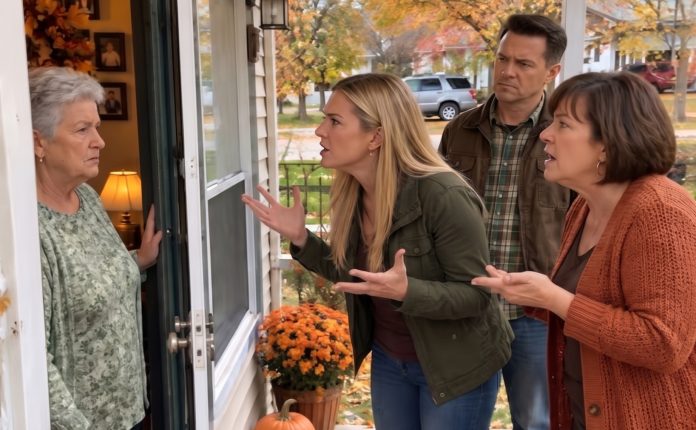
By ten to six, they had all arrived. My parents sat on the left of the sofa,
my dad’s hand resting on my mom’s knee. Carol and Frank
sat across from them, rigid and pale. Marcus and Dave perched
on dining chairs near the window, not looking at anyone.
I put a small speaker on the coffee table, next to a thick blue folder.
At 6:20, Ethan’s key turned in the lock.
“Babe? Whose cars are those in the—”
He stopped in the doorway. His eyes swept across the room,
and I watched his face go from puzzled to wary to something very
close to fear. He saw his parents. He saw his co-workers. He saw my father,
who was looking at him with the quiet, steady gaze of a man who has taught
a thousand teenagers and never once raised his voice.
“What’s going on?” Ethan asked, trying to laugh. “Is this an intervention?”
“Sit down, Ethan,” I said.
“Maya—”
“Sit.”
He sat, slowly, on the edge of the armchair.
I pressed play.
I had recorded it in my head the way you memorize a phone number,
but I hadn’t needed to rely on memory. Our home security system,
the one Ethan had installed himself and bragged about,
recorded audio in the living room. I had pulled the clip that morning.
His own voice filled the room, clear and cheerful.
*”I married my ugly wife for the housework and the kids.
And I take the pretty ones on vacation without her knowing.
Her parents bought us the house and the car. I’m just living the good life.”*
Laughter. The clink of bottles.
Nobody said a thing.
I let the silence stretch. I watched Ethan’s face go from tan to gray to white.
I watched his mother put her hand over her mouth and his father close his eyes.
I watched my own mother, who had never said an unkind word
about him in eleven years, look at the man she’d welcomed into our family like a stranger.
“That’s not…” Ethan’s voice cracked. “That was a joke. Guys, tell her. We were just messing around.”
Marcus looked at the floor. “I heard you, Ethan,” he said quietly. “I didn’t think it was funny.”
Dave, who hadn’t spoken all night, cleared his throat. “Neither did I.”
“Dad,” Ethan said, turning desperately to Frank. “You know I didn’t mean—”
“Be quiet,” his father said. His voice was hoarse. “Just be quiet and let her finish.”
I picked up the blue folder and slid it across the coffee table until it rested directly in front of him.
“Open it.”
—
His hands shook as he flipped the cover back.
The first page was a printout of our mortgage documents and the deed. “Read the names on the title,” I said.
He didn’t need to. The house was held in a family trust, with my parents as the trustees and me as the sole beneficiary. They had set it up the day they gave us the money. Ethan had signed the papers himself and never read past the first line.
“The house isn’t yours, Ethan,” I said. “It never was. The car is in my name. So is the savings account my parents started for Lily. The only thing you own is your clothes and that ridiculous watch.”
“Maya, please—”
“Turn the page.”
The second section was the spreadsheet. Cancún, Charleston, Napa, Scottsdale. The jewelry store. The apartment. Three names. Dates and amounts, highlighted in yellow, with screenshots of every charge.
“Eleven years,” I said. “And you spent almost forty thousand dollars of our shared money on three women while telling me we couldn’t afford a vacation.”
His mother made a small, broken sound. His father put an arm around her shoulders.
“I never wanted to see these,” Carol whispered. “Ethan, how could you?”
“Mom, I can explain—”
“Don’t,” she said. “Please don’t.”
“There’s more,” I said.
The third section was a stack of papers with a bright yellow flag on top. Divorce petition, filed that afternoon, with a request for full custody and a proposed parenting plan. Behind it was a letter from my lawyer, a cheerful, ruthless woman named Patricia Okafor, summarizing the financial disclosures and a request for an immediate accounting of every dollar moved out of our joint accounts.
“Patricia says the court takes a dim view of marital funds spent on affairs,” I said. “She also says that audio recording is admissible in our state, since it was captured in my own home. She was very excited about that.”
Ethan stared at the page. His lips moved, but nothing came out.
“One more thing,” I said, and held out my hand.
My father reached into his jacket and handed me a small envelope. I set it on top of the folder.
“This is the key to your apartment, the one you’ve been paying eight hundred dollars a month for since 2023. I called the landlord this morning. Since you listed me as co-signer and never told me, I terminated the lease. You have until Friday to collect your things.”
“You can’t…”
“I already did.”
—
For a long time, nobody moved.
Then, slowly, Ethan began to cry. It wasn’t the quiet, dignified crying of a man who has lost something. It was the ugly, panicked crying of someone who has just discovered what the world looks like without a safety net.
“Maya, please. I love you. I love Lily. I made a mistake. I was stupid and I was showing off and I didn’t mean any of it. You know I didn’t.”
I looked at him. I looked at the man I had fallen in love with at twenty-six, who had once brought me soup when I had the flu and held me at my grandmother’s funeral. I tried to find that man somewhere inside the shaking figure in the armchair, and I couldn’t.
“You meant every word,” I said. “That’s what makes it so clear. You said it to people you wanted to impress, and you said it in the voice you use when you’re telling the truth.”
“I—”
“I’m not angry anymore,” I added, and I realized it was true. “I was last night. I cried in the shower so you wouldn’t hear me. But today I just feel clear. You said I was ugly, Ethan. Do you know what ugly is? It’s laughing at the woman who cooked your dinner while she was stirring the pot in the next room. It’s spending my parents’ wedding gift on hotel rooms. It’s teaching our daughter what a husband looks like by showing her you.”
His father stood up. He crossed the room, put a hand on Ethan’s shoulder, and said in a voice I had never heard from him, “Get up, son.”
“Dad…”
“Get up. We’re going to your mother’s car. You are not going to say another word to this woman tonight.”
Carol rose too. She came over to me, her eyes red, and took my hands in both of hers.
“Maya, I am so ashamed,” she said. “Whatever you need, whatever Lily needs, we are here. I mean it. We’re going to do the right thing, even if it’s hard.”
“Thank you, Carol.”
“I raised him better than this,” she whispered. “I swear I did.”
“I know,” I said. “Some people just forget.”
Frank led Ethan out. At the door, Ethan turned one last time, with his face wet and his shirt untucked, and looked at me as if he hoped I would call him back.
I didn’t.
The door closed. A car started in the driveway and pulled away.
—
The house was quiet.
My mother came over and wrapped her arms around me, and my father stood behind her with a hand on my shoulder, and for the first time in two days I let myself shake.
“You did so well,” my mom murmured. “You were so calm.”
“I wasn’t calm,” I said into her sweater. “I was terrified.”
“That’s what calm is,” my dad said gently. “Being terrified and doing it anyway.”
Marcus and Dave stood awkwardly by the window. Marcus stepped forward first.
“Mrs. Reyes, I want to tell you something. I’ve worked with Ethan for six years. I never liked how he talked about you. I should have said so. If you need a statement for the court, or anything else, I’ll give it, signed and sworn.”
“Me too,” Dave said. His voice was rough. “My wife is the best person I know. I’d never let anyone talk about her like that. I’m sorry we didn’t speak up sooner.”
“You came tonight,” I said. “That matters more than you know.”
When everyone had gone, I made myself a cup of tea and sat in the living room with the blue folder on my knee. The audio was still on my phone. I thought about deleting it, and then I thought about Lily, and I saved it to three different places.
—
The divorce took seven months.
Patricia was as good as she’d promised. The audio, the spreadsheet, and the records from the apartment all held up. Ethan’s lawyer advised him to settle, and he did. I got the house, the car, full custody of Lily, and a fair division of what remained of our savings. He got weekend visitation and a monthly bill he resented paying.
His job, however, was a different story. Marcus and Dave were not the only ones who had heard what he said. A recording that is played once, in front of the right people, has a way of traveling, and by the time the divorce was final, Ethan had been quietly moved out of the client-facing role he’d spent a decade building. HR never said why. They didn’t have to.
I heard from his mother sometimes. Carol called every few weeks to ask about Lily, and she was always careful never to ask about Ethan unless I brought him up. She sent birthday cards and she sent soup when I had a cold, and I realized she had become, in the strangest way, my friend.
“I’m sorry,” she told me once, over coffee. “I keep saying it. It doesn’t feel like enough.”
“It’s enough,” I said. “You can’t apologize for someone else’s choices. You showed up. That’s what counts.”
—
I started painting again.
I had given it up after Lily was born, telling myself I was too busy. One night in the spring, I dug out my old brushes and found a canvas in the attic. I set it up in the sunroom, in front of the big window that faced the garden.
Lily wandered in, in her pajamas, and watched me for a while.
“Mom, what are you painting?”
“I’m not sure yet,” I said. “Maybe a garden.”
“It’s pretty,” she said, and leaned her head on my arm. “Your painting is going to be pretty. Like you.”
I put down the brush and held her close, and I breathed in the smell of her shampoo and thought about the word he had used. Ugly. I had carried that word around for a few hours, and it had weighed on me like a stone. But I put it down that night, at the coffee table, in front of everyone, and I never picked it up again.
Here is what I learned. People who call you ugly are usually describing themselves. The word is a mirror, and it only shows what’s behind the glass.
My parents still come to dinner every Sunday. Lily still steals the garlic bread. The house still has the same creaky stair, the same window seat, the same morning light.
But it doesn’t feel like the same house anymore. It feels like mine.
**The End**
—
If you’d like, I can write a hook and thumbnail text for this one, or a shorter version for Facebook.