Three days before Christmas, I was standing in the kitchen of the house I had spent almost two years building outside Asheville, North Carolina.
Snow drifted beyond the floor-to-ceiling windows.
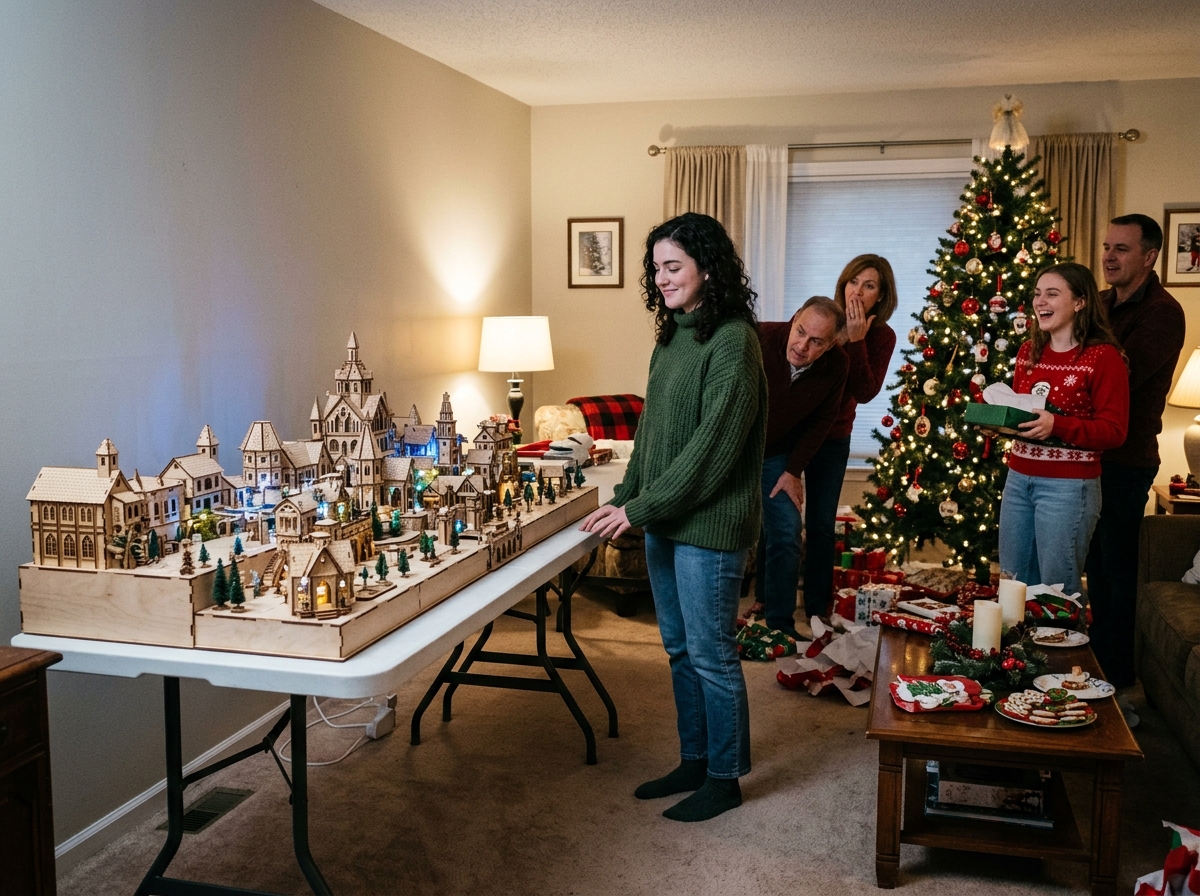
The Christmas tree glowed in the living room. Two guest bedrooms upstairs were ready. I had even bought my father’s favorite coffee and the orange marmalade my mother always complained she could never find in the mountains.
This was the first Christmas I had ever hosted in a house that belonged entirely to me.
I wanted them there for one simple reason.
I wanted my parents to finally see what their older daughter had built.
Not what I had borrowed.
Not what I had been given.
Not what someone had helped me achieve.
What I had built.
For years, my parents had treated my younger sister, Emily, as though she were made of glass.
Emily was three years younger than me, and from the time we were children, there had always been a difference in the way our parents looked at us.
If Emily struggled, everyone stopped.
If I struggled, I was told I was strong enough to handle it.
When Emily wanted something, my parents found a way.
When I wanted something, I was usually told to wait.
I never hated my sister for it.
She hadn’t asked to become the center of everyone’s attention.
But sometimes, I hated the role I had been given.
The dependable daughter.
The responsible daughter.
The one who didn’t need anything.
After college, I moved away from home and started working as an architectural designer. I rented a tiny apartment, worked long hours, saved almost everything I could, and eventually bought a small piece of land outside Asheville.
Then I built the house.
It wasn’t a mansion.
It wasn’t even particularly large.
But every wall represented a decision I had made.
Every window.
Every piece of flooring.
Every beam.
Every dollar.
I had spent weekends at construction sites, arguing with contractors and checking measurements. I had learned more about plumbing, insulation, roofing, and permits than I ever expected to know.
There were nights when I sat alone in the unfinished living room eating takeout from a paper container while snow fell outside.
And every time I felt exhausted, I reminded myself:
One day, Mom and Dad will walk through this front door.
So, when December arrived, I called them.
“Why don’t you come for Christmas?” I asked. “You can stay here. I’ve got the guest rooms ready.”
There was a pause.
Then my mother said, “That sounds lovely, sweetheart, but…”
I already knew there was going to be a “but.”
“Emily needs groceries.”
I looked out at the snow.
“Groceries?”
“Yes. She has a lot going on right now. You know how things are.”
I did know.
Emily had recently moved into an apartment about forty minutes from my parents. She was between jobs, and my parents had been helping her financially.
I swallowed.
“Of course.”
My mother continued, almost apologetically.
“Maybe we can visit after Christmas.”
“Sure.”
There was another silence.
Then she said, “You understand, don’t you?”
I stared at the Christmas tree.
“All good, Mom.”
I hung up.
For a few minutes, I stood there in silence.
Then I laughed quietly.
Not because anything was funny.
Because sometimes laughing is easier than admitting you’re hurt.
I looked at the three stockings hanging over the fireplace.
One had my name.
One had Dad’s.
One had Mom’s.
I had bought them months earlier.
I hadn’t bought one for Emily.
I wondered if that made me selfish.
Then I wondered why I was the one who always felt guilty for wanting my parents to show up.
That evening, I put the phone away and went back to decorating.
Christmas would still come.
Whether they were there or not.
The next morning, I woke up to a text from our neighbor, Mrs. Dalton.
She lived two houses down and had become something of a grandmother to me during the construction of the house.
Her message said:
“Your parents are in town, aren’t they?”
I frowned.
I replied:
“I think so. Why?”
A few minutes later, she answered.
“Your mother called me.”
My stomach tightened.
Then another message appeared.
“She asked about your house.”
I stared at the screen.
Before I could respond, my phone rang.
It was Mrs. Dalton.
“Hello?”
“Sweetheart,” she said, sounding confused, “your mother just called me.”
“What did she want?”
“She asked if I had seen your house.”
I laughed nervously.
“That’s strange.”
“That’s what I thought.”
Mrs. Dalton paused.
Then she said, “Actually, I saw your parents yesterday.”
“You did?”
“Yes. They were driving toward Emily’s apartment.”
I felt a familiar ache in my chest.
“Right.”
Then Mrs. Dalton said something that made me sit up.
“Did they tell you they weren’t coming because Emily needed groceries?”
“Yes.”
There was silence.
Then she said quietly,
“That’s odd.”
“Why?”
“Because yesterday afternoon, I saw Emily here.”
My heart stopped.
“What?”
“She came by your house.”
I stood up.
“Emily came to my house?”
“Yes. She was with your father.”
I couldn’t speak.
Mrs. Dalton continued.
“They were looking at the house from the road. Your father got out of the car and walked toward the driveway.”
I gripped the edge of the kitchen counter.
“Why?”
“I don’t know.”
“Did they come inside?”
“No.”
“Are you sure?”
“Yes.”
I stared at the front door.
Something suddenly felt wrong.
Then Mrs. Dalton said,
“And that’s why I was confused when your mother called me this morning.”
“What did she say?”
Mrs. Dalton lowered her voice.
“She asked me if I’d seen your house.”
“Okay.”
“Then I told her, ‘Of course. It’s beautiful.'”
Another pause.
“And she asked me, ‘Why weren’t you there last night?'”
My heart started beating faster.
“What did you say?”
“I said, ‘I saw your daughter’s house yesterday. I assumed you had already visited.'”
Mrs. Dalton stopped.
Then she said:
“That’s when your mother went completely silent.”
I sat down.
“What happened next?”
“She asked me, ‘Where did you see it?'”
I whispered, “And?”
Mrs. Dalton said:
“I told her, ‘From your daughter’s driveway.'”
Another long silence.
Then Mrs. Dalton said something that I would never forget.
“Your mother asked me, ‘Wait… you honestly don’t know?'”
I felt a chill run through me.
“Know what?”
“I don’t know,” Mrs. Dalton said. “She hung up.”
For the next several hours, I couldn’t concentrate.
I kept thinking about the same question.
What didn’t my mother know?
That evening, my father called.
I almost didn’t answer.
“Hello?”
“Hey, sweetheart.”
His voice sounded unusually careful.
“Hi, Dad.”
He cleared his throat.
“Your mother and I were wondering if we could come over tomorrow.”
I stared through the windows at the snow.
“Tomorrow?”
“Yes.”
“What changed?”
Silence.
Then he said,
“Your mother found something.”
“What?”
“I think you should hear it from us.”
I felt my stomach twist.
“Is Emily okay?”
“Yes.”
“Did something happen?”
“No.”
“Then what is it?”
My father sighed.
“Tomorrow.”
I didn’t sleep much that night.
The following afternoon, my parents arrived.
My mother stepped out of the car first.
She looked at the house for a long moment.
Then she looked at me.
Her eyes were red.
My father walked toward me slowly.
Neither of them spoke.
Finally, my mother whispered,
“Why didn’t you tell us?”
I frowned.
“Tell you what?”
She looked around.
“This.”
I almost laughed.
“I invited you.”
“No.”
She shook her head.
“Not about Christmas. About everything.”
My father looked down.
My mother continued.
“Your sister told us you bought this land with help from someone.”
I stared at her.
“What?”
“She said you couldn’t possibly have built this house by yourself.”
I felt something inside me go cold.
“Mom, I didn’t say I built it completely by myself. I hired contractors.”
“That’s not what I mean.”
She took a breath.
“Emily told us you had been struggling financially.”
I stared at her.
“Emily told you that?”
“Yes.”
“Why?”
My mother didn’t answer.
Instead, she walked inside.
She looked at the Christmas tree.
Then the fireplace.
Then the staircase.
Then the framed photographs on the wall.
There were photographs from the construction.
Me wearing a hard hat.
Me standing beside the foundation.
Me holding blueprints.
Me standing in the empty living room after the final inspection.
My mother touched one of the photographs.
“You did all this?”
“Yes.”
“By yourself?”
“With contractors.”
My father walked over to another photograph.
He stared at it for a long time.
Then he said,
“Why didn’t you ever tell us?”
I looked at him.
“I did.”
He shook his head.
“No. You told us you were working.”
“I was.”
“You told us you bought land.”
“I did.”
“You told us you were building.”
“I did.”
My voice cracked.
“You just never listened.”
Neither of them spoke.
I looked at my mother.
“I invited you because I wanted you to see it.”
She covered her mouth.
“I wanted you to see that I was okay.”
My father lowered his head.
“And when you said Emily needed groceries…”
I stopped.
My mother closed her eyes.
“We weren’t going to Emily’s.”
I stared at her.
“What?”
“We were going to come here.”
My heart skipped.
“Then why didn’t you?”
My mother looked at my father.
He finally spoke.
“Emily called us.”
“What did she say?”
“She said she was having a difficult week and needed help.”
“So you canceled.”
“Yes.”
“And you didn’t tell me the truth.”
My mother started crying.
“We didn’t want you to think we were choosing her over you.”
I looked at her.
“But you did.”
The words came out quietly.
Not angrily.
That seemed to hurt her even more.
My father stepped closer.
“You’re right.”
I looked at him.
He continued.
“We’ve spent years convincing ourselves that you didn’t need us.”
My throat tightened.
“And Emily did?”
My mother nodded.
“That’s what we believed.”
I looked toward the Christmas tree.
“Do you know what the worst part is?”
Neither answered.
“I stopped asking you for things because I knew you would say yes to Emily first.”
My mother’s face crumpled.
“I stopped telling you when I was scared.”
I wiped my eyes.
“I stopped telling you when things were difficult.”
My father whispered,
“Why?”
“Because I didn’t want to become a burden.”
The room became completely silent.
Then my mother walked toward me.
She didn’t try to hug me.
She simply stood there.
“Can I?”
I nodded.
She wrapped her arms around me.
And for the first time in years, I let myself cry in front of her.
Not as the responsible daughter.
Not as the strong daughter.
Just as her daughter.
My father joined us.
For a long time, the three of us stood there.
Then my mother pulled away.
“We owe you an apology.”
I nodded.
“You do.”
She smiled sadly.
“Can we still have Christmas here?”
I looked at the clock.
“Christmas is tomorrow.”
“I know.”
“Where’s Emily?”
My father answered.
“At home.”
I thought about it.
Then I said,
“Invite her.”
My mother looked surprised.
“Are you sure?”
“Yes.”
“But after everything…”
I shook my head.
“She’s still my sister.”
The next morning, there were four cars in my driveway.
My parents arrived first.
Emily came later.
She stood awkwardly at the front door, holding a small wrapped gift.
“I almost didn’t come,” she said.
“Why?”
She looked down.
“Because I knew you were angry.”
I sighed.
“I was.”
She nodded.
“I’m sorry.”
I didn’t answer immediately.
Then I stepped aside.
“Come in.”
She did.
That Christmas wasn’t perfect.
There were uncomfortable conversations.
There were tears.
There were things that couldn’t be fixed in a single afternoon.
But for the first time, everyone sat around the same table and actually talked.
My father drank the coffee I’d bought for him.
My mother spread orange marmalade across a piece of toast and laughed when she realized I’d remembered it.
Emily looked around the room and said,
“You really did build all this.”
I smiled.
“Yeah.”
She shook her head.
“I’m proud of you.”
Those four words meant more to me than she probably realized.
Later that night, after everyone had gone upstairs, I stood alone in the living room.
Snow was falling outside.
The Christmas lights reflected in the windows.
For years, I had thought the house was the thing I was building.
But standing there, I finally understood.
The house had never really been the destination.
It was proof.
Proof that I could build a life even when nobody was watching.
Proof that being overlooked didn’t mean I was invisible.
And perhaps most importantly, proof that sometimes people don’t realize how much they’ve hurt you until you stop pretending it doesn’t hurt.
My parents didn’t suddenly become perfect.
Our family didn’t magically change overnight.
But something had shifted.
The next morning, I found a note beside my coffee cup.
It was from my mother.
It said:
“We should have come sooner.”
Underneath it, my father had written:
“We’re proud of you.”
I folded the note and put it in the drawer beside my bed.
Then I looked out at the snow-covered mountains.
For the first time, I didn’t wonder whether my parents had finally seen what I had built.
I knew they had.
But more importantly, I finally saw it too.
I hadn’t built that house because I needed their approval.
I had built it because, somewhere along the way, I had finally learned that my life was mine to build.
And no one had to choose me first for me to know that I mattered.