My name’s Ethan. I’m 34, and I need to tell you about the day I locked my own mother out of my son’s birthday party.
I know how that sounds.
Trust me, if someone had told me 5 years ago that I’d be the kind of person who physically removed his mother from a 10-year-old celebration, I would have laughed in their face.
But life has a funny way of pushing you to the edge, one small shove at a time, until you realize you’ve been standing at the cliff for years and just never looked down.
Let me back up.
I grew up in Murfreesboro, Tennessee, the middle child of three boys.
My older brother, Garrett, is 37.
My younger brother, Drew, is 30.
And then there’s me, the human equivalent of a participation trophy.
At least according to my mother, Patricia.
Now, I want to be fair here because I think context matters.
My mom isn’t some cartoon villain.
She’s charming.
She volunteers at her church.
She makes incredible pecan pie.
She remembers every neighbor’s birthday and drops off little gift bags with ribbon and everything.
To the outside world, Patricia is a saint.
But behind closed doors, she had a ranking system for her sons.
And I was never anywhere near the top.
Garrett was the golden child.
He was the firstborn, the football star, the one who got a full ride to UT Knoxville and came back with a business degree and a jaw that could cut glass.
My mom talked about Garrett the way some people talk about sunsets or their first love.
Just pure, unfiltered admiration.
Drew was the baby, so he got the other end of the favoritism spectrum.
The coddling, the excuses, that “he’s still finding himself” energy well into his late 20s.
And me?
I was just Ethan, the quiet one, the one who got Bs instead of As.
The one who played baseball instead of football.
The one who, according to my mother, “tried hard, bless his heart,” which in the South is basically code for “he’s mediocre, but we love him anyway.”
I spent most of my childhood trying to earn her approval.
I mowed the lawn without being asked.
I got a job at 16 bagging groceries.
I paid for my own prom ticket.
I never got into trouble, never had a rebellious phase, never gave her a single reason to worry.
And you know what that got me?
Invisibility.
Because when you’re the low-maintenance kid, people stop maintaining you altogether.
They just assume you’re fine.
And eventually, you start believing you are fine even when you’re not.
I married my wife, Jenna, when I was 26.
She’s the best thing that ever happened to me.
And I say that without an ounce of exaggeration.
Jenna is the kind of person who sees through nonsense the way an X-ray sees through skin.
She clocked my mom within 30 minutes of meeting her, pulled me aside at dinner, and said, “Your mother just complimented Garrett’s tie four times and hasn’t said a word to you since we sat down. Is that normal?”
And I just shrugged and said, “Yeah, pretty much.”
Jenna stared at me like I just told her I didn’t believe in gravity.
When our son Miles was born, something shifted in me.
I looked at this tiny, screaming, red-faced human and thought, “I will never make you feel like you’re not enough.”
Chapter 2: Tension at the party
Miles was everything to me.
He was creative, funny, a little weird in the best possible way.
He liked bugs and origami and asked questions that would stump a philosophy professor.
“Dad, if you forget a dream, did it still happen?”
This kid was 10 going on ancient, and I loved every single thing about him.
But my mom?
She was polite about Miles.
That’s the best word I can use.
Polite.
Not warm, not excited, not proud.
Just polite.
She’d send him a card on his birthday with a check for $25.
She’d pat him on the head at Thanksgiving like he was a neighbor’s dog.
Meanwhile, Garrett’s two kids, Landon and Presley, got weekend sleepovers at Grandma’s house.
They got surprise trips to Dollywood.
They got framed photos on her mantle.
Miles got a pat on the head and a “He sure is growing, isn’t he?”
I tried to bring it up once.
Just once.
I sat down with my mom at her kitchen table, just the two of us, and I said, “Mom, Miles notices that you treat Garrett’s kids differently. He asked me why Grandma doesn’t invite him over like she invites Landon.”
And do you know what she said?
She tilted her head, gave me this pitying smile, and said, “Ethan, honey, you’re being sensitive. I love all my grandchildren the same. Some kids just connect more naturally.”
Some kids just connect more naturally.
I replayed that sentence in my head for weeks.
It’s the kind of thing that sounds reasonable on the surface, but is absolutely devastating when you sit with it long enough.
Jenna was furious.
She told me flat out, “If your mother can’t treat Miles the same as Garrett’s kids, she doesn’t get access to Miles. Period.”
And I agreed with her in theory.
But in practice?
In practice, I was still that kid mowing the lawn, hoping Mom would notice.
I kept the peace.
I made excuses.
I told myself it wasn’t that bad.
I told myself Miles was too young to really understand.
I told myself a lot of things that weren’t true because the truth was too heavy to carry.
Then Miles turned 10, and everything changed.
We planned a party.
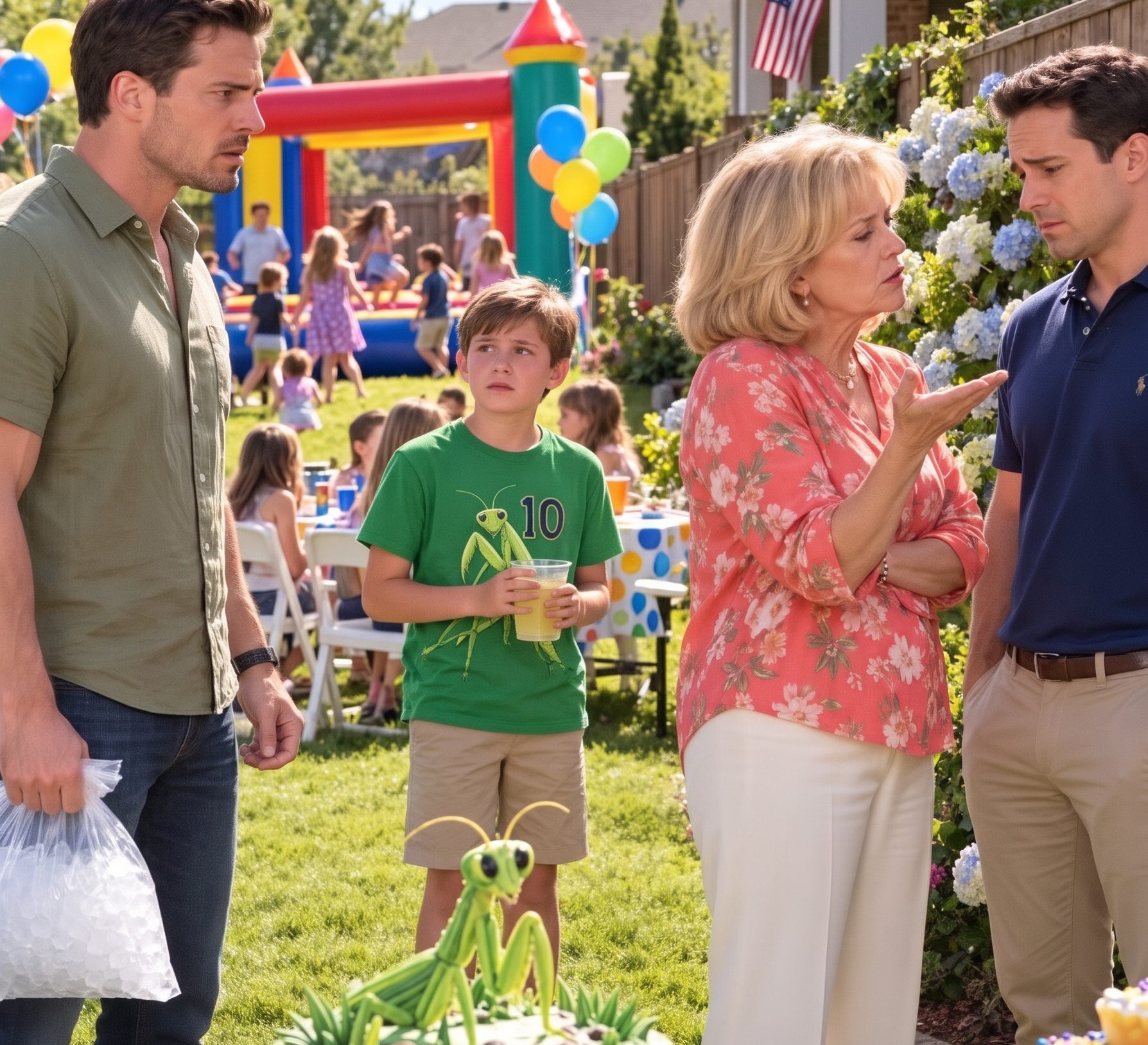
Nothing extravagant, just a backyard cookout with his friends, a bounce house, a cake shaped like a praying mantis because that was his favorite bug that month.
Jenna handled the decorations.
I handled the grill.
And Miles was bouncing off the walls with excitement.
He’d made his own invitations by hand, little folded cards with drawings of bugs on the front.
He made one for every kid in his class.
He made one for Garrett’s family.
And he made a special one for my mom because, despite everything, this kid still wanted his grandmother there.
She showed up about 45 minutes late, which was classic Patricia.
Walked in with a small gift bag, looked around the yard, and said, “Oh, this is cute,” in a tone that made it clear she meant the opposite.
Garrett and his wife Meredith were already there.
Drew had sent a text saying he couldn’t make it, which was also classic Drew.
My mom made a beeline for Garrett and started talking to him about some renovation he was doing on his house.
She hadn’t said happy birthday to Miles yet.
I let it go.
I flipped burgers.
I refilled drinks.
I watched Miles play with his friends and tried to focus on how happy he looked.
Jenna squeezed my arm at one point and whispered, “You okay?”
I nodded.
I wasn’t, but I nodded.
Then it happened.
Chapter 3: Setting firm boundaries
I was walking back from the garage with a bag of ice when I heard my mother’s voice coming from around the side of the house.
She was talking to Garrett, standing near the fence where the hydrangeas are, and she clearly thought no one was within earshot.
I stopped.
Not because I was eavesdropping.
I stopped because I heard my son’s name.
“This party is a waste,” she said. “He’s not even that special. I mean, a bug cake? Come on. Landon had a real party last year. This is just sad.”
I felt my chest tighten.
And then I saw him.
Miles, standing about 5 ft behind her, holding a cup of lemonade, completely frozen.
He’d heard every word.
I could see it in his face, the way his eyes went wide and then sort of dimmed like someone had turned the brightness down on him.
He looked at me, and I looked at him.
And in that moment, something inside me broke and rebuilt itself at the same time.
I didn’t yell.
I didn’t make a scene.
I walked over to my mother, put my hand gently on her arm, and said, “Mom, can you step outside for a moment? I need to talk to you.”
She looked confused but followed me to the front of the house.
I opened the gate, walked her through it, and then I went back inside and locked the door behind me.
My mother stood on the other side of that gate for a solid 10 seconds before she realized what had just happened.
I watched through the front window as her expression shifted from confusion to disbelief to something I’d never seen on her face before.
Genuine shock.
She knocked on the door.
Not hard, just a polite little tap like she was visiting a neighbor.
“Ethan? Ethan, what are you doing? Open the door.”
I didn’t open the door.
I went back to the party.
Jenna was standing near the grill with her arms crossed, watching me with a look that was half concerned and half something else.
Something like relief.
“What just happened?” she asked quietly.
I told her all of it.
What my mother said, where Miles was standing, what his face looked like.
Jenna’s jaw tightened.
She looked over at Miles, who was sitting on the edge of the bounce house by himself.
Not bouncing.
Just sitting.
“Go be with him,” she said. “I’ll handle the party.”
I walked over and sat down next to Miles.
He didn’t say anything at first.
He just picked at the grass and took tiny sips of his lemonade.
Then he said very quietly, “Dad, does Grandma not like me?”
That sentence hit me like a freight train wrapped in barbed wire.
I put my arm around him and pulled him close.
“Miles, listen to me. Grandma said something really hurtful, and it was wrong. It wasn’t about you. It was about her. You are one of the most incredible people I’ve ever known. And I’m not just saying that because I’m your dad. I’m saying it because it’s true.”
He nodded, but I could tell he was processing.
10-year-olds are smarter than we give them credit for.
He wasn’t going to forget what he heard, and no amount of dad reassurance was going to erase it completely.
But I could be there.
I could make sure he knew he was seen, and I could make sure the person who hurt him was never in a position to do it again.
Chapter 4: Family fallout
Meanwhile, my mother was apparently losing her mind on the front lawn.
Garrett came inside after about 5 minutes looking uncomfortable, which for Garrett was unusual because the man has the emotional bandwidth of a cereal box.
“Hey, uh, Mom’s outside, and she’s pretty upset. She says you locked her out.”
“I did,” I said.
“Ethan, come on. It’s a kid’s party. Whatever happened, just let her back in and deal with it later.”
“She told Miles he wasn’t special, Garrett. He was standing right behind her when she said it. He heard everything.”
Garrett blinked.
He opened his mouth, closed it, then opened it again.
“Okay, that’s not great, but you know Mom. She says stuff without thinking. She didn’t mean it like that.”
“How else would she mean it? She said the party was a waste and he’s not even that special. How many ways can you interpret that?”
Garrett rubbed the back of his neck.
“Look, I’ll talk to her. Just let her back in so it doesn’t become a whole thing.”
“It already is a whole thing,” I said. “It’s been a whole thing for 34 years. I’m just the first one to say it out loud.”
Garrett didn’t know what to do with that.
He looked at Jenna, who was silently stacking plates with the intensity of someone defusing a bomb.
And then he walked away.
A few minutes later, I heard him go out the front door.
Through the window, I watched him talk to my mother in the driveway.
She was gesturing wildly.
At one point, she pressed her hand to her chest like she was the victim in all of this.
Classic Patricia.
Meredith, Garrett’s wife, came up to me quietly and said, “For what it’s worth, I think you’re right. She says stuff about Landon and Presley, too, when she thinks we’re not listening. It’s never good enough for her unless it was her idea.”
That surprised me.
I’d always assumed Garrett and his family were immune to my mother’s criticism, that they existed on some untouchable pedestal.
Turns out the pedestal had cracks, too.
She just hid them better.
The rest of the party went on.
Miles eventually started playing again.
His friend Cooper dragged him back into the bounce house.
And within 20 minutes, he was laughing and doing backflips off the sidewall, which nearly gave Jenna a heart attack, but at least he was smiling.
The bug cake was a hit.
His friends thought the praying mantis was cool.
Miles beamed when everyone sang happy birthday to him, and for a moment, everything felt okay.
My mother left the driveway about an hour into her exile.
Garrett told me later that she’d driven home in tears, called Drew, and told him I’d humiliated her in front of the entire family.
Drew texted me that night, just one line.
“Dude, what did you do to Mom?”
I didn’t respond.
I was tired of being the one who explained, apologized, managed, and smoothed things over.
For once, I just didn’t have it in me.
The next morning, my phone lit up like a switchboard.
My mother had apparently spent the night calling every relative in her contact list to tell them her version of events.
And her version, from what I gathered, was that I’d thrown her out of a children’s party for making a harmless comment and that Jenna had turned me against my own family.
The second part was rich, considering Jenna had barely spoken a word during the whole thing.
But that was my mother’s playbook.
When she couldn’t control the situation, she controlled the narrative.
My aunt Linda called me at 8 in the morning.
“Ethan, your mother is devastated. She says you embarrassed her in front of everyone. Is that true?”
I told her what happened, word for word.
There was a long pause.
Then Aunt Linda said, “Well, she shouldn’t have said that about the boy, but locking her out seems extreme. She’s still your mother.”
“And Miles is still my son,” I said. “Which one of those relationships am I supposed to protect?”
Aunt Linda didn’t have an answer for that.
Garrett called an hour later.
His tone was different this time.
Less dismissive, more measured.
“Okay, I talked to Meredith last night, and she told me some things Mom said when we weren’t around. I didn’t realize it was that bad.”
He paused.
“But Ethan, you can’t just lock Mom out of a party. That’s going to follow you forever.”
“Good,” I said. “Maybe it should.”
He didn’t know what to say to that either.
Chapter 5: Finding personal clarity
Over the next few days, the family grapevine did what it does best.
Twisted the story into a dozen different versions depending on who was telling it.
In one version, I’d screamed at my mother and shoved her out the door.
In another, Jenna had orchestrated the whole thing because she’d always hated Patricia.
In my mother’s preferred version, she’d simply been having a private conversation that was taken out of context, and I’d overreacted because I was always so sensitive.
Not one version included the detail that my 10-year-old son was standing right there when she said it.
Not one version mentioned the look on his face.
My mother didn’t call me directly.
Not once.
She called everyone around me, recruited them as messengers, and waited for me to come crawling back with an apology.
That was how it had always worked.
She’d do something hurtful, the family would pressure me to smooth it over, and I’d show up at her door with flowers or a casserole or some carefully worded olive branch that let her pretend nothing had happened.
I’d done it a hundred times, maybe a thousand.
But not this time.
This time, I had a kid sitting on the edge of a bounce house asking me if his grandmother liked him.
And that image was burned into my brain so deep that no amount of family pressure was going to make me pretend it didn’t happen.
Jenna sat with me on the porch that night after Miles went to bed.
She handed me a beer and said, “How are you holding up?”
I told her I felt like I’d pulled a pin out of a grenade that had been sitting on the mantle for 30 years.
She laughed a little and said, “Well, at least it went off outside the house this time.”
That was the night I decided I was done.
Not done with my family forever.
Not done in some dramatic, burn-every-bridge way.
But done performing.
Done pretending.
Done being the quiet middle kid who absorbed every insult and called it love.
I didn’t know exactly what that would look like yet, but I knew one thing for certain.
My mother owed my son an apology.
And until she gave one, a real one, she wasn’t getting within 100 ft of him.
The first two weeks after the party were rough.
I won’t sugarcoat it.
When you spend 34 years as the family peacekeeper and then suddenly stop keeping the peace, the silence that follows is deafening.
My phone was quiet in a way it had never been before.
No group texts about Sunday dinner, no updates about what Garrett was building or what Drew was up to.
Just silence.
And honestly, that silence hurt more than I expected because even though the attention I’d gotten from my family was mostly crumbs, at least it was something.
Losing even the crumbs made me realize how starved I’d been.
Jenna was a rock through all of it.
She didn’t push me to talk when I wasn’t ready, and she didn’t let me spiral when I started overthinking.
One night, I was lying on the couch staring at the ceiling, and she sat down next to me and said, “You’re not the bad guy here. You know that, right?”
I said, “Yeah.”
She said, “Say it like you mean it.”
I couldn’t.
Not yet.
But she didn’t force it.
She just put her hand on mine and let the quiet sit there.
Miles was handling things better than I was.
Or at least that’s what I thought at first.
He went back to school, played with his friends, kept catching bugs in the backyard.
But there were little cracks.
He stopped asking about Grandma.
He used to bring her up once or twice a week.
“Can we go see Grandma this weekend?”
Or, “Do you think Grandma would like this drawing?”
That just stopped.
And one afternoon, I found him sitting on his bed folding a piece of origami paper into a frog.
He’d made dozens of those frogs.
They were lined up on his windowsill like a little army.
I asked him what they were for, and he said, “I don’t know. I just like making things that can jump away.”
I sat down next to him and made one, too.
Mine looked like a crumpled napkin with ambition, but he laughed, and that was enough.
Chapter 6: Professional growth
Work was a welcome distraction.
I manage a commercial HVAC company in town, Ridgeline Mechanical.
I’d been with them for 8 years and had worked my way up from technician to operations manager.
The owner, a guy named Sullivan, was the closest thing I’d had to a father figure since my actual dad passed when I was 19.
Sullivan was a no-nonsense, straight-talking guy in his 60s who’d built the company from nothing.
He noticed I was off.
Didn’t say anything for a few days.
Just watched me the way he does when he’s reading the room.
Then one Thursday afternoon, he walked into my office, closed the door, and said, “You look like someone who’s been carrying a refrigerator up a staircase. What’s going on?”
I told him an abbreviated version.
Family stuff, my mom, the party, the fallout.
He listened without interrupting, which was rare for Sullivan.
Then he leaned back in his chair and said, “My mother was the same way. Played favorites like it was an Olympic sport. I spent 20 years trying to win a race that didn’t have a finish line. You know what finally fixed it?”
“What?”
“I stopped running.”
That stuck with me.
I stopped running.
Not running away.
Not running toward.
Just stopping.
Standing still in my own life and deciding that I was enough.
Not because my mother said so, but because I said so.
Around this time, something unexpected happened at work.
Sullivan called me into his office on a Friday and told me he was thinking about retiring in the next year or two.
He had no kids, no heir apparent, and he didn’t want to sell to a corporate outfit that would gut the company.
He looked at me and said, “I’ve been thinking about who could run this place after I’m gone. And honestly, Ethan, it’s you. You know the systems, the people trust you, and you give a damn. That’s rarer than you think.”
He was proposing a partnership transition.
I’d buy in over 3 years, and by the time he retired, I’d be the majority owner.
I went home and told Jenna.
She stared at me for 5 seconds and burst into tears.
The good kind.
“You deserve this,” she said. “You’ve worked so hard, and someone finally sees it.”
I held her and thought about all the years I’d spent wondering why I was never good enough.
Turns out I was good enough.
I was just showing it to the wrong audience.
Over the next few months, I threw myself into the transition.
I renegotiated supplier contracts, hired new techs, restructured the scheduling system.
Revenue went up.
Morale went up.
Sullivan told me one morning, “I should have done this 5 years ago.”
Coming from him, that was practically a standing ovation.
Jenna and I also made some changes at home.
We started a tradition where every Friday night was Miles night.
Whatever Miles wanted to do, we did.
One week, it was building a terrarium for his beetle collection.
Another week, it was sitting on the back porch looking at stars through his telescope for 2 hours while eating popcorn.
He started opening up more during those nights.
He told me about a kid at school who made fun of his bug collection and how he’d told the kid, “At least I’m passionate about something.”
I almost burst with pride.
He also asked me about Grandma one night.
Just once.
“Dad, is Grandma ever going to say sorry?”
I told him the truth.
“I don’t know, buddy, but I know that what she said wasn’t true, and I know that you deserve to be around people who see how amazing you are.”
He nodded.
Then he pointed his telescope at Jupiter and said, “Did you know Jupiter has 79 moons?”
That was his way of saying the conversation was over.
Meanwhile, the family situation stayed frozen.
My mother hadn’t reached out directly, but I heard through Aunt Linda that she was heartbroken and couldn’t understand what she’d done wrong.
That last part was the killer.
Couldn’t understand.
She’d stood in my backyard and told my brother that my son’s birthday was a waste, that he wasn’t special, while that same son stood 5 feet behind her with a cup of lemonade and a heart full of hope.
And she couldn’t understand what she’d done wrong.
Garrett had gone quiet, too.
He’d sent me one text about a week after the party that said, “I think Mom needs time. Maybe after things cool down, you two can talk.”
I didn’t respond.
Not because I was angry at Garrett, but because I was done being the one who initiated reconciliation.
If my mother wanted to fix this, she knew where I lived.
Drew, to his credit, actually called me about a month later.
He was awkward about it, which was on brand for Drew, but he said, “Hey, I just wanted you to know I think what Mom said was messed up. I don’t know the whole story, but Miles is a good kid, and she shouldn’t have said that.”
It was the most mature thing Drew had ever said to me.
I told him I appreciated it.
He said, “Yeah, well, don’t tell Mom I called you. She’ll cut me out of the Christmas list.”
He was joking, but he also wasn’t.
By the time fall rolled around, my life looked completely different from the inside.
I was still in the same house, same job, same marriage.
But I carried myself differently.
I stopped flinching when my phone rang.
I stopped rehearsing conversations in my head where I defended myself to relatives who’d already made up their minds.
I stopped apologizing for having boundaries.
I felt like I was enough.
Not because anyone told me so, but because I’d finally stopped needing them to.
Then, about 4 months after the birthday party, I got a call from Garrett.
His voice was tense, the way it gets when he’s about to deliver news he doesn’t want to deliver.
Chapter 7: The ultimatum
“Hey,” he said. “So, Mom’s planning a big Thanksgiving dinner. She wants the whole family there. And she specifically said she wants you and Miles to come.”
I was quiet for a moment.
Then I said, “Did she say anything about an apology?”
Garrett sighed.
“She said she’s willing to move forward.”
“That’s not the same thing, Garrett.”
“I know, but it’s something.”
I told him I’d think about it.
And I did think about it.
For about 3 days, I thought about nothing else.
Because a part of me, the kid who mowed the lawn and bagged groceries and never made waves, that part of me wanted to go.
Wanted to sit at that table and pretend everything was normal.
But the father in me, the man who watched his son’s brightness dim in real time, that part of me knew better.
I called Garrett back on a Sunday evening and said two words.
“She apologizes or we don’t come.”
He said he’d pass it along.
And then I waited.
Garrett called me back three days later.
I was at the office reviewing a bid for a new hospital renovation project when his name popped up on my screen.
I stared at it for two rings before answering.
“Well?” I said.
“She said she’s sorry you feel that way.”
I actually laughed out loud in my office with the door open.
Sullivan poked his head in and gave me a look, and I waved him off.
“Garrett,” I said, “that’s not an apology. That’s a deflection wrapped in a sympathy card.”
“I know what it is, Ethan. I’m just the messenger.”
“Then go back and tell her the message didn’t land.”
He groaned.
“Come on, man. It’s Thanksgiving. Miles can see his cousins. You and Mom can hash it out after dinner. Just show up, eat some turkey, and we’ll figure out the rest later.”
“No,” I said.
“And here’s why. Every single time something like this happens, the plan is always the same. Show up, pretend it’s fine, hash it out later. And you know what later means? Never. Later means we all eat pie and someone changes the subject and 3 weeks go by and suddenly it’s Christmas and nobody ever mentions it again. I’m done with later, Garrett. I want now.”
There was a long pause.
Then he said, “So what do you want me to tell her?”
“Tell her that if she wants her grandson in her life, she needs to call me directly. Not through you. Not through Aunt Linda. Not through Drew. She picks up the phone. She calls me, and she tells me she’s sorry for what she said about Miles. Not sorry I feel that way. Not sorry things got out of hand. Sorry for what she said. That’s it. That’s the bar. It’s not even a high bar, Garrett. It’s on the ground.”
He said he’d pass it along.
I didn’t hold my breath.
Thanksgiving came and went.
Jenna and I hosted our own.
Just the three of us, plus Jenna’s parents from Chattanooga.
Jenna’s dad, Roger, spent the afternoon teaching Miles how to whittle a wooden bird.
Miles was in heaven.
At dinner, Roger raised his glass and said to Miles, “The best bug scientist, origami artist, stargazer I know.”
Miles grinned so wide I thought his face would split.
And I looked at Jenna, and she looked at me, and we both knew we’d made the right call.
My mother had Thanksgiving at her house with Garrett’s family and Drew.
Garrett told me later she spent most of the evening talking about how Ethan chose to be absent and how Jenna has so much influence over him.
She never once mentioned Miles.
Not once.
Even in her guilt, she still couldn’t center the person she’d actually hurt.
December came, and with it the annual question of Christmas.
My mother always hosted Christmas Eve.
It was her thing.
The whole family at her house, matching pajamas, a reading of the Christmas story, the works.
I hadn’t gone to one in my life that I could remember missing.
But this year, I already knew the answer.
Unless something changed, we weren’t going.
Then something did change.
Just not the way I expected.
It was a Wednesday evening about 2 weeks before Christmas.
I was helping Miles with his homework at the kitchen table when my phone rang.
The caller ID said, “Mom.”
I stared at it.
Jenna was in the next room and looked at me through the doorway.
I held up the phone so she could see the screen.
She raised her eyebrows and gave me a small nod.
I answered.
“Hello?”
“Ethan.”
Her voice was tight, controlled, the way it gets when she’s been rehearsing.
Chapter 8: A hollow apology
“I’ve been thinking about things, and I want you to know that I’m sorry if what I said at the party caused any confusion.”
Confusion.
She said confusion.
Like my son’s heartbreak was a scheduling mix-up.
“Mom,” I said, “what exactly are you sorry for?”
“I just said I’m sorry.”
“You said you’re sorry if what you said caused confusion. I need you to tell me what you said and why it was wrong.”
There was a silence so thick you could have spread it on toast.
Then she said, “I don’t remember the exact words, Ethan. It was months ago. People say things in conversation. I was talking to Garrett privately, and you took it out of context.”
“Miles was standing right behind you, Mom. He heard you say his birthday party was a waste and that he’s not even that special. Those are the exact words. There’s no context that makes those words okay when your grandson is standing 5 ft away.”
Another pause.
“Well, I didn’t know he was there.”
“Does that matter? Would it be fine if he wasn’t there? Would it be okay to say those things about a 10-year-old as long as he couldn’t hear you?”
She didn’t answer.
And in that silence, I heard everything I needed to hear.
She wasn’t sorry.
She was inconvenienced.
She didn’t want forgiveness.
She wanted access.
She wanted her Christmas Eve pageant to look complete.
And the empty chairs where Jenna, Miles, and I should have been sitting were ruining her backdrop.
“Mom, I love you, but I’m not bringing my son around someone who talks about him like he’s a lesser version of her other grandchildren. You said he wasn’t special. You said his birthday was a waste. And instead of apologizing to him, you spent 5 months telling everyone in the family that I’m the problem. That’s not how this works anymore.”
“Ethan, you’re blowing this out of proportion. You always do this. You always make everything bigger than it is.”
“This is exactly how big it is. This is a grandmother who told her brother that her own grandson wasn’t special. That’s not small, Mom. That’s not a casual comment. That’s a 10-year-old boy who went from bouncing in a bounce house to asking his dad if his grandma even likes him. That’s what you did.”
I heard her breathing change.
It got shakier.
Part of me wanted to back off.
The old Ethan would have.
The old Ethan would have said, “Look, let’s just forget it. I’ll come for Christmas. We’ll start fresh.”
But the old Ethan didn’t have a son staring at him across the kitchen table with a pencil in his hand and a question in his eyes.
“I need to go,” she said.
And she hung up.
I put the phone down.
Miles looked at me.
“Was that Grandma?”
“Yeah, bud.”
“Is she coming for Christmas?”
“Not this year.”
He nodded slowly.
Then he went back to his homework.
And I sat there for a long time staring at nothing, feeling like I’d just walked through a wall I’d been leaning against my whole life.
Jenna came in after Miles went to bed.
She sat across from me and said, “I heard most of it. You were good.”
I said, “I don’t feel good.”
She said, “That’s because doing the right thing and feeling good about it don’t always happen at the same time. Sometimes the right thing just feels like a rock in your stomach.”
She was right about that.
A few days later, Garrett called again.
This time, his tone was different.
Quieter.
“I talked to Meredith,” he said. “And we talked to Mom. I told her what Meredith has heard over the years. The comments, the comparisons.”
Mom didn’t take it well.
She cried.
She told us we were all ganging up on her.
“What did you say?”
“I told her we weren’t ganging up. I told her we were being honest for the first time.”
He paused.
“I also told her that if she doesn’t apologize to Miles, she’s going to lose you, and that I don’t want that to happen.”
“What did she say?”
“She said she needs time.”
“She’s had 5 months, Garrett.”
“I know, but I think she’s actually hearing it now. I think it’s landing.”
I wasn’t convinced, but I told him I appreciated him stepping up, and I meant it.
Garrett had spent his whole life coasting on the golden child label, and for the first time, he was using that position to push back instead of coast.
It wasn’t perfect, but it was something.
Christmas came.
We did our own thing again.
Jenna and I took Miles to a cabin in Gatlinburg for 3 days.
Chapter 9: The breakthrough letter
We hiked, built a fire, roasted marshmallows, and watched Miles catalog every insect he found on the trail in a little notebook he’d brought.
On Christmas morning, he opened his presents and said, “This is the best Christmas ever.”
And I believed him because, for the first time, our holiday wasn’t built around managing someone else’s ego.
It was built around us.
We got home on December 27th, and sitting on my front porch, tucked under the doormat like a secret, was a handwritten letter.
It was from my mother.
I didn’t read the letter right away.
I stood on the porch holding it while Jenna carried bags inside and Miles ran to the backyard to check on his beetle habitat.
The envelope was plain white, my name written on the front in my mother’s handwriting.
The same looping cursive she’d used on every birthday card and grocery list my whole life.
I turned it over twice like I was trying to weigh the words inside before I opened it.
Jenna came back out.
“What’s that?”
“A letter from my mom.”
She looked at it, then at me.
“Do you want to read it alone?”
“Yeah, I think so.”
She squeezed my shoulder and went inside.
I sat down on the porch step and opened the envelope.
Inside was a single sheet of paper, front and back, written in pen.
No crossed-out words, no smudges.
She’d taken her time.
It started the way every letter from my mother started.
“Dear Ethan.”
But what followed was nothing like anything she’d ever written to me before.
She wrote about the day I was born.
How I came 3 weeks early, and the first time she held me, I didn’t cry.
I just stared at her with big brown eyes like I was trying to figure out the world before I’d been in it for 5 minutes.
And then she wrote something that stopped me cold.
“And then you were different. And I didn’t know what to do with different. Garrett was loud and confident, and I understood him because he was just like your father. Drew was the baby, but you were quiet. You watched everything. And somewhere along the way, I confused quiet with not needing me. I confused easy with unimportant. And by the time I realized what I was doing, it had become a habit.”
I had to stop reading for a second.
I put the letter on my knee and looked up at the sky and breathed.
Then I kept going.
She wrote about the party.
She didn’t minimize it.
She wrote, “I said your son’s birthday was a waste. I said he wasn’t special. I said those things out loud in your home at a celebration you and Jenna put together with love. And your boy heard me. Your boy who makes origami frogs and knows more about insects than most adults. Who drew me a special invitation with his own hands. I don’t have words for how ashamed I am of that.”
She wrote about the months that followed, how she’d spent them angry and defensive.
“The truth is that I have treated you differently your whole life. And I’ve treated Miles the way I treated you, like an afterthought. I told myself I loved all my children the same, and I believed it because believing it was more comfortable than changing.”
She wrote about Garrett coming to her, about Meredith telling her things she’d overheard, about Drew, of all people, calling her and saying, “Mom, you need to fix this. Ethan’s the best one of all of us, and if you lose him, it’s on you.”
That part surprised me.
I made a mental note to buy Drew a steak dinner.
And then she wrote the part that broke me.
“I’m not writing this letter to get an invitation to Christmas or Thanksgiving. I’m not writing it to get things back to normal. I’m writing it because I owe your son an apology, and I owe you the truth. Miles is special. He has always been special. And the fact that I couldn’t see it says everything about me and nothing about him. I would like the chance to tell him that in person if you’ll let me. But I understand if you won’t. I understand if this letter isn’t enough. Some things can’t be fixed with words. But I’m hoping it’s a start.”
She signed it.
“Your mother who is trying.”
I sat on that porch for a long time.
Jenna eventually came out and sat next to me without saying anything.
I handed her the letter.
She read it slowly.
When she finished, she folded it carefully and handed it back.
“That’s real,” she said quietly. “That’s not performance. That’s real.”
“I know,” I said.
“So, what do you want to do?”
I thought about it.
Not for 5 months this time.
Just for a few minutes.
Because I’d already done the hard work.
I’d already drawn the line.
I’d already proven to myself and to my son that we didn’t need anyone’s approval to be whole.
The question wasn’t whether I was strong enough to keep her out.
The question was whether I was strong enough to let her back in on my terms.
Chapter 10: Reconciliation and healing
I called her the next day.
She answered on the first ring.
“Mom,” I said. “I read your letter.”
“Okay.”
Her voice was small.
I’d never heard my mother sound small before.
“I want you to come to the house on Saturday. Not for a production. Just to sit with Miles and talk to him. Tell him what you told me, that he’s special, that what you said was wrong, and tell him to his face.”
“I will,” she said.
“And Mom, this is the beginning, not the end. One conversation doesn’t erase 34 years. If at any point Miles or I feel like we’re sliding back into old patterns, I will put the boundary right back up.”
“I understand.”
“I’m not the kid who mows the lawn and hopes you’ll notice. I’m a father now, and my son comes first every time.”
“He should,” she said.
And for the first time, I believed she meant it.
Saturday came.
My mother arrived at noon.
On time for maybe the first time in her life.
She was carrying a small wrapped gift and looked nervous in a way I’d never seen.
Jenna answered the door, and the two of them exchanged a look that carried 6 months of tension and one cautious nod of truce.
Miles was in the living room working on a new origami project, a dragonfly.
This time, he looked up when my mother walked in.
He didn’t run to her.
He didn’t freeze.
He just watched her with those big brown eyes, the same ones she’d written about in her letter.
Waiting.
My mother sat down across from him.
She put the gift on the coffee table.
And then she said, “Miles, I need to tell you something. At your birthday party, I said something terrible. I said your party was a waste and that you weren’t special. You heard me say that, and I know it hurt you. I’m so sorry. I was wrong. You are one of the most special people I’ve ever known, and I should have been telling you that every single day.”
Miles looked at her for a long moment.
Then he said, “Why did you say it?”
My mother blinked.
She wasn’t expecting the question.
Neither was I, honestly.
But that was Miles.
Always asking the question that cuts to the bone.
“Because I was being mean,” she said. “And being mean is sometimes easier than being kind, especially when you don’t realize you’re doing it. But that’s not an excuse. There is no excuse. I was wrong, and I’m sorry.”
Miles nodded.
Then he picked up the gift, unwrapped it, and found a field journal for naturalists, the kind with waterproof pages and sections for sketches and observations.
He flipped through it, and his eyes lit up.
“This is really cool,” he said.
“Your dad told me you like bugs,” my mother said. “I thought maybe I could learn about them, too, if you’d teach me.”
Miles looked at me.
I gave him a small nod.
He looked back at his grandmother and said, “Okay, but you have to start with beetles. They’re the most important.”
My mother smiled.
A real one.
The first real smile I’d seen from her in years.
“Beetles it is,” she said.
It wasn’t perfect.
It wasn’t a movie ending where everyone hugs and the credits roll.
My mother and I still have a long road ahead.
She slips sometimes.
A comparison starts to form before she catches herself.
But she catches herself now.
That’s the difference.
She’s trying, and more importantly, Miles can see it.
Sullivan and I signed the partnership papers in January.
I’m co-owner of Ridgeline Mechanical with a clear path to full ownership in 2 years.
Miles won his school science fair with a project about the communication patterns of carpenter ants.
He used the field journal his grandmother gave him to document the whole thing.
And every Friday night is still Miles night.
Last week, he wanted to go to the pond behind our house and catch fireflies.
We filled a mason jar with about a dozen of them and watched them glow in the dark.
Miles held the jar up and said, “Dad, did you know fireflies light up to find each other?”
I said, “Yeah, bud. I did.”
He looked at the jar and smiled.
“I think people do that, too, just in different ways.”
I don’t know when my kid became the wisest person I know, but he is.
And he’s special.
He’s always been special.
And now, finally, everyone who matters knows it, including his grandmother.
If you came here from Facebook because this story touched you, please return to the original Facebook post, hit Like, and leave exactly these two words in the comments: “So moving”. That simple gesture means more than you might think. It shows your support for my storytelling and gives me the encouragement to keep bringing you more heartfelt stories like this.