Mom slipped the keys into her coat pocket.
“Get your shoes on,” she told me.
I looked down at my right sneaker.
The laces were loose,
and I couldn’t bend
my fingers enough to tie them.
I had been trying to pretend that
my hand didn’t hurt,
but the pain had started
traveling up my arm in slow,
sickening pulses.
My fingertips felt tight
and hot. Every heartbeat seemed
to push against the swollen skin.
“I can’t tie it,” I whispered.
Mom knelt in front of me.
She didn’t ask why I hadn’t
told her sooner. She didn’t tell
me to be brave. She simply took
the laces and tied them for me,
making two careful loops.
Her hands were shaking.
I noticed that before I noticed anything else.
My mother had always seemed
like someone who knew what to do.
She knew which bills to pay first,
how to remove stains from school
uniforms, how to make a little food
last until payday. When my
stepfather became angry,
she usually knew how to lower
her voice, how to change the subject,
how to make herself small
enough that his anger passed over her.
But as she tied my sneaker,
her fingers trembled so badly
that she had to start the knot twice.
That frightened me.
If she didn’t know what to do, then perhaps nobody did.
My stepfather gave a humorless laugh.
“Look at you,” he said to her. “You’re actually going to turn this into something.”
Mom finished tying my shoe.
“Stand up,” she told me gently.
I did.
She put her arm around my shoulders and guided me toward the hallway.
My stepfather followed.
“Where are you going? It’s freezing outside.”
Mom kept walking.
“You don’t even know if he hurt himself somewhere else,” he continued. “You haven’t heard my side properly. You’re taking a child’s word over mine.”
I felt my stomach tighten at the word child.
It sounded like an accusation.
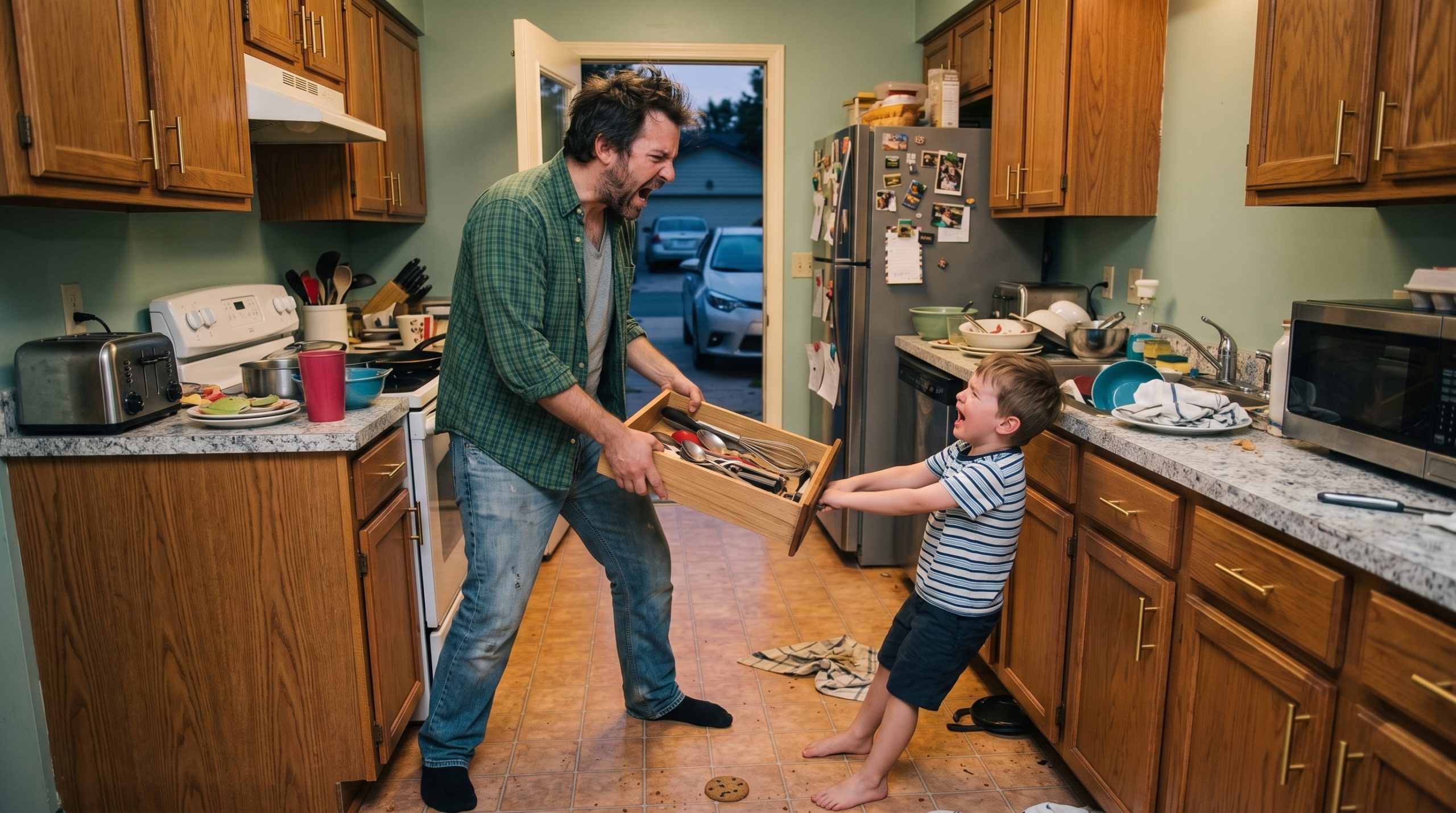
I wanted to tell Mom that I wasn’t trying to get anyone into trouble. I wanted to explain that I hadn’t taken the cookie because I was hungry enough to steal. I had eaten dinner that night. I had simply seen the cookie on the counter and wanted it.
One ordinary cookie.
I had been nine years old.
I didn’t know that a small mistake could become something a grown man needed to punish. I didn’t know that an adult could hurt a child and then spend the next twenty minutes explaining why the child deserved it.
I only knew that if Mom changed her mind, I would have to return to that kitchen.
And I would never again be able to hide what had happened.
At the front door, my stepfather moved in front of us.
He didn’t touch me.
He didn’t need to.
He rested one hand against the doorframe and looked down at my mother with an expression I had seen many times before. It was the look he used when he wanted someone to understand that the conversation was over because he had decided it was over.
“Put the keys down,” he said.
Mom looked at his hand on the frame.
Then she looked at his face.
“No.”
It was such a small word.
I had heard my mother disagree with him before, but usually her disagreements came wrapped in explanations. Maybe tomorrow. Let’s talk about it later. I don’t think that’s necessary.
This time, there was nothing around the word to soften it.
He stared at her as if she had spoken in a language he didn’t understand.
“You’re embarrassing yourself.”
Mom reached for the door handle.
He straightened.
“You walk out that door, don’t expect me to sit here waiting for you to come back.”
Mom paused.
For one terrible second, I thought he had won.
Then she looked at me.
Not at my hand. Not at my shoes.
At my face.
And she seemed to notice something that had been there all along: I was not looking at him anymore.
I was looking at her, waiting to discover whether love was something a person could choose when choosing it was dangerous.
She opened the door.
“Move,” she said.
He stepped aside.
The cold air struck my cheeks. I could smell damp pavement and wet leaves. The porch light made the driveway shine silver, and the dark windows of the neighboring houses looked like closed eyes.
Mom led me to the car.
She opened the passenger door and helped me climb in. Then she walked around the front, got behind the wheel, and put the keys into the ignition.
Her first attempt failed.
The engine clicked.
She tried again.
It started.
My stepfather appeared in the doorway before she could pull away.
He was no longer laughing.
“Think carefully about what you’re doing,” he called.
Mom gripped the steering wheel.
I watched him through the windshield. He looked less frightening from inside the car, but not because he had become smaller. It was because there was glass between us, and for the first time in my life, I was on the other side of something he could not immediately reach.
Mom reversed out of the driveway.
Neither of us spoke for several minutes.
The heater blew cold air against my knees. The streetlights passed across the windshield in yellow bars. My hand rested in my lap, wrapped in the sleeve of my jacket, and I tried not to move my fingers.
At the first red light, Mom reached across the center console and placed her hand over my uninjured one.
“I’m going to take you to the hospital,” she said.
I nodded.
“Then we’re going to talk to someone who can help us.”
I nodded again.
She swallowed.
“And I need you to tell the doctor exactly what happened. Even if you’re afraid.”
I looked at her.
“Are you angry with me?”
Her head turned so quickly that the car drifted slightly before she corrected it.
“What?”
“For taking the cookie.”
She stared at me for a moment.
Then she pulled into the empty parking lot of a closed pharmacy and stopped the car.
The silence inside the vehicle changed. It was no longer the silence of waiting for someone to become angry. It was something heavier.
Mom turned toward me.
“Oh, sweetheart.”
Her voice broke on the second word.
I had seen her cry before, but usually she hid it. She cried quietly in the bathroom or stood at the kitchen sink with her back to everyone. This time, she didn’t turn away.
“You did not deserve that,” she said.
I looked down at my hand.
“But I took it before dinner.”
“You took a cookie.”
“He said I needed discipline.”
Mom closed her eyes.
For a few seconds, she seemed unable to speak.
Then she leaned toward me, stopped as if she were afraid of frightening me, and asked, “Can I hug you?”
I nodded.
She held me carefully, keeping my injured hand between us.
I didn’t cry immediately. I had learned to keep my tears behind my eyes because crying sometimes made things worse. But my mother smelled like laundry detergent and the peppermint gum she always kept in her purse, and I could hear her breathing unevenly against my hair.
Something inside me loosened.
I began to cry so hard that my chest hurt.
Mom held on.
She didn’t tell me to calm down.
She didn’t tell me everything would be fine.
She just stayed there until I could breathe again.
At the hospital, a nurse brought me into a small examination room. The doctor asked what had happened, and I told him about the drawer.
I watched his face while I spoke.
I had become good at watching faces. I knew when an adult was annoyed, when a teacher thought I was exaggerating, when someone was deciding whether my story was worth believing.
The doctor didn’t interrupt.
He examined my fingers gently and ordered X-rays. My mother sat beside me with both hands folded in her lap, watching every movement.
When the doctor returned, he explained that I had fractures in two fingers. They needed to be immobilized, and I would need follow-up care.
I didn’t understand all the medical words.
I understood my mother’s face.
She looked as if she had been waiting for someone official to confirm that the pain I felt was real.
After the doctor left, a hospital social worker came into the room.
She introduced herself, pulled up a chair, and asked my mother whether we had somewhere safe to stay that night.
Mom opened her mouth.
Nothing came out.
The social worker waited.
I watched my mother’s hands. The same hands that had tied my shoes and taken the keys were now twisting the edge of her sleeve.
Finally, she said, “I don’t know.”
It was the first completely honest answer I had heard from her all evening.
The social worker nodded as if there was nothing shameful about not knowing.
She explained that she could help us contact the appropriate people and discuss a safe plan. She asked whether my stepfather had hurt me before.
Mom looked at me.
For the first time, I understood that the question wasn’t only about what had happened to my hand that night.
It was about everything that had happened before.
I remembered the times he had grabbed my arm hard enough to leave fingerprints. The nights he had stood outside my bedroom door, telling me that I was selfish and ungrateful. The mornings when I had worn long sleeves because I didn’t want my teacher to ask about a bruise.
I remembered how often I had told myself that none of it counted because he had not done something worse.
“I don’t know,” I whispered.
The social worker didn’t rush me.
“That’s okay,” she said. “You don’t have to figure everything out tonight.”
Mom covered her mouth.
I turned toward her, expecting her to tell me not to say anything else.
Instead, she said, “You can tell her.”
I looked at her.
She was crying again.
“You can tell her everything,” she repeated.
And that was when I realized my mother had not brought me to the hospital simply because my fingers were broken.
She had brought me because she was finally willing to hear what had been happening when she wasn’t in the room.
I told the social worker about the shouting, the threats, and the way my stepfather would make me apologize after hurting me. I told her that sometimes he stood in the doorway and asked me to repeat what I had done wrong until I said the answer he wanted.
I told her about the cookie.
I told her about kicking it under the refrigerator.
When I finished, the room was quiet.
The social worker wrote something down, then looked at my mother.
“Has anything like this happened to you?”
Mom’s face went still.
I watched her eyes move toward the closed door.
For a moment, I thought she would say no.
Instead, she whispered, “Yes.”
Just that.
One word.
And suddenly, the night became much bigger than my hand.
Because Mom wasn’t looking at the doctor anymore.
She was looking at the floor, as though she could see a long line of moments stretching backward through our house, each one ending with her deciding that tomorrow might be different.
The social worker asked whether she would feel safe returning home.
Mom shook her head.
Then she reached into her pocket, took out the car keys, and placed them on the bedside table.
“I don’t want to go back tonight,” she said.
I looked at those keys for a long time.
They were ordinary keys.
They opened the front door, the car, and the little lock on the shed behind our house.
But that night, they had opened something else.
And I was beginning to understand that once a door opened, you didn’t always get to choose what came through it.
Before we left the hospital, a staff member helped us arrange a safe place to stay. We didn’t go back to the house. Mom made a few calls, answered questions she clearly wished she didn’t have to answer, and signed papers with a hand that shook less each time she picked up the pen.
At nearly midnight, she helped me into the passenger seat again.
The city was quiet.
I rested my bandaged hand against my chest and watched the road unwind in front of us.
“Mom?”
“Yes?”
“Is he going to be there when we go home?”
She didn’t answer immediately.
Then she said, “We’re not going back there tonight.”
“That isn’t what I asked.”
Her fingers tightened around the steering wheel.
“No,” she said softly. “It isn’t.”
I waited.
She glanced at me at the next stoplight.
“I don’t know what happens next. But I know I’m not going to pretend this didn’t happen.”
I leaned against the window.
It was not the promise I had wanted.
At nine, I wanted a promise that would make the future simple. I wanted to know that my stepfather would never hurt me again, that my mother would never cry in the bathroom, that the kitchen would become just a kitchen.
Instead, I had a splint on my hand, a borrowed place to sleep, and a mother who was finally telling me the truth.
It would have to be enough for that night.
I closed my eyes.
For the first time in years, I fell asleep in a moving car without worrying about what I would find when I woke up.
I didn’t know then that the hardest part would not be leaving.
It would be discovering what had been waiting for us long before I ever kicked that cookie under the refrigerator.
# PART 3: What the Refrigerator Was Hiding
We stayed in a small guest room at my aunt’s house.
She lived forty minutes away, in a quiet neighborhood where the houses had white fences and the lawns were cut so neatly that they looked painted onto the ground. She had a spare bed with a blue quilt, a lamp shaped like a flower, and a box of old children’s books in the closet.
She didn’t ask me to explain anything.
When Mom told her that we needed somewhere safe to stay, my aunt opened the door wider and said, “Come inside.”
That was all.
I remember thinking that perhaps this was what kindness looked like when it didn’t need to announce itself.
My aunt made me hot chocolate, then found a clean pair of pajamas. She put an extra pillow under my injured hand and showed me where the bathroom was.
Mom stood in the doorway while I climbed into bed.
“Do you need anything?” she asked.
I shook my head.
She lingered.
I knew that look. It was the look of someone who wanted to say something important but didn’t know how to begin.
“Are you staying here too?” I asked.
“Yes.”
“All night?”
“Yes, sweetheart.”
I studied her face.
“Even if he calls?”
Mom sat on the edge of the bed.
“Even if he calls.”
I wanted to believe her, but I had learned that promises made in quiet rooms could disappear when my stepfather raised his voice.
So I asked the question I had been afraid to ask since the hospital.
“What if he says he’s sorry?”
Mom looked toward the window.
Outside, a branch scraped gently against the glass.
“I don’t know what he’ll say,” she answered. “But being sorry doesn’t mean you have to go back somewhere you’re not safe.”
I thought about that for a long time.
Then I asked, “Are you sorry?”
Her eyes filled with tears.
“Yes,” she whispered. “I am.”
She reached for my good hand, but she stopped before touching it.
“I am sorry I didn’t see it sooner. I’m sorry you had to find a way to show me. And I’m sorry that you thought you had to be clever enough to prove you were hurt.”
I looked at the bandage around my fingers.
“I didn’t know what else to do.”
“I know.”
She waited until I nodded before she held my hand.
Then she stayed beside me until I fell asleep.
For several days, the world seemed to move without us.
My aunt drove me to follow-up appointments. Mom spoke with people who asked careful questions and explained what would happen next. There were forms, phone calls, meetings, and conversations that stopped whenever I entered the room.
Sometimes Mom would look at me as if she had suddenly remembered something.
Sometimes I would find her sitting alone at the kitchen table, staring at a cup of coffee that had gone cold.
I began to understand that adults could be frightened in ways children couldn’t see.
I had always thought my stepfather was the frightening one because he shouted, slammed doors, and made everyone else adjust to his moods.
But my mother was frightened too.
She had simply learned to hide it differently.
One afternoon, while my aunt was at the grocery store, I found Mom sitting on the back steps. She had a folded piece of paper in her hand.
“What is that?” I asked.
She looked up quickly.
“Nothing important.”
I knew that answer.
It was the answer I used when someone asked about the marks on my arms.
I sat beside her.
The paper had been folded into quarters, and its edges were worn soft. There was something written on the outside in my mother’s handwriting.
I could make out three words.
If it happens again.
I stared at them.
Mom followed my eyes.
For a long time, she didn’t move.
Then she unfolded the paper.
Inside was a list of dates.
Some had short notes beside them. Others had only a few words.
March 12. He broke the kitchen chair.
April 3. He grabbed my wrist.
June 18. Told me I would lose everything if I left.
I read each line slowly.
The last entry was dated almost a year earlier.
If he ever touches the child, I will go.
My throat tightened.
I looked at my mother.
“You knew?”
She lowered her eyes.
“I knew he was getting worse.”
“You knew he might hurt me?”
“I was afraid he would.”
The words seemed to pull the air out of the space between us.
I stood up so quickly that my chair scraped against the concrete.
“Then why didn’t you take me away?”
Mom flinched.
I had never spoken to her like that.
I had never even imagined that I could.
“Why did you leave me there?” I demanded.
She didn’t tell me to watch my tone.
She didn’t remind me that she was the adult.
She sat very still, holding the paper in both hands.
“I thought I could keep it from getting worse,” she said.
“How?”
“I thought if I stayed calm, if I didn’t argue with him, if I made sure he wasn’t angry when you came home from school—”
“But he was still angry!”
“I know.”
“He still hurt me!”
“I know.”
“You knew he could do it, and you still let me live there!”
My voice cracked on the last word.
Mom pressed her lips together.
For a moment, I thought she would defend herself. I thought she would tell me about the bills, the house, the money she didn’t have, or how hard it was to leave someone when your whole life had become tangled up with theirs.
Those things might have been true.
But she didn’t use them to make me feel responsible for what had happened.
Instead, she said, “You’re right to be angry with me.”
That answer frightened me more than an argument would have.
I wanted her to fight back. I wanted her to tell me I was wrong so that I could hate her for a few minutes and then stop feeling the other things underneath.
But she didn’t.
“I was trying to survive him,” she continued. “And I told myself that if I could manage his anger, I could keep you safe. I was wrong. I should have found help sooner.”
I stared at her.
“Did you ever plan to leave?”
She unfolded the paper completely.
At the bottom, beneath the list of dates, was an address.
Under it was a phone number.
And beneath that, in smaller handwriting, were four words.
Ask about the blue folder.
“What does that mean?” I asked.
Mom’s expression changed.
It wasn’t quite fear.
It was recognition.
She folded the paper again.
“I need to tell you something,” she said.
I sat down.
For the first time since we had left the house, she looked as if she had decided to stop protecting me from a part of the truth.
“Before I married your stepfather, I tried to leave him once.”
I blinked.
“You weren’t married yet?”
“No.”
“Then why didn’t you?”
She looked toward the garden.
“Because I found out I was pregnant with you, and he convinced me that he would change. He said he was frightened, that he was under pressure, that he only acted the way he did because he was afraid of losing us.”
She paused.
“At first, he could be very kind. He could make you feel like you were the most important person in the world. And when he hurt me, he would tell me it would never happen again.”
I thought about how my stepfather behaved in front of other people.
He remembered birthdays. He carried groceries for elderly neighbors. He told jokes at family dinners and spoke proudly about how much he cared about discipline.
People called him dependable.
They called him a good man.
Sometimes I wondered whether they had met the same person I knew.
Mom looked down at the paper.
“I started keeping records because I was afraid that if I ever needed help, no one would believe me.”
“Why didn’t you tell Auntie?”
“I thought she would ask me to leave immediately, and I wasn’t sure I could do it. I was afraid of what he would do if I tried.”
“Did he know about the list?”
“No.”
I thought about the blue folder.
“Where is it?”
Mom hesitated.
“At home.”
The house seemed to appear around us again: the narrow hallway, the kitchen table, the refrigerator humming in the corner.
And beneath it, perhaps, a small blue folder holding everything my mother had been too frightened to say aloud.
“What’s inside?” I asked.
“Copies of messages. Some photographs. Notes about things that happened.”
“Why didn’t you take it when we left?”
She looked at my bandaged fingers.
“Because I forgot everything except getting you out.”
For some reason, that answer made me cry.
Not because it solved anything.
Because I believed her.
She had not left with a suitcase full of clothes or a careful plan. She had left with a frightened child, an injured hand, and the keys to a car.
She had forgotten the evidence because, for once, she had put the person in front of her before the things she might need to prove what had happened.
I leaned against her shoulder.
“I don’t want to go back there.”
“We won’t go back without help,” she said.
“But the folder—”
“We’ll deal with that safely. You don’t have to worry about it.”
I wanted to ask what would happen if the folder disappeared. I wanted to know whether anyone would believe us without it.
But I was tired.
So I rested my head against her arm and listened to the wind move through the trees.
For a little while, we sat without speaking.
Then Mom said something I would remember long after I forgot the color of the quilt, the smell of the hot chocolate, and the exact shape of the garden.
“When you kicked that cookie under the refrigerator, I thought you were trying to get me to see what happened.”
“I was.”
“I know that now.”
She took a breath.
“But I need you to understand something. You should never have had to leave me clues. You should never have had to plan how to make me believe you.”
I looked at her.
She was crying, but she did not turn away.
“You were nine,” she whispered. “You were supposed to be able to tell me that someone hurt you, and I was supposed to protect you.”
I didn’t know what to say.
So I asked the question that had been sitting inside me since that night.
“Why did you believe me this time?”
Mom looked at the folded paper in her lap.
“Because I saw your hand.”
She swallowed.
“And because I saw the cookie.”
She stared at the garden for a long time.
“I had spent so long explaining things away. Every time he frightened me, I found a reason. Every time he hurt me, I told myself it wasn’t as bad as it looked. When you were quiet, I thought you were adjusting. When you stopped asking for things, I thought you were becoming easier to manage.”
Her voice became almost inaudible.
“I didn’t understand that you were learning how to disappear.”
I felt something painful move through my chest.
I had thought my mother would save me by becoming stronger than my stepfather.
Instead, she was beginning to save me by admitting where she had failed.
That was harder to understand.
It was also the first thing that made me believe our lives might actually change.
## The blue folder
We did not return to the house that week.
The people helping us explained that there were ways to address the situation without sending my mother and me back alone. They helped her understand the options available to us and how to seek assistance safely.
I wasn’t included in every conversation, and I was grateful for that.
For the first time, I was allowed to spend an afternoon doing something that had nothing to do with my stepfather.
My aunt found an old board game in the hall closet. We played until the pieces covered the coffee table, and I laughed so suddenly that I startled myself.
Mom looked up from her paperwork.
For a second, she smiled.
Then her eyes filled with tears.
I didn’t ask why.
I was beginning to understand that happiness and grief could arrive together.
Several days later, my mother was able to arrange for the necessary belongings and documents to be collected with appropriate assistance. She returned with a small bag of clothes, my schoolbooks, and a blue folder.
She placed the folder on the dining table.
Neither of us opened it immediately.
It was an ordinary office folder, the kind teachers used to store worksheets. One corner had been bent, and there was a faint coffee stain near the metal fastener.
I had imagined something more dramatic.
I had imagined photographs covered in dates, letters written in anger, perhaps a secret that would explain everything about my stepfather.
Instead, there was paper.
Pages and pages of paper.
Mom sat beside me and opened it.
There were printed messages in which my stepfather apologized for frightening her. There were notes she had written after arguments, each one dated. There were photographs of damaged objects and a few pictures of bruises on her arms.
There was also a folded sheet of paper I had never seen before.
Mom picked it up carefully.
“I wrote this after the first time he hurt you,” she said.
My stomach tightened.
“What does it say?”
She unfolded it.
Her handwriting was smaller than usual, as if she had been trying to fit the words into a space that was already too small.
He said the child was testing him.
He said he needed to be firm now, before things became harder.
I told him he had gone too far.
He cried afterward and said he was ashamed.
At the bottom of the page was a sentence written in a different pen.
I want to believe him because I don’t know how to begin again.
I read it twice.
“Why did you keep this?” I asked.
“Because I knew I was making excuses.”
She pressed the page flat against the table.
“I think part of me was waiting for a day when I would be brave enough to read everything without explaining it away.”
I looked at the papers.
“Does this mean people will believe us?”
Mom didn’t answer too quickly.
“These records may help explain what happened,” she said. “But the people helping us will look at the whole situation. We don’t have to solve everything by ourselves.”
She closed the folder.
Then she looked at me.
“I also need you to know that none of this is your responsibility. You don’t have to remember every detail. You don’t have to prove anything for me. You don’t have to be the reason I leave.”
I stared at the blue cover.
For weeks, I had believed the cookie was the most important thing I had done.
I had thought that if I had not taken it, if I had obeyed every rule, if I had stayed quiet enough, then maybe nothing would have happened.
Now I was beginning to see how little the cookie had mattered.
The drawer had been there before I took it.
My stepfather’s anger had been there before the drawer.
My mother’s fear had been there before the kitchen, the hospital, and the car.
The cookie had not created any of it.
It had simply been the small, ordinary thing that happened on the night someone finally stopped pretending.
That evening, Mom asked whether I wanted to talk to a counselor who worked with children who had been frightened or hurt at home.
I asked if I would have to tell the whole story again.
She said I could ask questions before deciding, and that I wouldn’t be expected to explain everything all at once.
I agreed to meet with someone.
Not because I wanted to talk about the drawer.
Because I wanted to stop thinking about it every time I heard a kitchen cabinet close.
## The call
My stepfather called three days later.
My aunt answered the phone first. She listened without speaking, then told him that any necessary communication would need to go through the appropriate arrangements.
After she hung up, she looked at my mother.
“He says he wants to apologize.”
Mom was standing at the sink.
She turned off the water.
For several seconds, she stared at the tap.
Then she asked, “Did he say what he was apologizing for?”
My aunt shook her head.
“He said he misses you both. He said things got out of hand.”
Mom dried her hands on a towel.
I watched her face.
I knew that phrase.
Things got out of hand.
It made the drawer sound like a door that had closed by itself. It made the bruises sound like weather. It made a grown man disappear from the story of what a grown man had done.
“What did he say about the fingers?” Mom asked.
My aunt hesitated.
“He said he never intended to break them.”
Mom closed her eyes.
I felt the old fear rise in me, familiar and quick.
What if he came back?
What if everyone decided that he had apologized enough?
What if the hospital, the folder, and the long drive through the night became just another family story that people stopped mentioning because it was uncomfortable?
Mom opened her eyes.
“Did he say he understood why we left?”
“No.”
“Did he ask what our son needs to feel safe?”
My aunt shook her head again.
Mom nodded once.
“Then he hasn’t apologized.”
She walked away from the sink.
There was no shouting. No dramatic declaration. She didn’t throw the towel or slam a cupboard.
She simply returned to the dining table and continued filling out the paperwork in front of her.
I watched her for a long time.
I had always thought strength would look like anger.
That night, I began to understand that sometimes it looked like refusing to accept a story that made the person who hurt you seem innocent.
Over the following weeks, there were more calls, more meetings, and more decisions.
My stepfather told people that Mom had overreacted. He said I had misunderstood him. He said the injury was an accident and that our family was being torn apart because my mother had become emotional.
Some people believed him.
One relative called Mom and said that every household had problems, that children could be difficult, and that a family should not be destroyed over one bad evening.
Mom listened.
When the relative finished, she said, “It wasn’t one evening.”
Then she ended the call.
I sat beside her, waiting for her to cry.
She did, later.
But she did not call the relative back.
Our lives did not suddenly become easy. Mom worried about money. She worried about school. She worried about whether she could keep everything stable while we found a way forward.
Some mornings she looked so tired that I wanted to tell her I was sorry for being another problem she had to solve.
But whenever I began to apologize for something that wasn’t my fault, she stopped me gently.
“You don’t have to make yourself smaller to make this easier,” she would say.
I didn’t believe her every time.
Healing, I discovered, was not a door you walked through once.
It was a series of ordinary moments in which you slowly learned that you were allowed to exist without anticipating punishment.
It was learning to ask for another helping of dinner.
It was leaving a cookie on a plate without hiding it.
It was hearing a drawer close in the kitchen and realizing, a few seconds later, that you were still breathing normally.
It was discovering that silence could mean peace instead of danger.
And it was learning that the people who loved you could make mistakes without those mistakes becoming your responsibility to repair.
## The last thing I found
Months later, when the worst of the immediate uncertainty had passed, I asked Mom whether we could visit the old house to collect the last of my things.
The arrangements were made with help, and I did not go alone.
I remember the hallway most clearly.
The same narrow strip of carpet. The same framed photograph beside the stairs. The same small crack in the wall where my stepfather had once slammed a cupboard door hard enough to shake a picture crooked.
The house looked almost exactly as it had before.
That surprised me.
I had expected the place where everything changed to look different afterward. I thought it would somehow reveal the terrible thing that had happened there.
But the kitchen was clean.
The counters were empty.
The refrigerator hummed in its familiar low voice.
I stood in the doorway, looking at the space between the table and the counter.
Mom stayed a few steps behind me.
“You don’t have to go in,” she said.
I shook my head.
I wanted to see it.
I wanted to know whether the kitchen still had power over me when I stood in it without my stepfather.
I walked to the refrigerator.
For a long time, I looked at the narrow gap beneath it.
There was nothing there now.
No cookie.
No smear.
No clue I had left for someone else to discover.
I crouched and looked underneath anyway.
Dust gathered near the wall. A small plastic bottle cap had rolled beneath the refrigerator, and one of the leveling feet cast a thin shadow against the floor.
That was all.
I sat back on my heels.
Mom knelt beside me.
“Are you okay?”
I considered the question.
My fingers had healed, although two of them still felt stiff when the weather turned cold. Sometimes I woke from dreams in which I was back at the kitchen table, unable to move my hand.
I wasn’t completely okay.
But I was no longer trapped in the place where the frightening thing had happened.
“I think so,” I said.
Mom nodded.
Then she looked at the refrigerator.
“I’ve thought about that cookie every day,” she admitted.
“Why?”
“Because I keep wondering what would have happened if I hadn’t found it.”
I thought about the question.
Maybe she would have believed him that night. Maybe she would have noticed my hand the next morning. Maybe something else would have happened later, and we would have left then.
I couldn’t know.
Neither could she.
“I wanted you to find it,” I said.
“I know.”
“I didn’t know how else to tell you.”
Mom’s eyes filled.
She put one hand over her mouth, then lowered it.
“I wish you hadn’t needed to.”
We stayed there for a little while, kneeling on the kitchen floor.
I had spent months imagining the moment when I would finally feel no fear in that room.
Instead, I felt several things at once.
I was frightened.
I was sad.
I was angry about the years we had spent pretending.
And I was relieved that I could feel all of those things without anyone telling me what they meant.
Before we left, I walked over to the kitchen table.
I placed my good hand on its surface.
The wood was smooth beneath my palm. There was a small scratch near one corner where I had once dragged a metal toy across it.
I remembered sitting there with my injured hand hidden between my knees.
I remembered the refrigerator humming.
I remembered the floorboards pressing cold against my feet.
And I remembered the moment my mother had asked me to show her my hand.
For a long time, I had believed that was the moment everything changed.
But standing in that kitchen, I understood that the change had been more complicated.
My mother had not become fearless that night.
She had not suddenly known how to solve every problem.
She had simply reached a point where pretending was more frightening than the truth.
And I had not saved myself by being clever enough to hide a cookie.
I had been a child trying to tell someone that I was hurt.
The responsibility for what happened had never belonged to me.
I looked at Mom.
“Can we go now?”
She stood up.
“Yes, sweetheart.”
She held out her hand.
I took it.
And together, we walked out of the kitchen.
## The ending: A cookie on the table
A year later, I was sitting at my aunt’s kitchen table when Mom came home from work carrying a small paper bag.
She placed it in front of me.
“What is it?” I asked.
“Something I picked up on the way home.”
Inside were four chocolate-chip cookies from the bakery near her office.
I stared at them.
For a moment, I was nine years old again.
I could smell the kitchen in our old house. I could hear the refrigerator. I could feel the tightness in my fingers and the terrible, careful silence that had filled the room.
Mom noticed my expression.
“You don’t have to eat one,” she said.
I looked up.
She wasn’t smiling too brightly or trying to make the moment into something it wasn’t.
She was simply giving me a choice.
I took a cookie from the bag.
It was still a little warm.
I broke off a piece and tasted it.
Then I took another bite.
Nothing happened.
No footsteps approached from the hallway. No voice demanded an explanation. No one told me that I had done something wrong.
Mom sat across from me with a cup of tea.
After a while, she asked, “How is it?”
I thought about it.
“Good.”
She smiled.
“I’m glad.”
I finished the cookie slowly, brushing the crumbs from my fingertips.
Then I noticed that I had dropped a small piece onto the floor.
My whole body went still.
Mom saw me looking down.
For a second, neither of us moved.
Then she got up, picked up the crumb, and dropped it into the bin.
“Problem solved,” she said.
Her voice was ordinary.
That was what made it important.
I laughed.
Not because the memory had disappeared, and not because everything that happened afterward had become easy.
I laughed because a crumb on the floor was just a crumb on the floor.
Mom sat back down.
I reached into the bag and took another cookie.
This time, I didn’t look at the refrigerator.
I didn’t hide the cookie beneath anything.
I didn’t plan what I would say if someone found it.
I simply ate.
And for the first time, I understood that the opposite of fear was not bravery.
It was the quiet freedom to do something ordinary without wondering what it might cost you.
My mother never told me that she had saved me that night.
She said we had found a way out together, though I knew I had been the child and she had been the one who should have protected me.
Years later, I would understand why she chose those words.
She didn’t want me to spend the rest of my life believing that my safety depended on finding the perfect clue, telling the story in the perfect way, or being hurt badly enough that someone could no longer look away.
She wanted me to know that I deserved to be believed before the evidence was found.
Before the bruise appeared.
Before the doctor confirmed the injury.
Before anyone else decided that what had happened was serious enough to matter.
I had been nine.
I had taken a cookie.
And none of that made what happened to me my fault.
Sometimes I still remember that kitchen exactly as it was: the yellow light above the table, the cold floor against my feet, the dark gap beneath the refrigerator.
But the memory no longer ends with me sitting alone, waiting for the next sound from the hallway.
It ends with my mother holding out her hand.
It ends with the keys closed inside her fist.
It ends with a door opening.
And beyond that door, there is no perfect life waiting for us. There are difficult conversations, uncertain mornings, old fears, and days when the past returns without warning.
But there is also a table where I can sit without hiding my hands.
There is a kitchen where I can eat when I’m hungry.
There is a mother who learned, painfully and imperfectly, that protecting a child sometimes means refusing to protect the story an adult has told about himself.
And there is a cookie on a plate.
No clues.
No secrets.
No need to prove anything.
Just a cookie.
Just a child who is safe enough to eat it.
And a home where nobody has to disappear to keep the peace.