Part One:
The Day I Stopped Calling It Home
My first memory after
falling down the staircase
was hearing my mother-in-law
speaking on the phone.
Her sharp, impatient voice echoed
through the entrance hall,
sounding exactly as it did
whenever a housekeeper misplaced
something or a dinner reservation disappointed her.
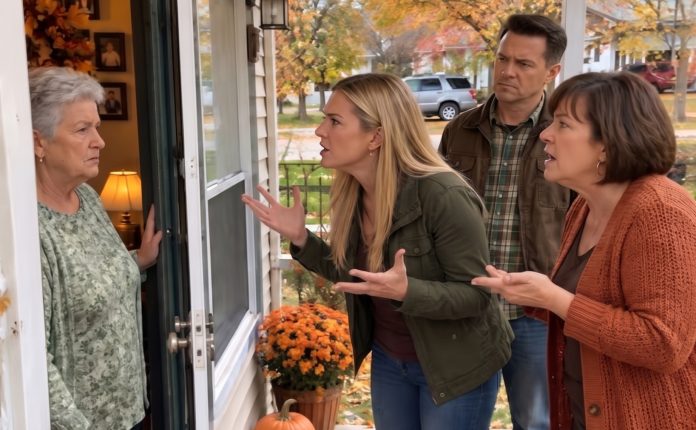
“Come get your daughter,
Arthur. We’ve done everything
we can for her, and frankly,
she’s become more trouble than she’s worth.”
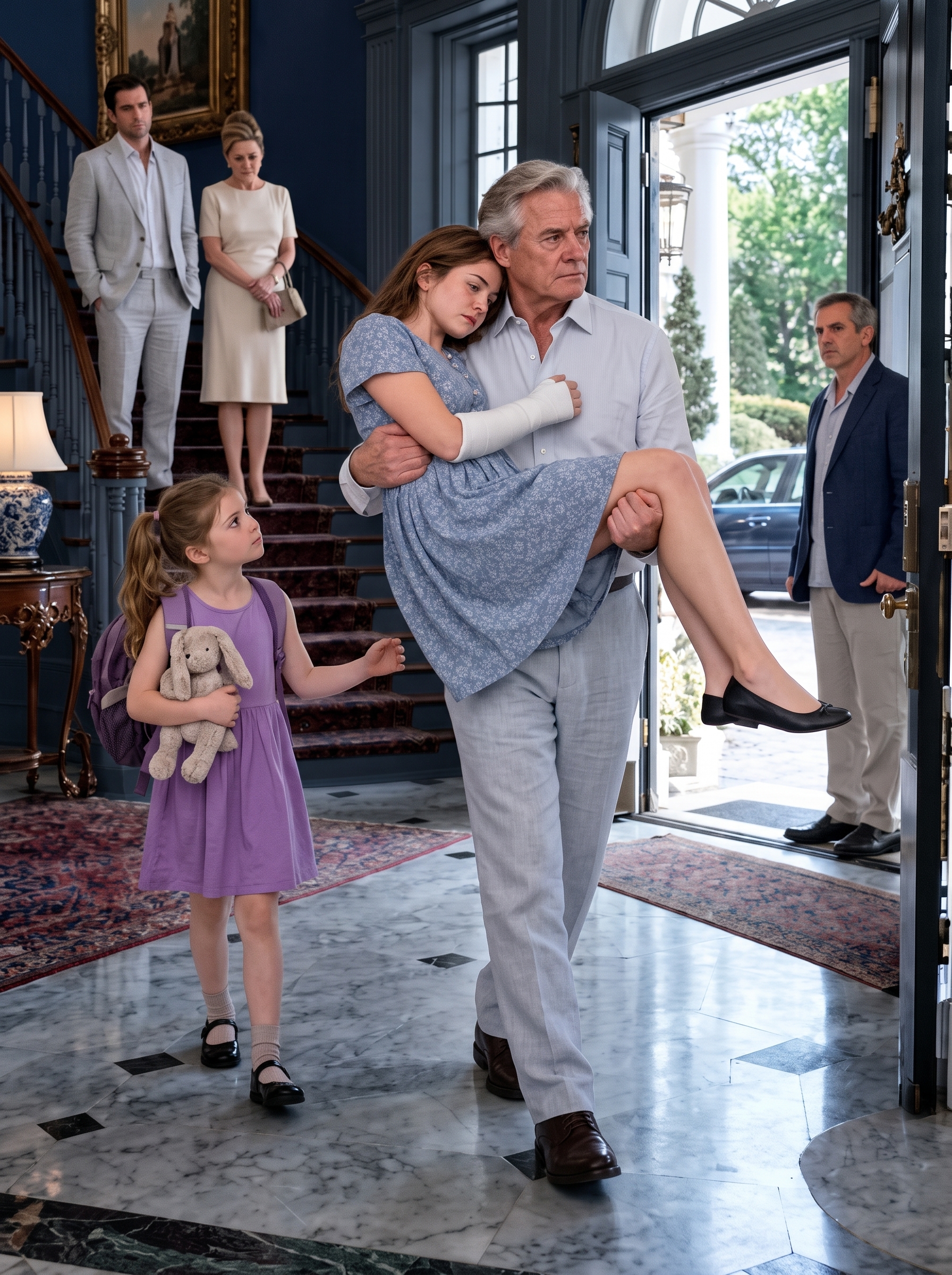
I lay on the cold marble floor,
struggling to breathe comfortably,
while my husband, Preston Whitcomb,
stood several feet away, making no attempt to correct his mother’s version of events.
Dad apparently said something she found amusing, because she laughed briefly before replying, “You really don’t understand who you’re dealing with.”
She moved the phone from her ear, allowing me to hear my father’s voice and recognize the quiet resolve beneath it.
“If my daughter has been harmed, Eleanor, I expect every person involved to answer for what happened.”
She hung up without a goodbye.
Until that morning, I’d spent nearly nine years persuading myself the Whitcombs were merely difficult people, accustomed to privilege and intolerant of challenges to their decisions. But watching Preston adjust his cuffs while I waited for an ambulance, I finally recognized that their refined manners concealed something more disturbing than ordinary family arrogance.
At the hospital in Richmond, Virginia, doctors diagnosed two fractured ribs, a severely strained shoulder, and injuries requiring weeks of recovery. Yet my physical pain was hardly my greatest concern.
My seven-year-old daughter Lily had been upstairs when the argument started. I didn’t know whether anyone had explained the incident to her or whether Preston’s parents intended to keep her from me.
I worked part-time as a speech therapist at a local elementary school, earned enough to help support our household, and arranged my hours around Lily. Still, I knew how easily the Whitcombs could portray my ordinary life as inadequate compared with their mansion, expensive lawyers, and powerful connections.
That afternoon, a distinguished attorney entered my hospital room carrying a worn leather portfolio. I assumed Preston had sent him.
Instead, he introduced himself as Jonathan Hale, explaining that Dad had hired him.
“Your daughter is with your father, Mrs. Whitcomb,” he assured me before I could ask. “She’s safe, and we have already taken steps to make sure she stays that way.”
Relief immediately brought tears to my eyes.
Then he placed a legal document beside my blanket. Preston’s family had petitioned for emergency custody, portraying me as emotionally unstable, financially irresponsible, and temporarily unable to care for Lily.
I could barely believe it.
“They know I take care of her,” I whispered. “They know I’m the one who takes her to school, helps with homework, and stays home when she’s sick.”
Jonathan nodded, his expression unusually grave.
“Your father knows that too, and he’s spent his professional life making sure people cannot replace evidence with a convenient story.”
I stared at him, puzzled. Dad lived in a modest brick house outside Charlottesville, drove an old sedan, and always described his former government job as administrative legal work.
Jonathan hesitated before revealing that Arthur Dawson had spent decades overseeing complex federal investigations into financial misconduct, public corruption, and influential organizations whose leaders believed their reputations protected them from scrutiny.
I struggled to connect this revelation with the man who clipped grocery coupons, repaired his porch railing, and attended every one of Lily’s school concerts.
But when Dad arrived minutes later, his familiar brown cardigan draped over his arm, I noticed an authority in his manner I’d never recognized.
He looked first at me rather than Jonathan or the documents, and whatever professional presence he possessed gave way to tenderness.
“There you are, sweetheart,” he murmured, taking my hand.
I burst into tears before answering.
For years, Dad had gently questioned whether my marriage made me happy. I’d taken his concern as an inability to appreciate the comfortable life Preston provided, especially when the Whitcombs constantly reminded me how fortunate I was to join their family.
Now, beside my hospital bed, Dad neither revisited those conversations nor questioned why I’d ignored his concerns.
Instead, he reassured me.
“We’re going to deal with what happened, one fact at a time, and you won’t have to do it alone.”
Then Jonathan opened another folder.
And I learned the custody petition was merely one piece of a much larger problem.
## Part Two: The Signature That Wasn’t Mine
The Whitcombs owned a regional commercial property business developing shopping centers, medical offices, and residential neighborhoods across Virginia and the Carolinas. Although Preston occasionally discussed construction schedules over dinner, he always insisted the financial details were too complicated for me.
I’d believed him partly because my work centered on children rather than business agreements, and partly because I’d grown used to accepting his reassurances whenever my questions made him uncomfortable.
Jonathan explained that financial investigators had recently begun examining transactions involving the family business, particularly payments to consulting companies with questionable histories and loans backed by unusually complicated guarantees.
Then he showed me a document bearing my name.
According to the agreement, I’d personally guaranteed a substantial business obligation for one of the Whitcombs’ subsidiaries.
The signature at the bottom closely resembled mine, enough to deceive anyone unfamiliar with my handwriting.
I examined it for several seconds before noticing the incorrect final curve and a capital D formed differently from how I wrote it.
“I didn’t sign this,” I told him.
“That’s what your father suspected,” Jonathan replied. “And there may be records that help us establish exactly what happened.”
I remembered Preston bringing paperwork home after dinner and spreading it across our kitchen table while I prepared Lily’s school lunch.
He’d assured me the documents concerned insurance renewals or routine household matters.
Whenever I asked to read something thoroughly, he sighed and reminded me that his family’s accountants had already checked everything.
Sometimes I signed simply because I was tired of feeling foolish for asking questions.
Dad listened quietly.
When I admitted how ashamed I felt, he squeezed my hand.
“Marriage is supposed to make trust possible, not turn it into something another person can exploit.”
Jonathan then presented credit reports showing unfamiliar inquiries and a summary of the allegations Preston’s attorneys planned to use against me.
They’d characterized a late utility payment from the previous winter as financial irresponsibility. Preston’s control over most household investments was being portrayed as evidence that I lacked independence.
Their constructed image barely resembled the person I knew myself to be, but every selected detail supported one conclusion.
I was supposedly incapable of making decisions without my husband.
Dad had contacted Jonathan because of his expertise in complex family disputes involving concealed assets and questionable financial documents. Yet what troubled me most was discovering Dad had quietly investigated for months.
“Why didn’t you tell me?” I asked.
He looked genuinely uneasy.
“Because I didn’t want suspicion to become an accusation before I had something solid, and because I knew how much you wanted your marriage to work.”
His concerns had started the previous spring, when Preston asked me to sign a broad authorization granting him control over certain financial matters.
I’d called Dad before signing, and he’d advised me to request a more detailed explanation.
Preston remained irritated for days afterward.
Now I wondered whether refusing had prevented something far worse.
Before Jonathan could answer another question, his phone rang.
He listened carefully and stepped into the hallway.
When he returned, he explained that someone claiming to represent the Whitcomb company’s insurer had contacted the hospital seeking information about my admission and visitors.
The hospital refused to disclose anything.
Dad looked thoughtful.
“They aren’t simply trying to control the story,” he said. “They’re trying to find out what we know.”
For the first time, I wondered whether my fall had presented Preston’s family with an opportunity they’d been anticipating.
## Part Three: The Blue Book
That evening, a nurse arranged a brief visit with Lily. She arrived wearing her favorite lavender sweater and holding a folded drawing.
She cautiously approached my bed, clearly following instructions to be gentle. Seeing the worry on her little face nearly shattered the composure I’d regained.
“Grandpa says you’re getting better,” she told me.
“I am, honey. I just need some time.”
She climbed onto the nearby chair and unfolded her drawing: a little house surrounded by flowers, featuring bright blue windows and a yellow front door.
“That’s where we’re going to live,” she announced.
I smiled, though I had no idea where we’d be living a month later.
“Why did you make the windows blue?”
She considered it carefully.
“Because blue is a peaceful color, and I want our house to be peaceful.”
I pressed the drawing against my blanket, momentarily speechless.
Lily noticed a photograph of our staircase among Jonathan’s documents and asked why police had photographed our home.
I carefully explained that they were trying to understand the incident, without suggesting an answer or making her feel responsible.
She glanced at Dad before mentioning that Preston had been angry that morning and her grandmother had instructed her to stay upstairs.
Then another memory surfaced.
“Grandma told Daddy to get the papers from the blue room.”
The blue room was Eleanor Whitcomb’s private sitting room beside her husband’s office at the family estate. Locked cabinets held business documents and personal correspondence.
I remembered entering that room the previous Christmas while searching for drawing paper for Lily.
A large blue record book with a brass-colored clasp had been lying on the desk.
At the time, I’d barely noticed it.
Now that detail seemed important.
After Lily left with Dad’s longtime neighbor, who’d offered to help care for her, Jonathan asked whether I remembered anything more.
I recalled visiting the Whitcomb estate several months earlier when Lily dropped her stuffed rabbit near the office entrance.
As I bent to pick it up, I saw Preston’s father talking with an auburn-haired woman whose hair was tied in a loose knot.
Both stopped speaking when I appeared.
I remembered her glancing at a blue folder on the desk while Preston’s father hurriedly shut a drawer.
The memory remained incomplete, but it prompted another recollection: the night before my fall, Preston had asked whether I still had the appointment notebooks I’d used before Lily began school.
Those notebooks were kept in a wicker basket beneath our staircase.
When I mentioned them, Jonathan immediately arranged for police to preserve the basket during their authorized examination of the property.
Soon afterward, an investigator sent him a photograph of an envelope found beneath the small table beside the stairs.
My name was written across the front in Eleanor’s handwriting.
Below it, smaller letters formed a message:
For the day you begin questioning what you remember.
I studied the photograph until my eyes ached.
The smaller handwriting was unmistakably mine.
I recognized my connected letters, uneven spacing, and distinctive final curve.
Yet I couldn’t remember writing it.
Dad sat beside me as I struggled to understand how such a personal memory could have vanished.
“You don’t have to recover every answer tonight,” he said gently.
But I was beginning to believe I’d hidden a warning for myself somewhere among the belongings of my former life.
## Part Four: The Woman Who Came Forward
The following morning, an investigator accompanied a woman named Rebecca Sloan to my hospital room.
She had auburn hair, a faint mark near one eyebrow, and the exhausted expression of someone who’d spent many sleepless nights deciding whether to speak.
I immediately recognized her from the Whitcomb office.
Rebecca explained that she’d been a senior financial records specialist at the family business until resigning several weeks earlier over discrepancies she could no longer explain.
Initially, she’d assumed the unusual transactions were bookkeeping errors. But further examination revealed that several property companies were receiving payments through businesses seemingly existing only on paper.
More concerning, certain guarantees were assigned to people who had never knowingly accepted those financial responsibilities.
I was among them.
“You asked questions about the paperwork last October,” Rebecca told me. “You were much more observant than they expected.”
She showed me an earlier version of the disputed agreement.
Beside one paragraph, my initials appeared alongside a handwritten request for clarification.
I remembered writing it at our kitchen table.
Preston had claimed the paperwork involved temporary insurance. When I questioned the paragraph, he’d promised to consult the accountant.
Rebecca explained that the page containing my question had later been replaced with a clean signature page.
She’d kept a copy because the alteration concerned her.
“I should have spoken up sooner,” she admitted.
Dad responded before I could.
“You’re speaking now, and that matters.”
Rebecca continued explaining that I’d visited the office the previous October after learning my name appeared on financial correspondence I’d never received.
She’d shown me sections of a blue record book listing transaction dates, names, and handwritten instructions.
Although frightened, I’d insisted on copying the records.
Rebecca remembered helping me place those copies in a blue folder, together with a note I’d written because I feared Preston might convince me I’d misunderstood what I’d discovered.
As she spoke, fragments returned.
Rain against my windshield.
A blue folder on the passenger seat.
Preston standing beside my car, speaking in that patient voice he adopted whenever he wanted me to question my judgment.
He’d claimed his father was experiencing temporary financial difficulties and involving outsiders would humiliate the family.
I remembered desperately wanting to believe him.
That realization hurt most.
Rebecca explained that I’d hidden the copied records before Preston could retrieve them, though she never knew exactly where I’d placed everything.
She only remembered me mentioning Lily’s old kindergarten backpack and an appointment notebook containing a reminder.
Jonathan arranged for police to inspect those items with appropriate authorization.
That evening, I watched through a secure video connection from my hospital room as an officer opened the storage basket beneath our staircase.
Inside were old gift-wrapping supplies, notebooks, a worn stuffed rabbit, and Lily’s faded purple backpack.
The officer carefully unzipped its inner pocket.
Tucked between an old drawing and a school photograph was the blue folder.
I covered my mouth as he lifted it out.
It contained copies of financial documents, correspondence bearing my name, and a handwritten page I immediately recognized.
If I begin doubting myself, remember that asking questions was not wrongdoing. I saw what I saw, and I have a right to understand it.
I’d written those words in my car after meeting Rebecca.
The memory returned with surprising clarity—not because everything suddenly made sense, but because I remembered my determination to protect the truth before fear convinced me to abandon it.
Investigators also found a small brass key inside an envelope in the folder.
Further authorized inquiries linked it to a secured box in a commercial storage unit leased through a Whitcomb company.
A preservation order prevented anyone from removing its contents, and investigators eventually recovered the original blue record book.
The evidence still required detailed examination, but it already established something significant.
My concerns hadn’t been imaginary.
And the family accusing me of dishonesty had concealed information themselves.
## Part Five: What the Court Finally Heard
The emergency custody hearing occurred the following afternoon. My doctors allowed me to participate remotely while recovering in the hospital.
Preston’s parents arrived impeccably dressed, accompanied by attorneys who described the petition as a responsible effort to protect Lily during a difficult family situation.
Their argument relied largely on my injuries, supposedly unstable finances, and school records suggesting I’d neglected certain parental duties.
Jonathan avoided emotional speeches.
Instead, he presented the evidence systematically, beginning with medical records, my original account of the incident, and statements from witnesses familiar with the family’s subsequent behavior.
He submitted employment documents, school attendance records, and letters from Lily’s teachers confirming my consistent involvement in her education.
The school district also identified discrepancies in records Preston’s family had submitted.
Rebecca supplied a sworn statement concerning the altered financial documents, while newly preserved business records raised serious concerns about whether my name had been used without authorization.
The judge emphasized that financial disputes required separate investigation and that the custody hearing couldn’t resolve every questionable business transaction.
Nevertheless, the contradictions in the Whitcombs’ accusations were impossible to overlook.
When Preston’s attorney argued that hospitalization made me an unsuitable parent, Jonathan explained that temporary medical restrictions didn’t erase years of responsible parenting, particularly when safe family support had already been arranged.
The judge rejected the emergency petition.
Lily would remain in my care, temporarily staying at Dad’s house during my recovery. Preston’s contact would be governed by protective arrangements and further review.
I listened with tears quietly streaming down my cheeks.
There was no spectacular confrontation, unexpected public confession, or courtroom moment when everyone suddenly admired Dad’s former professional standing.
He’d requested no special treatment.
He’d simply helped secure experienced legal representation, preserve evidence, and ensure my account was heard.
When he later returned to my hospital room, he carried another drawing from Lily.
It showed three people outside a little house beneath a clear blue sky.
Across the bottom, in her uneven handwriting, she’d written:
Home is where we can tell the truth.
Dad set it beside my bed.
“She wanted to make sure you saw it before bedtime,” he said.
I smiled through tears.
“She has a way of saying things better than either of us.”
He chuckled softly, and for several minutes we sat without discussing attorneys, records, or the uncertain months ahead.
Talking about nothing more serious than a child’s drawing felt wonderful.
## Part Six: A Home With Clear Windows
My recovery took longer than anticipated, while legal proceedings continued well beyond the dismissal of the custody petition.
The financial investigation eventually resulted in formal proceedings against several individuals connected to the Whitcomb businesses. Preston acknowledged knowing about disputed documents and failing to correct them.
Our divorce became final the following spring.
I didn’t receive an extraordinary settlement or suddenly become wealthy because Dad had once held a senior government position.
I kept my savings, gradually resumed work, and began restoring the everyday routines I’d once taken for granted.
Dad converted his study into a bedroom for me. Lily adapted enthusiastically to life there, mostly because he let her help prepare Saturday pancakes and never complained about colored pencils scattered across the dining table.
Rebecca continued cooperating with investigators and eventually joined a smaller accounting firm.
We maintained contact, not because friendship erased what had happened, but because we both understood how difficult honesty could be when powerful people demanded silence.
I also started counseling, learning why I’d spent years excusing Preston’s behavior and why ordinary sounds, particularly footsteps near stairs, could still unsettle me.
Healing didn’t mean choosing to forget.
It meant understanding that the past no longer had to govern every decision.
Lily had questions too. I answered carefully, ensuring she understood adults were responsible for their own choices and that nothing she’d said or done had caused our family to change.
Several months after the divorce, we found a modest apartment overlooking a courtyard lined with trees.
It had a bright kitchen, a balcony spacious enough for flowerpots, and wide windows offering views of the changing seasons.
When Lily asked to grow marigolds, I bought two packets of seeds and let her select the containers.
Dad helped carry furniture upstairs and spent an afternoon hanging pictures, including the drawing Lily had made while I was hospitalized.
I framed my handwritten note and displayed it beside her artwork.
For a long time, I’d considered hiding the note because it reminded me of everything I’d nearly lost. Eventually, I understood it represented something more.
Even when frightened and uncertain, part of me had recognized that I deserved truthful answers.
I’d tried to preserve that knowledge for my future self.
On the anniversary of my departure from the Whitcomb house, Dad came for dinner carrying a small cake from our favorite bakery.
Gentle rain fell outside while Lily arranged paper napkins around the kitchen table and proudly announced that our balcony marigolds had grown six new flowers.
After dinner, Dad lifted his teacup.
“To the home you’ve made,” he said.
Lily raised her apple juice.
“And to windows we can see through.”
We laughed, though tears gathered in my eyes as I surveyed our little kitchen.
For years, I’d confused an impressive house with a secure home, believing luxurious furniture, beautiful gardens, and a respected surname could compensate for the uneasiness I lived with daily.
Our apartment was now smaller than the Whitcombs’ dining room, and its cabinets didn’t quite match. Yet Lily could laugh without worrying about someone’s disapproval, and I could ask questions without preparing to apologize.
Later, after Lily went to bed, Dad joined me on the balcony as the rain softened into mist.
“You know,” I told him, “when Jonathan explained who you really were, I thought your career was going to be the thing that saved us.”
Dad smiled.
“It probably helped me know which questions to ask.”
“But that wasn’t the most important part.”
He waited.
I glanced through the open balcony door toward Lily’s drawing hanging beside my framed note.
“You believed me before anyone had found a single document.”
His face softened.
“You’re my daughter. I knew your character long before I knew anything about those papers.”
We stood silently for a moment.
Then he gently rested his hand on my shoulder, just as he’d done when I was young, and we returned inside to finish the dishes.
People sometimes ask what finally gave me the courage to leave my marriage, expecting me to identify the staircase, custody petition, or concealed financial records. But I cannot separate those incidents from the quieter realizations that followed.
I learned that love cannot thrive when honesty is considered dangerous, that a distinguished family name doesn’t guarantee integrity, and that seeking help may be someone’s first truly independent decision in years.
Above all, I learned that home isn’t defined by those claiming authority over it, the property’s value, or how many years a family has lived beneath one roof.
Home is where a child can speak truthfully without fear, where ordinary questions receive honest answers, and where loved ones never demand that you diminish yourself to belong.
Our windows were clear, our marigolds were flourishing, and the future beyond them was finally ours to decide.
Make the opening more immediately dramaticClarify who caused my fall