# The Red Light in the Garage
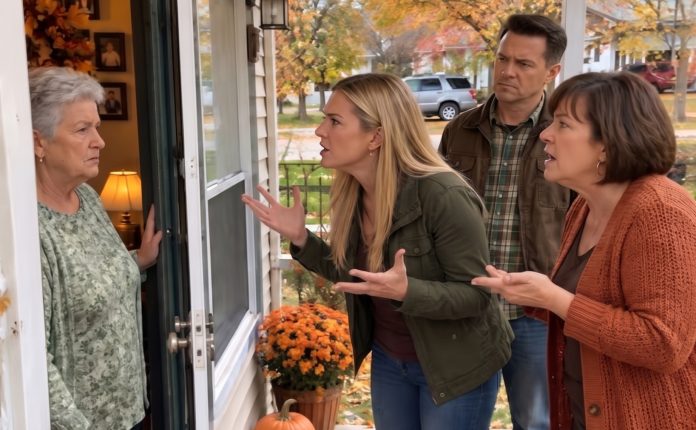
Emma opened the front door before I could knock.
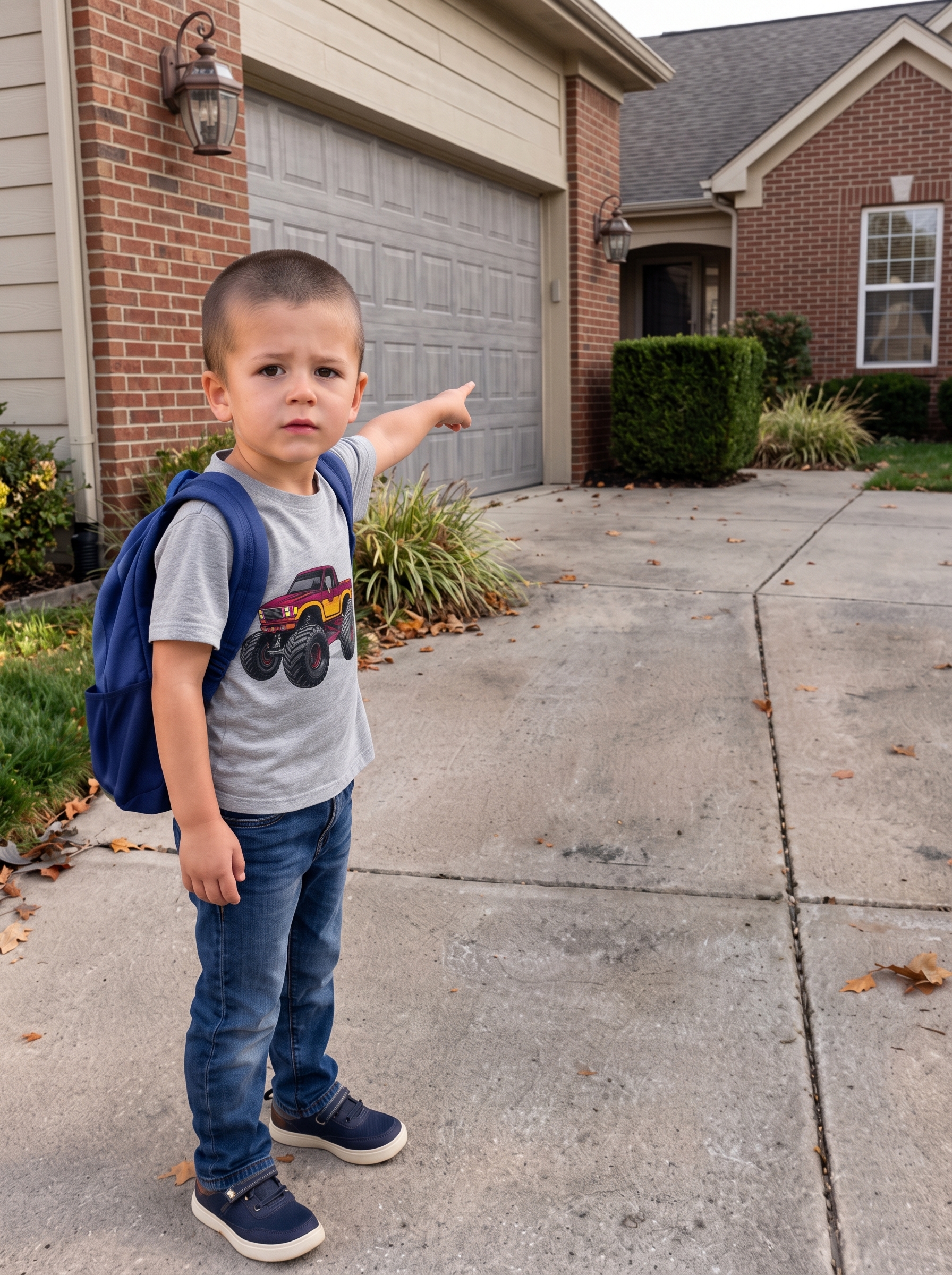
She looked at me, then at Noah, who was suddenly very interested in his shoes,
and her face went through three expressions in two seconds:
surprise, guilt, and something close to dread.
“Mom. You’re early.”
“Noah told me a secret,” I said. “Something about the garage.
Something about what you’ll do if I find out.”
“Noah.” Emma closed her eyes. “Buddy, I asked you…”
“I only told her a little,” he whispered.
“He told me enough.” I kept my voice gentle, but I did not move from the doorstep.
“Emma, what is in there?”
She was quiet for a long moment. Then she took a breath and stepped aside.
“I was going to tell you this weekend. I just needed to be sure first.
Come see. But sit down before you look at anything, okay? Please.”
That was when my stomach really dropped.
Emma had never in her life told me to sit down before showing me something.
—
The garage smelled of vinegar and something sharp and chemical that took me a second to place.
Then I saw the red glow, and my knees nearly gave out.
It was a safelight, the kind that hangs over a darkroom bench.
On the table beneath it sat an old photo enlarger,
trays of liquid in a neat row, and a clothesline strung across the corner with strips of film clipped to it like laundry.
Emma’s husband, Ben, stood by the bench with his hands in his pockets, looking like a man bracing for a verdict.
I had known him for eight years, and I had never seen him so nervous.
“Mom,” Emma said softly. “I bought a box at the flea market two weeks ago.
A man was selling off the contents of a storage unit. There was a camera in it,
an old Pentax, and a shoebox of film rolls that had never been developed.”
“All right,” I said slowly. “That’s a nice find. Why would that frighten you?”
“Because the box had a name on it.” She swallowed. “Under the lid, in marker. *Claire Whitaker, 1985.*”
The room tilted.
Claire was my sister. My older sister, by six years,
the one who taught me to ride a bike and to lie to our father. In the summer of 1985,
at the age of twenty-two, she left a note on the kitchen table that said
*I can’t do this anymore. Don’t look for me*, and she was never seen again.
I had spent forty years believing she was dead. My parents died believing it.
For a long time, so did I, and then I learned to stop thinking about it,
which is not the same as healing, though it feels like it from the outside.
I sat down on the overturned bucket Ben pushed toward me.
“Why didn’t you tell me?” My voice sounded thin and far away.
“Because I didn’t know what was on the film,” Emma said.
“It could have been nothing. Vacation snapshots, blurry trees.
I couldn’t bring you something this big and then have it turn out to be empty.
Ben learned how to develop it from a video.
We’ve been doing it at night after Noah goes to bed. And we weren’t telling anyone until we knew,
Mom. Not even you. Ben kept calling it a state secret.”
“Dad said not even the police,” Noah piped up from the doorway.
“I said it as a joke, bud,” Ben said weakly. “I meant it was *that* secret.”
I laughed, a cracked and wet sound I did not recognize. Then I put my hand over my mouth,
because I was crying, and I hadn’t known it had started.
“Show me,” I said.
—
Emma took a strip from the line and held it to the light. Then she handed me a stack of prints, still faintly damp, laid out on a tray.
The first was a street I didn’t know, with palm trees and a yellow bus.
The second was a girl at a café table, squinting into the sun, with a cigarette she was clearly pretending not to hold.
It was Claire.
Her hair was shorter than I remembered, and she was thinner,
but the crooked grin was the same, the one that used to get her out of every kind of trouble.
There were dozens of photos. Claire on a beach. Claire on a ferry.
Claire laughing in a doorway with a woman I didn’t know. In the later ones,
she looked happier than she ever had at home, and I felt a grief and a gladness so tangled I couldn’t separate them.
“She wasn’t gone,” I whispered. “She left. She got *out*.”
“There’s more.” Emma crouched beside me.
“The last roll has pictures of the back of a building.
A street sign. A shop with the name still readable on the window.
Ben found it on a map. It’s a small town in Portugal, Mom.
And in two of the photos there’s a mailbox with a number on it.”
I could not speak.
“I didn’t want to call you until I’d checked,” she went on.
“So last week I wrote a letter to the address. Just a few lines,
nothing scary. Just that I was Claire Whitaker’s niece and I’d found some of her photographs.”
“Emma.”
“And yesterday I got a reply.” She reached into her pocket and pulled out a folded sheet,
soft from being carried and opened many times. “It’s from a woman named Inês.
She says Claire lived in that house until 2009. She says she’s her daughter.”
The world went very quiet.
“Claire had a daughter?”
“She had two. And Claire…” Emma’s voice trembled.
“Mom, she passed away fifteen years ago. I’m so sorry.
I wanted to tell you in person, not in a letter, not in a garage.
I should have told you sooner, and I’m sorry. But Inês wrote the last paragraph twice, and I want you to read it.”
I took the page with hands that did not feel like mine.
*My mother spoke of a little sister every year on her birthday,* it read.
*She kept one photograph of you in a frame by her bed, a girl in a yellow raincoat holding a frog.
She said she left because she could not breathe in that house,
but that leaving you was the one thing she never forgave herself for.
She always meant to come back. She didn’t know how. We have always hoped someone would find us.*
I remembered the raincoat. I remembered the frog.
I sat on a bucket in my daughter’s garage, under a red lightbulb,
with my grandson’s small hand creeping into mine, and I wept for my sister,
for the forty years, for the little girl in the raincoat who had waited at a window and never known that someone,
somewhere, had been keeping her photograph by the bed.
“I’m sorry I kept it from you,” Emma said, crying too. “I thought I was protecting you.”
“You were,” I said, and pulled her into my arms. “And you found her. You *found* her.”
Noah patted my knee gravely. “Grandma, is it still a secret?”
I laughed through my tears.
“No, sweetheart. I think it’s time everybody knew.”
—
Three months later, I stepped off a plane in Lisbon with a suitcase,
a yellow raincoat I’d carried from home for reasons I couldn’t explain, and Emma’s hand in mine.
Two women were waiting at the arrivals gate, one holding a framed photograph.
When she turned it around, I saw a small girl in a yellow raincoat, holding a frog.
I don’t remember crossing the floor.
I only remember that when I reached them, the older of the two said, in careful English,
“You have my mother’s eyes.”
For forty years, I had thought the door to my past was closed for good.
It turned out someone had been holding the other side open the whole time.
**The End**
—
Want a few hook options or a short video-style version of this one?