The Envelope in the Medication Bag
For twelve years, I paid for my mother-in-law’s prescriptions.
Heart pills, blood thinners, an inhaler that cost more than our monthly groceries.
Whenever I hesitated at the pharmacy counter, my husband, Daniel, would squeeze my shoulder and say,
“His brothers can’t afford much. You know how it is. We’ll make it up to you someday.”
I didn’t mind. Rose was the kind of woman who kept butterscotch candies
in her purse for the grocery clerks, who called me
“my girl” from the first day. When her health failed, I drove her to appointments,
learned to flush her IV line, and slept in a hospital recliner more nights than I could count. She was family.
She died on a Tuesday in March. I stayed at the hospital to strip the bed and fold the last blanket,
because it felt wrong to leave it a mess. By the time I got to her house,
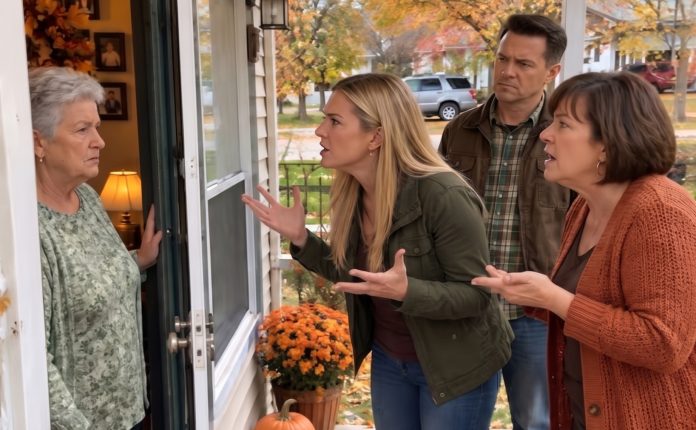
Daniel’s brothers, Curtis and Mark, and their wives were already there.
Drawers were open. Curtis’s wife was wrapping Rose’s china in newspaper.
Mark had put a red sticky note on the dining table that said *MINE*.
“The jewelry stays with blood family,” Curtis’s wife
said when she saw me looking at the bedroom door.
She smiled without warmth. “You understand, honey.”
I looked at Daniel. He studied his shoes.
“Of course,” I said, and I went home hurt but quiet. I had spent twelve years learning how to be quiet.
—
Three days later, my phone rang while I was making toast.
“Mrs. Alvarez? This is Greenleaf Pharmacy. We were going through Rose’s medication bag,
the canvas one you always brought in. There’s an envelope at the bottom with your name on it.
It was tucked behind the pill organizer. We didn’t want to throw it out.”
The envelope was cream-colored, soft at the corners,
and *For my girl* was written across the front in Rose’s shaky handwriting.
I opened it at the pharmacy counter. No jewelry, no cash. Inside was a thick,
rubber-banded stack of small receipts, each one from Greenleaf,
each one with my name at the bottom under *Paid by*. And one notarized page.
The receipts were mine. Every one. Rose had kept them for twelve years,
in order, and clipped a handwritten tally to the top.
The number at the bottom made me sit down on the plastic chair by the blood pressure machine.
$61,340.
Under it, in blue ink: *Every dollar she spent. Not one from my sons.*
Then I unfolded the notarized page and read it twice, slowly, because my hands had started to shake.
It was a sworn statement dated fourteen months earlier,
signed by Rose and stamped by a notary.
It said that her sons Curtis and Mark had each sent her son Daniel four hundred dollars a month
“for my medications,” starting the year she was diagnosed.
It said she had learned this from Curtis by accident at Christmas.
It said Daniel had never given her one cent of it.
It said she had watched her daughter-in-law pay for her care while her own children “let her believe they had nothing to give.”
The last paragraph made me put my hand over my mouth.
*I leave my house, its contents, and everything in my jewelry box to my daughter-in-law, Elena,
who earned it. If my sons object, they may read this statement aloud in front of a judge.*
Below it, a second note, on a yellow sticky pad in her looping hand:
*I’m sorry I never said it out loud, my girl. I didn’t want to break your heart while I still needed you.
Now you can do what you want with this. I trust you.*
I did not cry. I paid attention to the sound of the pharmacy door and the hum of the cooler.
Then I took out my phone and called my husband.
—
“Where were you Saturday night?” I asked when he picked up.
“Not the night of the funeral. Saturday. When you told me you were at Curtis’s.”
“What? Elena, I don’t—”
“Four hundred a month from Curtis. Four hundred from Mark. For twelve years.
” I kept my voice level. “What did you do with it, Daniel?”
The line went silent. I could hear him breathing.
“Who told you that?”
“Your mother did.”
A long, ragged exhale. “It wasn’t like that. I had debts.
The truck, the loan for the shop, I was going to pay it back. And you always covered the pharmacy, so I thought, what does it hurt—”
“Ninety-six hundred dollars a year from your brothers.
Sixty-one thousand from me.” I looked down at the tally in Rose’s handwriting. “And I was the one who wasn’t blood.”
“Elena, please. Let’s talk at home.”
“No. I’m going to Rose’s house. Bring your brothers. All of them.”
—
They were in the living room when I arrived, still sorting through what they considered theirs.
I walked in and set the envelope on the coffee table beside Curtis’s newspaper-wrapped china.
“I have something to read,” I said. “Sit down.”
Curtis’s wife started to object. Then she saw my face, and she sat.
I read the statement aloud, all of it, not hurrying.
I watched Curtis’s expression change first,
from irritation to confusion to horror, when he realized what Rose had learned at Christmas.
Mark turned slowly toward Daniel. Daniel stared at the carpet the way he’d stared at his shoes.
“You told us she didn’t need the money,” Mark said quietly. “You said her insurance was covering it.”
“That’s not—” Daniel began.
“You told me Elena’s family was helping out,” Curtis said, and his voice cracked.
“Ma was on her own for twelve years and we were sending you money?”
The room was very still. Curtis’s wife slowly put down the china.
I read the last paragraph one more time, because Rose deserved to have it heard.
Then I picked up the jewelry box from the bedroom, where it had sat untouched since the funeral, and set it in my lap.
“I’m not going to take anything out of this house today,” I said. “The lawyer will handle that. But I wanted you to hear it from her, not me.”
Mark was the first to speak. “Elena. I’m sorry. We didn’t know.”
“I believe you,” I said, and I did.
—
The house was mine within the month. The court did not need a second hearing;
the notarized statement stood on its own, and when Curtis and Mark saw the bank records,
they withdrew every objection and paid back what Daniel had taken from their mother’s care, sending a check to me for the difference.
I refused it. They donated it to a hospice in Rose’s name instead.
Daniel and I did not survive the winter. I don’t hate him.
I just couldn’t stay married to a man who watched me spend twelve years’
worth of savings on his mother while pocketing his brothers’ money and kissing my forehead.
I kept the house. In the spring, I opened the jewelry box.
Under the tray of brooches and pearls was one more sticky note: *The butterscotch is in the kitchen drawer. Take some for the clerks.*
I laughed until I cried, and then I did exactly that.
Every Tuesday now, I drive to Greenleaf Pharmacy. I hand a bag of butterscotch candies to the woman at the counter,
the one who called me about the envelope. She always asks how I’m doing.
“Better,” I tell her. “Family finally showed up.”
**The End**
—
Want a few clickbait-style title options for this one, or a shorter version for social media?