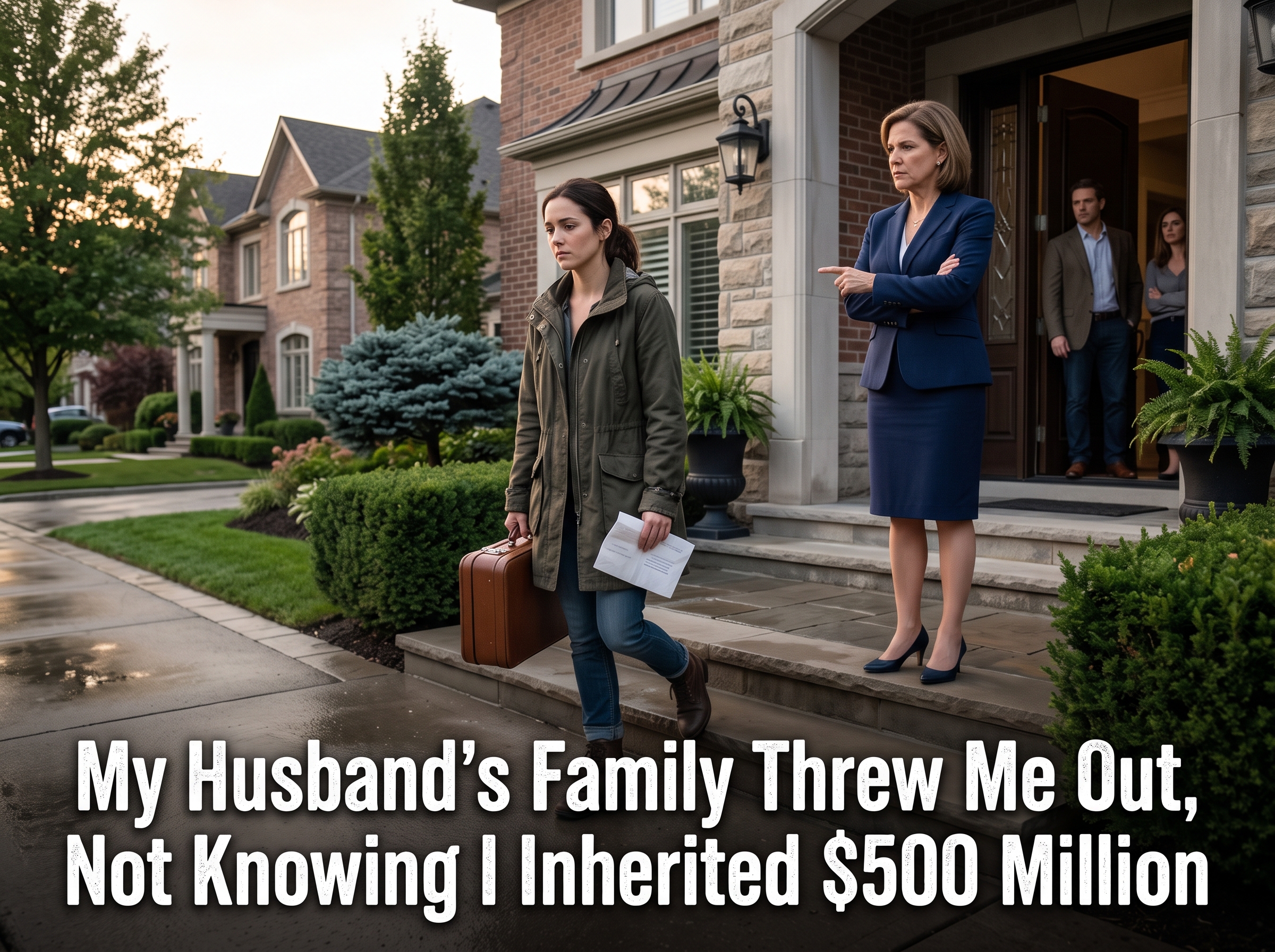
After my husband passed away, I kept my $500 million inheritance a secret just to see who would still treat me with respect. Twenty-four hours after the funeral, my mother-in-law dragged a suitcase onto the lawn and sneered, “Now that Terence is gone, you get nothing.” My sister-in-law laughed while filming my humiliation. I quietly picked up my muddy wedding album and said, “You’re right… I have nothing.” Six months later, at their glittering charity gala, I walked in, looked Howard straight in the eye, and said one calm sentence that made every one of them go silent. But that was getting ahead of the story. The truth was, Terence had never been the wealthy one. At least, that was what his family believed. For twelve years, I had watched the same people treat me like an outsider because they assumed I had married into their money. They were wrong. I had married Terence. And that was the only thing I had ever wanted. We met when I was twenty-eight and he was thirty-one. He wasn’t interested in my clothes, my apartment, or what kind of family I came from. He was interested in the fact that I laughed at terrible jokes and that I always ordered dessert even when I claimed I was full. We fell in love slowly. Then completely. Terence worked hard, but he wasn’t obsessed with money. His family was different. His father, Howard, had built a successful chain of luxury hotels and restaurants. His mother, Evelyn, had spent decades reminding everyone that their family name opened doors. His younger sister, Vanessa, had turned that family name into a lifestyle. Designer clothes. Expensive vacations. Charity galas. Social media posts. And an endless need to know what everyone else owned. When Terence proposed, Evelyn pulled me aside. “I hope you’re not expecting anything from this family,” she said. I smiled politely. “I expect Terence.” She looked at me as though I had given the wrong answer. At the wedding, Howard shook my hand for exactly three seconds. “Take care of my son,” he said. “I will.” He never said, “Welcome to the family.” And I never forgot it. Still, Terence and I built our own life. We bought a modest house outside the city. We traveled when we could. We cooked together. We argued over stupid things and apologized before going to bed. Then, three years into our marriage, something happened that changed everything. My grandfather died. He had been a private man, almost obsessively so. What my husband’s family never knew was that he had built a technology investment company decades earlier. Before his death, he placed the majority of his assets into a family trust in my name. The inheritance was enormous. Five hundred million dollars. But there was a condition. I could access everything only after my thirtieth birthday and after completing a series of legal requirements. My grandfather’s attorney told me that the trust had been structured to protect me from exactly the kind of people who might suddenly become interested in my money. I understood why. So I told almost nobody. Not even Terence. Not because I didn’t trust him. Because I knew him. He would have told his family. Not intentionally. He simply wasn’t good at keeping secrets from the people he loved. And I didn’t want his family treating me differently because they thought I was rich. I wanted to know whether they loved me at all. Then came the accident. One rainy evening, Terence was driving home from work when another vehicle crossed the center line. The police called me at 11:47 p.m. I remember staring at the kitchen clock while the officer spoke. I remember dropping my glass. I remember saying, “No,” over and over. But grief doesn’t negotiate. It simply arrives. Terence was gone. The funeral was held three days later. Hundreds of people came. His colleagues. Friends. Business partners. People I had never seen before. And, of course, his family. Evelyn cried loudly in public. Howard stood beside the casket with a rigid face. Vanessa spent half the service whispering to someone on her phone. I didn’t care. I couldn’t care. I had just buried my husband. The next morning, I woke up alone. His side of the bed was untouched. His coffee mug was still beside the sink. His jacket still hung behind the bedroom door. I sat on the floor and cried until my chest hurt. Then someone began pounding on the front door. It was Evelyn. Howard was behind her. Vanessa stood on the sidewalk holding her phone. “What are you doing here?” I asked. Evelyn walked past me. “We’re here to collect Terence’s things.” I stared at her. “Excuse me?” “This house belongs to the family,” she said. “It doesn’t.” Howard finally spoke. “My son paid for most of it.” “Then I’ll provide the records.” Evelyn rolled her eyes. “Don’t make this difficult.” I looked at Vanessa. She was already recording. “Are you filming me?” She smiled. “People should know how you’re behaving after my brother’s death.” I couldn’t believe what I was hearing. “Please leave.” Evelyn walked into the bedroom and began opening drawers. Then she came back outside carrying a suitcase. She threw it onto the lawn. “Pack your things.” I stood in the doorway. “What?” “You heard me.” Howard avoided my eyes. Evelyn continued. “Terence left nothing that belongs to you. The house, the cars, the accounts—we’ll sort all of it out.” “That isn’t your decision.” “It is now.” Vanessa laughed. “You really thought you were going to live off my brother forever?” My hands were shaking. Not because I was afraid. Because I was trying desperately not to break down. I looked around the house. Our photographs. Our books. The little wooden dining table we had bought during our first year of marriage. The blue sofa Terence hated because I insisted it matched the curtains. And then I saw it. Our wedding album. It had fallen from a shelf during the commotion. It landed in the wet grass. Mud covered the white cover. I picked it up. Evelyn folded her arms. “Well?” I looked at her. Then at Howard. Then at Vanessa’s camera. And I said quietly: “You’re right.” They all stared at me. “I have nothing.” Vanessa laughed. “Finally, some honesty.” I walked inside. I packed one suitcase. Clothes. My passport. A few photographs. And the muddy wedding album. Then I left. I didn’t tell them about the trust. I didn’t tell them about the $500 million. I didn’t tell them that their lawyers would soon discover that Terence had never owned the house they were trying to claim. I simply disappeared. For six months. I rented a small apartment in another city. I stopped answering Evelyn’s calls. I ignored Vanessa’s messages. I hired my grandfather’s attorney, Daniel, to handle everything. Within weeks, the legal situation became clear. The house was mine. The investment accounts were mine. Terence had left me everything he legally owned. And the inheritance from my grandfather remained untouched. I could have destroyed his family financially. I could have exposed every ugly thing they had done. But I didn’t. Instead, I waited. During those six months, I learned something painful. Grief changes shape. At first, it is a storm. Then it becomes rain. Eventually, it becomes something you carry. I began rebuilding my life. I started a foundation in Terence’s name. It supported families who had lost loved ones unexpectedly. I funded scholarships. I donated to hospitals. I n
“My Husband’s Family Threw Me Out, Not Knowing I Inherited $500 Million”