88 views
# The Girl Who Wasn’t Allowed Out
My wife called me a traitor for taking our
eight-year-old daughter to the emergency room.
She said it before she even asked
why the little girl had bruises across her ribs.
It started two hours before
the recital that, according to Bridget,
was going to change our lives.
She was arranging white lilies
in the foyer of our home in Scottsdale,
Arizona, while her father, Lawrence Vance,
sent last-minute reminders to
VIP guests. Lawrence had run an elite
private conservatory for thirty
years and still had the clout to get
faculty from Juilliard and Eastman to
return his calls. Our daughter,
Tessa, had been playing piano
since she was five.
I honestly believed she loved it.
My name is Thomas Reyes.
I’m forty-two, and I repair commercial
refrigeration units for restaurants
and grocery chains across the Phoenix metro area. My hours are a mess, but I had never once missed one of Tessa’s performances. That afternoon I came home early with a bouquet of daisies, her favorite. Bridget didn’t look up to say hello.
“Don’t distract her,” she snapped. “She’s been running the finale for two hours and she’s still stumbling on the last twelve measures.”
“Has she eaten?”
“She’ll eat after the showcase. We can’t break her focus over a snack.”
I went upstairs anyway, planning to sneak her half a turkey sandwich. On the landing, I found her spiral sketchbook lying open. Between drawings of houses and stray cats, one sentence had been written over and over in heavy graphite:
*If I miss a note, I don’t come out.*
I was still staring at it when my phone buzzed with a message from her iPad: *Dad, come up by yourself. Don’t tell Mom.*
—
She was sitting cross-legged on her bedroom floor in sweatpants, her hair pulled into a bun so tight the skin at her temples looked red. I closed the door softly and sat down on the carpet at her eye level.
“What’s going on, kiddo?”
“Promise me first that you’ll believe me.”
“I’m listening.”
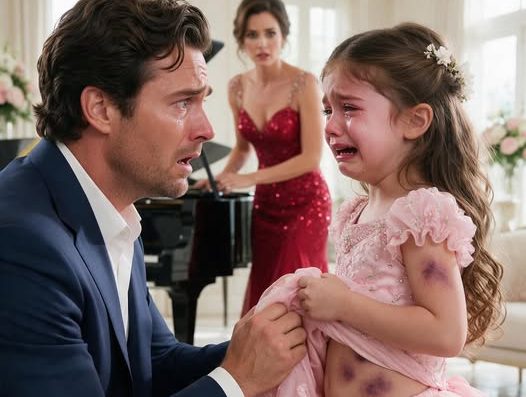
She lifted the hem of her shirt. Oval bruises darkened both sides of her ribs, with deeper marks on her upper arm and a faint welt near her wrist. The blood drained from my face. I didn’t grab her. I asked quietly if I could come closer, and she gave a tiny nod.
“Who did this?”
“Grandpa Lawrence. When I make a mistake, he grabs me so I’ll remember. Sometimes Mom tells him where to hold me so it doesn’t show under my dress.”
Every instinct told me to storm downstairs. Tessa caught my sleeve with a grip far stronger than I knew she had.
“Don’t yell. If you yell, they’ll say I made the family fight.”
I thought about the Thursday stomachaches that had lasted for months, the exact afternoon of her lessons at her grandfather’s house. I thought about how she had stopped singing in the shower, and how every time I walked near the study during practice, Bridget found a reason to steer me away. I had told myself it was pre-competition nerves.
“Does your mom know?”
Tessa stared at her sneakers. “She locks the door from the outside. When I ask for water, she says lazy kids are always thirsty. One time I was in there until it got dark. Grandpa said you’d leave us if you found out how much money they’ve spent on my lessons.”
I told her no amount of money on earth could make me stop loving her. I slipped the sketchbook into my backpack, helped her into an oversized hoodie, and led her downstairs.
Bridget stood in front of the door.
“Where do you think you’re going? Curtain is in forty minutes.”
“To the hospital.”
She didn’t ask what was wrong with Tessa. Her eyes went straight to the baggy sleeve of the hoodie, then to her father, who had just stepped in from the back patio.
“Children make things up under pressure,” Lawrence said, with a calm that made my skin crawl.
“Move,” I told Bridget.
“You’re throwing away the opportunity of her lifetime.”
“The opportunity can wait. My daughter can’t.”
We left without the white dress or the sheet music.
—
On the drive, I called Tessa’s pediatrician, who told me to go straight to the pediatric ER and note how the marks had been discovered. Tessa held my hand the whole way. At a red light she asked, in a very small voice, whether the police could force her to go back and play.
“We’re not making any decisions about music tonight,” I said.
At the hospital, an attending physician separated us from the waiting room and ordered a full evaluation. She explained that staff were legally required to contact Child Protective Services. While a nurse documented every mark, my phone buzzed nonstop with calls from Bridget and Lawrence. I let them all go to voicemail.
Tessa stared at a closed exam-room door and began to cry quietly.
“Dad, do you believe in ghosts?”
“Why do you ask, sweetheart?”
“The lady who showed me how to send you that message said she used to get locked in that same kind of room.”
“What lady?”
“Her name is Elena Vance. She said she’s Mom’s sister.”
I knew that name. I had seen a framed portrait of a young girl in a storage box in the garage, and Bridget had always told me her younger sister had drowned as a child on a family trip to Lake Powell.
Then Tessa whispered something that knocked the wind out of me.
“She asked me not to tell Grandpa she’s still alive.”
—
The ER doctor asked that Tessa be allowed to rest without repeating her story. We received a medical report, the hospital notified local law enforcement, and a social worker contacted the Arizona Department of Child Safety to set up a safety plan.
Bridget arrived with Lawrence at her side. I was at the intake desk filling out forms when I heard her voice behind me.
“Thomas, hand over my daughter. You’re traumatizing her with this melodrama.”
“She has bruises on her ribs. A doctor documented them.”
Lawrence stepped forward with a polite, reasonable smile, as if smoothing over a dispute between neighbors. “Proper technique sometimes requires physical correction. An instructor has to steady a student’s arm. You wouldn’t understand classical discipline.”
“Mr. Vance,” said a woman’s voice, “you are going to want to stop talking.”
A Scottsdale detective had come through the double doors with a Child Safety specialist. She introduced herself as Detective Marisol Ortega, and she looked at Lawrence the way I imagine she looked at most people who explained things too smoothly.
“Mrs. Reyes, Mr. Vance, you’re not to approach the child or her father. The hospital has placed a hold, and we need to speak with each of you separately.”
Bridget turned to me, her face white with fury. “You’ve destroyed this family.”
“No,” I said. “I’m just not hiding it anymore.”
—
Elena found me three days later.
I was sitting in the kitchen of my sister’s house in Mesa, where Tessa and I were staying, when a car pulled up outside. A thin woman in her early thirties got out, with dark hair and Bridget’s exact jawline. She stood at the end of the driveway for a long time before she came to the door.
“Mr. Reyes,” she said. “I’m Elena. I’m sorry to come like this. I didn’t know where else to go.”
I invited her in. Tessa came to the kitchen doorway in her pajamas, took one look at her, and ran straight into her arms.
“You came.”
“I told you I would, sweet girl.”
It took Elena most of an hour to tell me what she hadn’t told anyone in fifteen years.
When she was ten, Lawrence had decided she would become a concert pianist. When she was eleven, she missed a passage in a recital rehearsal, and he locked her in the soundproofed practice room beneath the conservatory for a full night. It happened again and again. Her mother, who died when Elena was thirteen, had begged him to stop and was told to mind her own household. Bridget, six years older, was already Lawrence’s favorite, the one who played perfectly, stayed quiet, and learned which rooms to keep her eyes away from.
“At sixteen, I ran,” Elena said. “I took a bus to Flagstaff with forty dollars. Lawrence told everyone I’d drowned at Lake Powell, and he held a memorial service with an empty casket.” She swallowed. “He wanted a story people would believe, so nobody would ask where I’d gone. Bridget stood at the podium and read a poem.”
I closed my eyes. I had been married to that woman for eleven years.
“How did you find Tessa?”
“I didn’t. She found me.” A small, wet laugh. “Three months ago a note came through my website. I teach music to kids in Flagstaff, and my contact page is public. It said, *My grandpa has a room like yours.* There was a drawing of a piano and a door with a lock.” She wiped her eyes. “I wrote back that night. We’ve been messaging on her iPad ever since, whenever she could get to it. I told her to find someone she trusted, and she said it was you.”
Tessa had her face buried in Elena’s shoulder. “I told Aunt Elena you’d be okay, Dad.”
I got up, went to the window, and stood there for a while, because I didn’t want my daughter to see me cry.
—
The case took fourteen months.
Detective Ortega built it with care. The ER report was the first piece. The sketchbook was the second, along with every message on Tessa’s iPad, which Elena had saved and which proved a pattern going back months. Child Safety interviewed Tessa with a trained forensic specialist, in a room with a couch and a box of crayons, and she told the whole story without once being led.
Then something happened that none of us had planned for.
Elena posted a short, quiet notice in an online group for former Vance Conservatory students. It said only: *I was a student there. I want to talk to anyone who is willing to talk.*
Within six weeks, nineteen people had come forward.
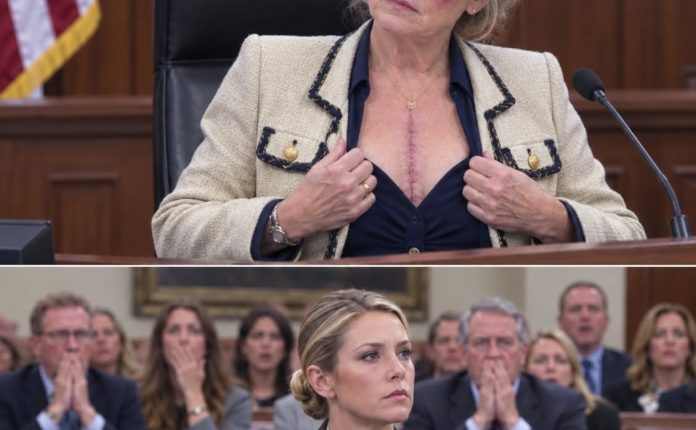
They were grown men and women, some of them now professional musicians, teachers, and conductors. They described locked rooms, cold practice studios in summer, hands that gripped too hard, and a director whose reputation had made every parent too grateful to ask questions. A retired cellist, a man in his sixties, came to the courthouse in a rumpled suit and told the court, in a voice that shook, that he had waited forty years for somebody to be believed first.
Lawrence’s lawyer called it a “coordinated smear.” The jury did not agree.
Lawrence Vance was convicted on multiple counts of child abuse and unlawful imprisonment. At sentencing, he looked old for the first time. The conservatory he’d built was closed by the state within a month, and his name was removed from its door.
Bridget’s case was harder, and I’m not going to pretend it was simple.
She had never raised a hand to Tessa. But she had told her father where to hold her. She had locked the door. She had stood at a memorial and read a poem for a sister she knew was alive. She was charged as an accomplice and eventually pleaded to a lesser count. The judge gave her probation, mandatory therapy, and a no-contact order with Tessa that could only be lifted by the court and by Tessa herself.
I saw her once, in the corridor outside the courtroom.
“Thomas,” she said, in a voice I hardly recognized. “I thought I was keeping her safe. I thought if she was perfect, nothing bad would happen. That’s what he told me when I was nine.”
“Bridget.” I held her gaze. “I believe you were hurt, too. I really do. But Tessa was eight.”
She nodded slowly, as if I’d finally said something true. She didn’t try to argue.
—
I filed for divorce and was granted full custody. Tessa started seeing a therapist named Dr. Okafor, who let her draw during sessions and never once asked her to talk before she was ready.
For the first six months, Tessa wouldn’t touch a piano. I didn’t push. We went to the park. We got a dog, a one-eyed beagle mix named Biscuit, who slept across her feet. We ate sandwiches at odd hours, whenever she was hungry, and I never once told her a snack would break her focus.
Elena came for dinner every Sunday. She never mentioned music, and neither did we.
One evening in March, I came home from a job to a sound I hadn’t heard in a year.
A single note, then another, from the old upright in the sunroom. It wasn’t a performance. It was a child picking out a tune, getting it wrong, and laughing.
I stopped in the hall and didn’t move.
Tessa was on the bench, Biscuit under her feet, and Elena sat beside her with her hands in her lap, not touching the keys.
“I messed up,” Tessa said, grinning, as she hit a wrong note.
“You did,” said Elena.
“I’m gonna do it again.”
“Okay.”
She hit the wrong note again. Then the right one. She turned, saw me in the doorway, and didn’t flinch or freeze. She simply waved.
“Dad! Come see! It’s a song about Biscuit.”
I sat down on the floor beside the bench, daisies in a jar on the windowsill, and listened to my daughter play a terrible, wonderful song about a one-eyed dog.
Nobody locked a door.
Nobody counted the mistakes.
And when she finished, with a wrong note on the very last chord, she turned and asked me the question I’d waited a whole year to hear her ask:
“Can I play it again?”
“As many times as you want, kiddo,” I said. “It’s your song.”
She played it again.
**The End**
—
I can also write a hook and thumbnail text for this one, a shorter Facebook version, or a Part 1 / Part 2 / Part 3 split for posting.