179 views
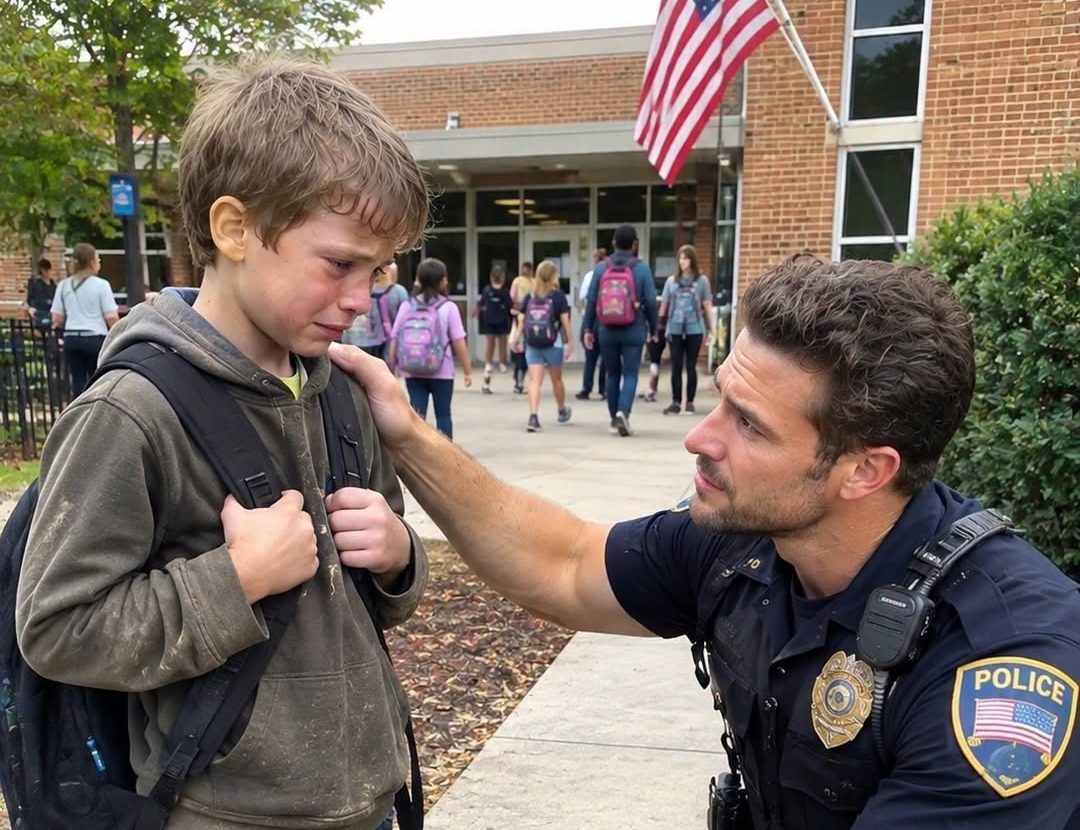
At 3:18 the front fence at Brookfield Elementary still
held its usual crowd of pickup trucks and parents,
but the boy in the blue backpack stood alone at the curb,
holding the zipper closed with both hands.
He was seven, small for it, and he watched
me while a teacher on duty finished telling me about a stop sign complaint.
When she walked away, he stepped in front of me.
“Officer Hayes, can you walk home with me?”
His backpack zipper had been stitched once with red thread and was pulling open again.
I looked past him at the empty sidewalk. “Where is your house?”
“Willow Street. The yellow one with the wreath.”
“Who picks you up?”
“Nobody. I walk.”
He said it without complaint, the way a child states the rules of a game he has already learned.
“Please walk home with me,” he said again. “Grandma might not be there much longer.”
I pressed my thumb against the edge of my duty notebook.
“What does that mean, Oliver?”
His hands tightened on the backpack. “It means she might not be there.”
The teacher on duty had gone inside. The last of the cars pulled away from the curb.
I asked him to come to the office with me.
The office smelled like floor wax and copy paper. A small desk sat under a bulletin board of fire drill schedules.
Oliver took the chair across from me and set the backpack on his knees. He did not let go of it.
“Tell me your full name.”
“Oliver Bennett.”
“Your father’s name?”
“Grant Bennett.”
“Your grandmother’s name?”
“Margaret Bennett. Grandma.”
I wrote each name in my notebook. “And where is your father now?”
“Work. He supervises at the warehouse.”
“What about after school? Who is supposed to be with your grandmother?”
He looked at the desk between us. “She is supposed to be with herself.”
“That is not what I asked.”
“I know.”
He pulled the zipper an inch and pushed it shut again.
“Have you told your father about this?”
“Yes.”
“And what did he say?”
“He said Grandma is stubborn and I should not worry.”
“Did you tell your teacher?”
“I told her Grandma forgot to get up one afternoon.”
The office clock clicked to 3:24.
“What did your teacher do?”
“She said she would call home.”
“Did she?”
“I think so.”
He did not say it like he believed it.
I asked him to tell me exactly what had happened the last time he went home.
Oliver described his grandmother sitting in her chair with a blue blanket over her legs. He described the television playing to the wall. He described a tray of food on the table beside her and how she asked him twice whether it was morning.
He did not raise his voice. He kept his eyes on my pen.
“Nobody believes me,” he said. “Dad says she is fine. Teacher says call home. I called home.”
“On what?”
“Grandma’s telephone. Dad did not answer. He was at work.”
I closed the notebook. Oliver watched me do it.
“You are not in trouble,” I said.
“Dad says do not talk to strangers.”
“I am not a stranger now.”
He considered that. “No.”
I stepped into the hall and called my supervisor. I told him a seven year old had requested an escort home and described an adult at risk. He asked whether the child was injured. I said no. He asked whether there was an immediate threat. I said I did not know yet.
“Follow the welfare check procedure,” he said. “Call it in before you enter. If you observe a medical concern, request assistance.”
When I came back, Oliver had moved to the bench outside the office. He sat with his backpack on his lap and his feet swinging above the tile.
He saw me and stopped swinging.
“You came back,” he said.
“I said I would.”
“People say they will.”
I crouched down, but only to his eye level, not close. “Here is what happens now. I walk with you. When we get to the house, I knock and introduce myself. If your grandmother needs help, I call medical. You stay where I can see you.”
He nodded.
“One more thing,” I said. “If at any point you want to go back to school, you tell me. We can wait there for your father.”
“Okay.”
“Okay what?”
“Okay, Officer Hayes.”
He stood, and he kept his eyes on my coat as we went out the front entrance.
The sidewalk on Willow Street was dry and cracked in long seams. Maple trees stood in the yards, and small houses sat close to the curb.
Oliver walked beside me, half a step behind, then half a step ahead, then beside me again.
“Why did you pick me?” I asked.
He looked at the sidewalk. “At the playground last month, a girl fell off the slide and cried. You sat with her.”
“I remember.”
“You did not get mad at her for crying.”
“That is not usually something to get mad about.”
He thought about that. “Grandma cried in the bathroom once. Dad said she was tired.”
The yellow house appeared at the end of the block. The lawn had gone shaggy at the edges. Two newspapers lay rolled on the porch steps, still in their plastic sleeves.
Oliver stopped at the walkway and looked back at me.
“Please don’t leave when you see it,” he said.
“See what?”
He did not answer. He started up the walk, and his backpack knocked against his side with each step.
I followed. The porch boards gave under my boots. A crooked flower wreath hung on the front door, the petals faded to the color of old paper.
Oliver stopped beside it and took a key from his backpack.
The key caught twice before Oliver turned it far enough. He leaned his shoulder against the door, and the old lock gave with a small click.
“Sometimes you have to lift the handle,” he told me.
He pushed the door open and stepped inside.
I glanced at the porch before following him. Three newspapers lay beside the flowerpot. The top one had a date from four days earlier. Another had been folded in half and left where it had fallen.
The lawn had grown high around the front steps. A plastic garden chair stood near the railing, with one leg resting in the dirt.
“Does your grandma know you’re here?” I asked.
“She knows I come.”
“Does your dad know?”
Oliver looked down at his backpack.
“Sometimes.”
I waited for him to explain, but he had already started toward the living room.
The television was on. A cooking program showed a woman stirring something in a large pan. The sound was low, just loud enough to hear a few words when the room became quiet.
Nobody was watching.
I stepped around a pile of unopened envelopes near the front table. Several magazines had slipped off a small wooden stand. One was dated July, although it was already September.
“Grandma?” Oliver called.
His voice was not loud. He sounded like a child who had called into another room many times and had learned not to expect an answer right away.
“She’s in her room.”
He pointed down the hallway.
“Does she spend most of the afternoon there?”
“Yes.”
“Is she usually awake?”
“Sometimes she sleeps.”
I looked toward the kitchen. A cup sat on the counter beside a plate with a piece of bread on it. The bread had dried around the edges.
“Does she eat in the kitchen?”
“She used to.”
Oliver did not wait for another question. He walked down the hallway, and I followed.
There were family photographs along the wall. One showed Margaret standing beside a Christmas tree. Another showed Oliver wearing a red shirt and holding a small birthday cake.
He stopped at the bedroom door.
“Grandma, I brought someone.”
A voice came from inside.
“Who is it?”
“Rebecca.”
I entered behind him.
Margaret Bennett sat in an armchair beside the window. A thin blue blanket covered her lap. Her hair was brushed back, and a pair of reading glasses rested on a small table beside her.
She looked toward Oliver first.
“Did you bring your school things?”
“Yes, Grandma.”
“Have you done your homework?”
“Not yet.”
“Then you should do that before your father gets home.”
Oliver glanced at me.
I moved closer to the chair, keeping my voice calm.
“Mrs. Bennett, my name is Rebecca Hayes. I’m a Cedar Falls police officer. Oliver asked me to come with him.”
Margaret looked at him again.
“Did you get into trouble?”
“No, Grandma.”
“Then why did you bring a police officer?”
Oliver opened his mouth, but no answer came.
I introduced myself again and told Margaret that I wanted to make sure she was comfortable. She nodded, though her eyes stayed on the boy.
“He’s a good boy,” she said. “He comes home from school.”
“Yes,” I said. “He does.”
A meal tray sat on the table beside her chair. A bowl of soup had formed a skin across the top. There was a piece of toast on a small plate, still untouched.
Beside the tray stood several medication bottles. Some had printed labels. One had a small handwritten note attached to it.
I did not pick up the bottles.
“Have you had lunch today, Mrs. Bennett?”
Margaret looked at the tray.
“I believe so.”
“Do you remember what you ate?”
She took a moment.
“Was it Tuesday?”
“It’s Thursday,” Oliver said.
“Thursday?”
She looked toward the window, then back at me.
“Yes. Thursday. I knew that.”
I pulled a chair closer and sat down.
“When did you last have help getting up from this chair?”
Margaret looked puzzled.
“I get up myself.”
“Do you ever have trouble?”
“No. Not usually.”
Oliver stood near the foot of the bed. His backpack hung from one shoulder.
“Grandma, remember yesterday?”
Margaret turned toward him.
“What happened yesterday?”
“You couldn’t get to the bathroom.”
“Oliver.”
“I helped you.”
She looked at me as if she expected me to correct him.
“He worries too much,” she said. “He has school.”
I looked at Oliver.
“How long has she been having trouble?”
He moved the backpack from his shoulder and set it on the floor.
“Sometimes she forgets where she is going.”
Margaret looked down at the blanket.
“I don’t forget everything.”
“I didn’t say everything,” Oliver replied.
His answer was so matter of fact that I had to look away for a second.
“Nobody said you did,” I told Margaret.
She reached for her glasses but picked up the television remote instead. She turned it over, examined the buttons, then placed it back on the table.
“Where is my telephone?” she asked.
“It’s right there, Grandma,” Oliver said.
He pointed toward a cordless phone beside the lamp.
Margaret looked at it.
“Oh, yes.”
She did not reach for it.
I asked whether anyone had visited her that afternoon. She said she could not remember. When I asked whether she had been alone since morning, she gave me a different answer.
“My son comes by.”
“Today?”
“Yes, he brings groceries.”
“Did he come today?”
Margaret looked toward the hallway.
“I think he did.”
Oliver shook his head.
“Daddy didn’t come today.”
Margaret pressed her lips together.
“Well, he comes when he can.”
I did not argue with her. I had no reason to make her defend herself, and I needed to understand what was happening before I made another decision.
“Oliver, can you show me where you put your school things?”
He reached for his backpack.
“Here?”
“Yes.”
He unzipped the front pocket, then the larger compartment. The zipper caught halfway, and he worked it free with two fingers.
He removed a folded napkin.
Then a juice carton.
Then two granola bars.
He placed each item on the bedside table, arranging them carefully beside Margaret’s reading glasses.
I looked at the food, then at him.
“What are these for?”
“Grandma.”
“Did you bring them from home?”
“No. From school.”
He picked up one granola bar and turned it over.
“I didn’t eat it.”
“Why not?”
“Because Grandma gets hungry.”
Margaret looked at the two bars.
“Oh, Oliver. You should eat your lunch.”
“I had some.”
“How much?”
He shrugged.
“Enough.”
I looked at the juice carton. Its straw was still attached beneath the paper wrapper.
“Do you bring food here every day?”
“Not every day.”
“How often?”
“Most days.”
The answer came without hesitation.
I glanced at Margaret. She was looking at the granola bars as if she were trying to remember seeing them before.
“Did you know Oliver was saving his lunch for you?” I asked.
Margaret shook her head.
“He likes those bars.”
“I do,” Oliver said. “But I can get more tomorrow.”
“Does your grandma eat when you bring them?”
“Sometimes.”
“And when she doesn’t?”
He looked at the tray.
“I leave them here.”
I took another look at the meal beside the chair. The soup, the toast and the untouched spoon were still where someone had placed them.
“Who made this lunch for your grandma?”
Oliver pointed toward the kitchen.
“I think Dad brought it.”
“When?”
“Before.”
“Before today?”
He nodded.
“Sometimes he puts food in the refrigerator.”
Margaret adjusted her position in the chair.
“Grant buys everything I need.”
“I know,” I said.
She seemed relieved that I had agreed.
“He works very hard.”
“I believe you.”
“He’s a good son.”
Oliver picked up the folded napkin and opened it. A small crumb fell onto the table.
“Grandma, you didn’t eat the sandwich yesterday either.”
Margaret frowned.
“Which sandwich?”
“The one with cheese.”
“Did I have cheese?”
“Yes.”
She looked at me again.
“Sometimes I get mixed up.”
I let that answer sit without asking her to explain it.
There was a small yellow cup on the windowsill, decorated with faded ducks. It held three pencils and a pair of scissors. Oliver glanced at it, then returned his attention to the table.
“Can Grandma have the juice now?” he asked.
“Has she had anything to drink?”
“I don’t know.”
Margaret looked toward the window.
“I had tea.”
“When?” I asked.
She paused.
“After breakfast.”
“What time was breakfast?”
She opened her mouth, then closed it.
Oliver reached for the juice carton.
“Grandma, I brought the kind you like.”
He placed it within her reach, but she did not pick it up.
“Thank you, sweetheart.”
He smiled a little.
I asked Margaret whether she had taken her medicine that morning.
She looked toward the bottles.
“I take what I’m supposed to take.”
“Do you remember taking it today?”
“I believe I did.”
Oliver looked at the bottles.
“Sometimes she asks me which one.”
I turned toward him.
“Which one what?”
“Which one she needs.”
Margaret shifted in her chair.
“He doesn’t know about medicine.”
“No,” I said. “He doesn’t need to.”
Oliver’s fingers rested on the broken zipper of his backpack.
“She gets worried when she can’t find the right one.”
I looked again at the handwritten note attached to one bottle. The writing was small and partly covered by the label.
“Mrs. Bennett, do you have someone who helps you organize these?”
Margaret shook her head.
“I manage.”
“Who checks on you during the day?”
“My family.”
“Which family member?”
She looked at Oliver.
“He’s here.”
I kept my voice gentle.
“I mean an adult who can help you.”
Margaret did not answer.
Oliver reached for the napkin and folded it along the same crease it had held before.
“Grandma doesn’t like being alone,” he said.
Margaret looked at him.
“I never said that.”
“You said it when the television stopped working.”
“That was different.”
He nodded, accepting the correction.
I asked him how he knew the television had stopped working.
“Because it makes a noise when nobody changes the channel.”
For a second, the ordinary answer made the room seem almost normal.
“You’re quite the television expert,” I said.
He gave me a small smile.
“Daddy says I watch too much.”
“Does he?”
“Yes. But Grandma likes the cooking shows.”
Margaret looked toward the television.
“That lady makes good pies.”
“She does,” I said.
Then Margaret asked the same question she had asked when I entered.
“Who are you?”
I gave her my name again.
“Rebecca Hayes. I’m here with Oliver.”
“Oliver?”
She looked toward him.
“Did you finish your homework?”
He lowered his eyes.
“Not yet, Grandma.”
She nodded as if that settled the matter.
I had handled plenty of calls involving older residents who needed assistance. I had learned not to mistake a quiet house for a safe one, but I had also learned not to jump ahead of what I could actually establish.
There was enough in that room to make another ordinary conversation with the family insufficient.
I stood and moved the chair slightly away from the tray so Margaret had room to reach the table.
“Mrs. Bennett, I want to arrange for someone to check your health today.”
“Why?”
“Because I have some concerns about how you’re managing.”
“I’m fine.”
She said it without anger. She sounded as if she were repeating an answer she had given many times.
Oliver stepped closer to her chair.
“Grandma, please.”
She looked at him.
“What is it, sweetheart?”
“Just let her help.”
Margaret reached toward his hand.
“All right.”
I looked at the food again. Two school granola bars sat beside a meal that had been prepared for an adult. The juice carton stood unopened between them.
Oliver watched me pick up my duty radio.
“Are you going to call somebody?” he asked.
“Yes.”
“Will they come here?”
“They will.”
He looked at Margaret, then back at me.
“Can they help her eat?”
“I’ll explain what I’ve seen, and we’ll make sure she gets the attention she needs.”
Margaret turned toward the television. The cooking program had moved on to a table covered with fresh bread.
“Oliver,” she said, “you should save some of your lunch for yourself tomorrow.”
He looked at the granola bars.
“I will, Grandma.”
I pressed the radio button.
Then I gave the dispatcher Margaret’s address and requested medical assistance.
The two granola bars remained beside the untouched meal tray.
The dispatcher answered on the second ring, and I gave her Margaret’s address, her age, and the condition of the room. I kept my voice level and described what I had seen, not what I suspected.
“Is she awake and responding to you?”
“Yes. She is sitting in a chair. She has an untouched meal beside her, and there are several medication bottles within reach.”
“Has she had anything to drink today?”
“I cannot confirm that.”
The dispatcher asked me to stay with Margaret and keep her comfortable until the medical team arrived. I told her I would.
Oliver remained beside his grandmother, holding her hand. Margaret looked down at his fingers and rubbed the edge of her blue blanket.
“Are you going to school tomorrow, sweetheart?”
“Yes, Grandma.”
“Good. You mustn’t miss school.”
Oliver looked at me before he answered. I gave him a small nod, and he turned back to her.
“Rebecca needs to ask me some questions, Grandma.”
Margaret nodded, though her eyes stayed on him.
I moved my duty notebook onto the arm of the chair and opened it. My thumb pressed against the edge before I wrote the first line.
“Oliver, when did you first notice Grandma having trouble?”
He considered the question.
“She forgot lunch one day. Then she forgot it another day.”
“Was that last week?”
“I don’t know. It was before the leaves got brown.”
I wrote down what he could tell me.
“What else happened?”
“She asked where the bathroom was. She asked me twice. I showed her, but then she asked again.”
“Did she know where she was?”
“She said she was in her house. But she didn’t know which room she was in.”
I kept my pencil still for a moment.
“Did you tell your father?”
“Yes.”
“What did he say?”
“He said Grandma was tired.”
Oliver’s voice stayed quiet. He wasn’t trying to make his father sound bad. He was giving me the answer to a question.
I asked him whether Margaret had trouble getting up from her chair, finding her clothes, or remembering to take her medicine. He answered each question carefully. Sometimes he said yes. Sometimes he said he wasn’t sure.
“Do you know when she last ate a whole meal?”
Oliver shook his head.
The dispatcher came back on the line and told me the medical team was on its way. I thanked her and ended the call.
“Will Grandma have to go somewhere?” Oliver asked.
“She needs a doctor to check her. We will find out what happens after that.”
He looked at Margaret.
“Grandma, they’re coming to help you.”
She gave his hand a little squeeze.
“That’s nice, sweetheart.”
I closed my notebook and followed Oliver into the kitchen. He had left the door open, and the small plate he had mentioned sat near the sink.
A butter knife lay beside it. There was a piece of bread folded over a slice of cheese, cut unevenly through the middle.
“Is that what you make after school?” I asked.
Oliver nodded.
“Sometimes I make two. Grandma might want one later.”
“Do you make them every day?”
“Most days.”
He reached toward a cabinet and took down a plastic cup.
“She likes this one because it has flowers on it.”
The cup was light in his hand. He filled it from the kitchen tap, then set it beside the plate.
“Does Grandma have trouble holding a regular glass?”
“Sometimes she spills.”
He looked at the cup and then at me.
“I don’t know how to make all the food she needs.”
There was no complaint in his voice. He sounded as if he had reached the end of a job he had been trying to do.
“You shouldn’t have had to figure that out,” I told him. “Making sure Grandma eats and gets her medicine is an adult’s responsibility.”
“But she gets hungry.”
“I know.”
He pushed the cup a little closer to the plate.
“I can still make sandwiches.”
“You can make sandwiches when you want one for yourself. You don’t have to prepare Grandma’s meals.”
Oliver looked toward the bedroom.
“Who will do it?”
“The medical team is coming. Then we will make a plan with your family.”
He nodded, but he didn’t move away from the counter.
I took the cup and set it on the table where Margaret could reach it if she wanted. The plate stayed beside the sink.
When I returned to the living room, headlights crossed the front window. A car door shut, and footsteps came up the porch.
Grant entered with his warehouse jacket still on. He glanced toward the bedroom, then at Oliver.
“What’s going on? Is Mom all right?”
“She’s being assessed,” I said. “The medical team is on its way.”
He put his jacket over the back of a chair.
“She has always been stubborn about accepting help. I have been trying to get her to let somebody come in.”
“How often have you seen her this week?”
“Three times, maybe. I brought groceries Tuesday.”
“Did you stay with her?”
“About twenty minutes.”
“Who stays with her in the afternoon?”
Grant stopped beside the chair.
“Patricia usually checks in.”
“Every afternoon?”
“That’s what I understood.”
I wrote his answer down.
“Has Patricia told you she is there every day?”
“She calls sometimes. She knows Mom’s habits.”
“Who is physically in the house when your mother needs help getting out of her chair or finding something to eat?”
Grant looked toward the bedroom.
“She can usually manage those things.”
“Usually?”
He rubbed the bridge of his nose.
“Mom doesn’t always tell us when she needs something.”
I asked him about the meals, the medication bottles, and the confusion Oliver had described. Grant answered with practical explanations. Margaret had been grieving. She had been tired. She didn’t like people rearranging her kitchen.
Each explanation might have been true. None answered who was with her.
“Did Oliver tell you she was forgetting meals?”
Grant looked at his son.
“He said she wasn’t eating properly.”
“Did he tell you she was getting lost inside the house?”
“I don’t remember him saying that.”
Oliver stood near the doorway, holding his backpack by one strap.
“I told you, Daddy.”
Grant looked at him, then back at me.
“I thought he meant she wouldn’t eat what I brought.”
I opened my notebook again.
“Your son has been trying to feed her, and he has been frightened enough to ask several adults for help.”
Grant’s mouth opened, but no words came.
A few minutes later, the medical team arrived. I stepped aside to let them enter Margaret’s bedroom, and Grant followed. Oliver stayed close enough to hear his grandmother’s voice.
One of the paramedics asked Margaret whether she could tell him what she had eaten that day.
Margaret looked toward Oliver.
“Did we have lunch?”
Oliver answered softly.
“You had some soup yesterday, Grandma.”
She nodded as if that settled it.
The paramedic asked Grant about her recent appointments and medication. Grant answered what he could, then turned toward me when the questions became more specific.
I stayed in the room and recorded the details that mattered. Margaret needed medical attention, and the family needed to understand what had been happening between visits.
When the paramedics prepared to take her to Cedar Falls Community Hospital, Oliver walked beside the chair they used to help her stand.
“Can I go with Grandma?”
“Your father will take you,” I said. “I will meet you there.”
Grant agreed, though he was still watching the paramedics.
After they left, he went back to his car and returned with a folded grocery receipt. He placed it on the kitchen counter.
“I bought everything she asked for,” he said. “There is food in the house.”
I picked up the receipt. The total was $68.41.
I laid it beside the plate Oliver had made.
Grant looked at the two items.
“Why didn’t you tell me you were saving food for Grandma?”
Oliver stood a few feet away.
“I did, Daddy.”
Grant turned the receipt over in his fingers.
He didn’t answer.
Grant folded the receipt once, then opened it again.
“Those groceries were for her,” he said. “I brought them over on Monday.”
“I know,” I said.
“She had food in the refrigerator. I checked.”
Oliver looked at the floor.
“When did you check?” I asked.
Grant glanced at his son. “Monday evening.”
“How long did you stay?”
“Not long. I had to get back.”
The paramedics came through the front door carrying their equipment. One of them asked me to show her where Margaret was, and I stepped aside to let them through.
Grant moved toward the hallway.
“Is she going to be all right?” he asked.
“They need to examine her first,” I said.
Oliver started after the paramedics, but Grant reached for his shoulder.
“Stay here, buddy.”
Oliver stopped.
“I want to go with Grandma.”
The paramedic looked back at him. “You can come with us. Just stay where I can see you.”
He went without another word.
At 5:22 p.m., I stood beside Margaret’s examination bed at Cedar Falls Community Hospital while a nurse adjusted the pillow behind her.
Margaret kept asking when she could go home.
“My family will be there soon,” she said. “They’ll be wondering where I am.”
Oliver stood beside the bed, holding the strap of his blue backpack.
“Grandma, Dad knows you’re here,” he told her.
“Does he?”
“Yes. He’s coming.”
She looked at the nurse, then at me.
“I don’t want to make trouble for anybody.”
“You’re not making trouble, Margaret,” I said. “They’re here to help you.”
She looked uncertain.
Oliver moved closer to the bed.
“She’ll help you get comfortable, Grandma. She’s nice.”
Margaret considered the nurse for a few seconds before allowing her to adjust the blanket.
“Thank you, dear,” she said.
The nurse smiled. “You’re welcome.”
Margaret turned to Oliver. “Did you have your lunch today?”
“Yes.”
“What did you have?”
“A sandwich and an apple.”
“Did you eat the apple?”
Oliver nodded.
“Good. You need your fruit.”
He gave me a quick look, then returned his attention to his grandmother.
I wondered how many ordinary conversations like that had taken place while he was trying to make sure she ate.
The nurse asked Margaret a few questions about the day and where she was. Margaret answered some correctly, then asked whether she was waiting for an appointment at the doctor’s office.
Oliver did not interrupt her.
When the nurse finished, she told me that the medical team needed to complete its assessment. She also asked whether a family member could provide information about Margaret’s daily routine.
“I’ll make sure they speak with Grant,” I said.
Margaret reached toward Oliver.
“You’re staying with me, aren’t you?”
He took her hand.
“Until Dad comes.”
At 6:10 p.m., Oliver and I sat in the hospital waiting area. His feet hung above the floor, and he had placed his backpack between his shoes.
A television mounted near the ceiling showed a cooking program with the sound turned low.
“Do you want something to drink?” I asked.
He shook his head.
“Are you worried about getting into trouble?”
He looked at me.
“With Dad?”
“With anybody.”
He rubbed a loose thread on his backpack.
“Dad told me not to talk about the house with strangers.”
I waited.
“He said people might get the wrong idea.”
“What did you think he meant?”
“That I shouldn’t tell them Grandma gets mixed up.”
I kept my voice steady.
“Did he tell you not to talk about her forgetting meals?”
Oliver nodded.
“Did you tell him anyway?”
“Yes.”
“What happened?”
“He said he’d bring more groceries.”
Oliver pulled the backpack onto his lap.
“I wasn’t trying to make Dad mad.”
“I understand.”
“He works hard.”
“I know he works.”
“He gets tired when he comes home.”
Oliver looked toward the doorway leading to the examination rooms.
“Sometimes Grandma asks me the same question four times. I answer her every time because she doesn’t remember asking.”
“That must take a long time.”
“Sometimes.”
He examined the broken zipper on his backpack.
“Am I in trouble because I told you?”
“No, Oliver. You did the right thing by asking for help.”
“What if Dad gets mad?”
I took a moment before answering.
“Your father may have questions. He may be upset about what happened. But you are not in trouble for telling an adult that someone needs help.”
Oliver considered that.
“Even if Dad told me not to?”
“Even then.”
He looked at the hospital doors again.
“Can you tell him that?”
“I can.”
A nurse passed with a clipboard. Oliver watched her disappear around the corner.
Then he asked, “Will Grandma have to stay here tonight?”
“I don’t know yet.”
“Can you find out?”
“I’ll ask.”
I went to speak with the nurse, leaving Oliver where he could see me through the open doorway.
The answer was not ready. Margaret needed further evaluation, and the medical team had not decided what would happen after the examination.
When I returned, Oliver had taken a small notebook from his backpack.
He was drawing squares along the edge of a page.
“What are those?” I asked.
“Practice fields.”
“For soccer?”
He nodded.
“How many?”
“Six.”
“That’s quite a few.”
“Coach says we need room to run.”
He closed the notebook when footsteps approached.
Grant had returned.
Patricia came in behind him, carrying a handbag and a paper cup.
She was Margaret’s daughter, and she placed the cup on a nearby table before greeting Oliver.
“How is Grandma?”
“She’s being checked,” he said.
Patricia touched his shoulder.
“Well, I’m sure it’s fine. Your grandmother has always been a little forgetful.”
Grant looked toward the examination rooms.
“Can we speak somewhere?”
We went to a small family consultation room at 6:35 p.m.
Patricia set her handbag on the table. She took out a folded sheet of paper and a pair of reading glasses.
“We’ve been doing our best,” she said. “Mother has always preferred being alone. She gets upset when people make too much of her business.”
Grant pulled out a chair.
“She doesn’t like people fussing over her.”
I sat opposite them.
“I understand that she values her independence. But I need to ask about her daily care.”
Patricia nodded.
“Of course.”
“Who is physically present with Margaret each afternoon?”
Patricia glanced at Grant.
“Grant has arrangements.”
Grant looked up.
“I thought you were checking on her.”
Patricia frowned.
“I call her every day.”
“I thought you went over after lunch.”
“I can’t go over every afternoon. I have my own household to manage.”
Grant rubbed the bridge of his nose.
“You said you would help.”
“I do help.”
“How often do you visit?” I asked.
Patricia turned toward me.
“I speak with her on the phone. Usually around two.”
“Does speaking with her on the phone tell you whether she’s eaten or taken her medication?”
Patricia adjusted her glasses.
“Mother tells me when she needs something.”
“Does she always remember?”
Neither answered immediately.
Grant leaned back.
“I bring groceries. I make sure the refrigerator is stocked.”
“Who stays with her after you leave?”
He looked at Patricia again.
“She usually checks.”
Patricia placed her glasses on the table.
“That’s not what I understood.”
I opened my notebook.
“Let’s go through the actual visits. When were you last inside the house?”
“Last Thursday,” Patricia said.
“At what time?”
“Late afternoon, I think.”
“How long were you there?”
“I can’t remember exactly.”
I turned to Grant.
“And you?”
“Monday evening. I delivered groceries.”
“Did you stay through dinner?”
“I had work the next morning.”
Patricia picked up her paper cup.
“We have been managing this for months. Mother has had difficult days before.”
“I am not asking who loves Margaret,” I said. “I am asking who is physically in this house when she needs help.”
Patricia took the paper from the table and folded it along its existing crease.
“Rebecca, I think you’re making a difficult situation sound worse than it is.”
Grant said nothing.
I looked down at my notebook. There were two accounts of family involvement, but no one had given me a dependable answer about who was with Margaret.
At 6:48 p.m., we moved into the hospital corridor. Patricia had gathered her papers, and Grant was looking at his phone.
I asked them to give me the dates of their most recent visits.
“Monday for me,” Grant said. “I told you, I brought the groceries.”
“That was a delivery,” I said. “When did you last stay for an afternoon?”
He pressed his lips together.
“I can’t give you an exact date.”
Patricia opened her handbag.
“I spoke with Mother yesterday.”
“On the telephone?”
“Yes.”
“Did you see her?”
“No, but she sounded fine.”
“Did you ask whether she had eaten?”
Patricia looked at Grant.
“She said she was going to have something.”
“What was she going to have?”
“I don’t remember.”
Grant shifted his weight.
“I thought you were going over there.”
“I thought you had hired someone,” Patricia replied.
He stared at her.
“Who told you that?”
“You said you were looking into getting help.”
“I said I would look into it.”
“Well, I thought you had.”
The words came out quietly. Neither seemed prepared to take them back.
I asked Grant whether he had a name or telephone number for the person he believed Patricia was visiting with Margaret.
He shook his head.
Patricia began arranging the papers inside her handbag, placing one sheet on top of another until their edges lined up.
“We have managed perfectly well until now,” she said.
I looked from her to Grant.
“Then help me understand the schedule.”
Grant rubbed the bridge of his nose.
“I don’t have one written down.”
“Who was supposed to be there yesterday afternoon?”
He looked at Patricia.
She looked at him.
Neither answered.
A hospital staff member approached with a clipboard and asked whether Grant was Margaret’s primary family contact.
“Yes,” he said.
“Then we need you to come back to the consultation room when the doctor is ready.”
Grant nodded.
The staff member turned to leave, but Patricia called after her.
“Is Mother going to be discharged tonight?”
“I can’t answer that,” the woman said. “The medical team will discuss her needs with the family.”
Patricia closed her handbag.
I had expected the family to help me establish what had been happening in that house. Instead, I was being asked to accept telephone calls, grocery deliveries and unfinished plans as proof of care.
Grant took one step toward the consultation room, then stopped.
“Patricia, I really thought you were going.”
“I thought you had somebody.”
A door opened farther down the corridor.
A nurse called, “Mr. Bennett?”
Grant turned.
“Yes?”
“Could you come with me, please? We need to discuss your mother’s condition.”
He started toward her.
Patricia followed, still carrying the papers.
And I went with them.
The social worker waited until Patricia had put her handbag down before she opened the folder.
“Before we discuss where Margaret might go next, I want to explain what the medical team has found.”
Grant pulled his chair closer to the table. He still had his warehouse jacket over one arm.
“Is she going to be all right?” he asked.
“She is receiving treatment, and we are continuing to evaluate her. She is dehydrated, she is undernourished, and she is having significant difficulty with her memory. We need to understand how much assistance she requires before anyone makes plans for her to return home.”
Grant rubbed the bridge of his nose.
“She has always been independent. She doesn’t like people fussing over her.”
The social worker turned one page.
“I understand that. But independence and being safe alone are two different questions.”
Patricia reached for the paper cup beside her. She had brought coffee but had not taken more than a sip.
“Could some of the confusion be because she hasn’t been eating properly?”
“It may be contributing. The medical team needs to complete its evaluation.”
“Then once she gets some food and rest, perhaps she will be herself again.”
The social worker did not argue with her.
“She may improve. We simply cannot promise that her memory will return to where it was.”
Grant looked down at the table.
“All right. What happens now?”
It was the first question he had asked that did not begin with an explanation of his mother’s habits.
The social worker took out another sheet. She explained that Margaret would need an assessment of her ability to manage ordinary daily activities. They would also need to consider what supervision she required throughout the day.
“Does that mean she cannot go home?” Grant asked.
“It means we cannot send her back to an arrangement that has already proved unsafe.”
Patricia straightened the papers in front of her.
“We could take turns visiting.”
“Who would be there on Monday afternoon?” the social worker asked.
Patricia looked at Grant.
He looked back at her.
Neither answered.
I pressed my thumb against the edge of my duty notebook. I had heard enough promises in the previous evening’s meeting. This morning, I wanted names and hours, not good intentions.
The social worker explained that a rehabilitation assessment could help determine what Margaret could do with support and what she could no longer manage alone.
“How long does that take?” Grant asked.
“That depends on her progress and the results of the assessment.”
“And if she needs help longer than that?”
“Then we discuss continuing support.”
Grant nodded slowly.
“Can we start that today?”
The social worker wrote something on her page.
“Yes. We can begin with the assessment.”
I stayed while the meeting continued, although my supervisor had already asked me to return to the station for my regular duties. I sent a message explaining that the hospital needed my observations documented before I left.
There were other calls waiting. I knew that.
I also knew that Oliver had gone home the previous evening without an answer about what would happen to his grandmother.
At 9:05, I found Margaret in a rehabilitation assessment room with a care professional beside her chair. A small table held a cup of water, a notepad and several ordinary household objects.
Margaret had her thin blue blanket across her lap.
“Good morning,” I said.
She looked up.
“Are you here about my house?”
“Partly. How are you feeling this morning?”
“People keep asking me that.”
The care professional smiled.
“That’s because we want to make sure you’re comfortable.”
Margaret picked up the edge of her blanket and began folding it. She brought one corner across, then stopped and looked at the other side.
“Is this the right way?”
“You can fold it however you like,” I told her.
She tried again.
“Oliver likes this blanket. He says it is soft.”
“Does he?”
“He sits beside me sometimes. He has very busy legs, that boy.”
I smiled.
“That sounds like Oliver.”
Margaret looked toward the doorway.
“When can I go back to my bedroom?”
I pulled a chair closer to the table.
“That depends on what the doctors and the care team find out.”
“I don’t need to stay here. My bed is perfectly good.”
“I understand that you want to go home.”
She folded the blanket once more.
“My son has a job. Patricia has her own house. They cannot keep coming over every day.”
I let her finish.
“Would you accept someone coming to help you?”
Margaret looked at me.
“What sort of someone?”
“Someone who could help with meals, medicines and the parts of the day that have become difficult.”
She considered that for a few seconds.
“Would I have to let them move all my furniture?”
“No. We are talking about help, not taking your home away.”
She looked down at the blanket again.
“I don’t want Oliver worrying about me.”
The words came quietly.
“He should be playing with his friends. He should be doing his schoolwork. He shouldn’t have to wonder whether I’ve eaten lunch.”
I waited.
Margaret looked at me again.
“Has he been doing that?”
I did not give her a false answer.
“He has been trying very hard to help you.”
She pressed her lips together.
“That little boy.”
The care professional asked Margaret whether she would be willing to continue the assessment. Margaret nodded, though she still glanced toward the doorway whenever someone passed.
“Will you tell Grant what I said?” she asked.
“I will.”
“And tell him I want my own pillow.”
“I can tell him that, too.”
She gave me a small smile.
“At least somebody is asking.”
At 10:20, I joined Grant and Patricia in the hospital social work office. A written outline of possible arrangements lay between them. It was several pages long, with sections about rehabilitation, daily supervision, appointments and the help Margaret might need after leaving hospital.
Patricia was reading the second page when I came in.
“There’s a rehabilitation program nearby,” she said. “They can assess her and help her practice ordinary activities again.”
The social worker pointed to the information.
“That is one option worth discussing. We would need to determine whether it meets Margaret’s needs.”
Patricia picked up a pen.
“I can coordinate the appointments. I can keep track of the dates and make sure everyone has the information.”
Grant nodded.
“That would help.”
She wrote her name beside the appointment coordination section.
I looked at the page.
“Who will be responsible for the afternoons?”
Grant turned toward me.
“I’m going to speak with my supervisor. I may be able to change some of my shifts.”
“Which shifts?”
“I don’t know yet. I need to see what he can offer.”
Patricia stopped writing.
“I can help with appointments, but I cannot promise to be at the house every afternoon.”
“Then we need another arrangement for those hours,” I said.
The social worker agreed.
“We can discuss available services and what level of supervision the assessment recommends. The important part is that the plan covers the hours when Margaret needs help.”
Grant picked up the pages and read them again.
“Will insurance cover rehabilitation?”
“That depends on the coverage and the recommendation. We can help you understand the costs.”
He looked at Patricia.
She placed her pen parallel to the edge of the folder.
“I can call tomorrow and find out what appointments are available.”
“Thank you,” Grant said.
It was a small agreement, but it had a name attached to it and a task that could be checked.
The social worker gave them another copy to take home.
“Please don’t sign anything until you have read all the information. We want the family to understand what is being recommended.”
Grant put the papers in his jacket pocket.
“Can I have a copy of the assessment when it’s finished?”
“Yes.”
“And can we know what she needs before we decide where she goes?”
“That is exactly what we’re working toward.”
Patricia asked about visiting hours. Grant asked about the expected length of rehabilitation. Neither question settled the afternoon problem, but they were finally asking about the work ahead instead of defending the arrangement behind them.
At 11:05, Grant found me in the hospital cafeteria.
He had a paper cup in one hand and a folded list in the other. I was looking over my notes when he sat across from me.
“Do you have a minute?”
“Yes.”
He placed the list on the table.
“I’ve been working out what this might cost.”
The paper had several handwritten amounts. Some had question marks beside them. Others were crossed out and written again.
“I spoke to the social worker about the program,” he said. “I also asked about help at home.”
“What did they tell you?”
“That we need to wait for the assessment before we know exactly what she needs.”
He turned the cup between his hands.
“If I reduce my hours, my pay goes down. I have bills that don’t change just because my mother is in the hospital.”
“I understand.”
“I’m not saying I won’t do it.”
“I didn’t think you were.”
He looked at the list again.
“I’ve been at that warehouse for eleven years. My supervisor has been fair to me, but I can’t just tell him I won’t work afternoons anymore.”
“Then ask what changes are possible.”
He gave a short nod.
“That’s what I’ll do.”
For a few seconds, neither of us spoke. A man at the next table was trying to open a packet of crackers without making a mess. Grant watched him struggle, then looked back at his own papers.
“Rebecca, did Oliver tell you everything?”
“I can only tell you what he told me and what I observed.”
“Did he say how long he had been doing it?”
“He described several afternoons. He also told me about the meals and the times your mother became confused.”
Grant rubbed the bridge of his nose.
“He used to ask me to come home early. I thought he wanted me to pick him up.”
“What did he say when you asked why?”
“He said Grandma needed me.”
I kept my notebook closed.
“What did you tell him?”
Grant stared at the list.
“I told him I’d check on her.”
He took a drink from his cup.
“I should have asked what he meant.”
I did not tell him that everything would be all right. I could not promise that.
“There’s still time to make a proper arrangement,” I said. “But it has to be one your mother can depend on, even when work gets busy or someone has another appointment.”
“What if she refuses to accept help?”
“Then the care team will need to discuss that with her and explain the choices. You cannot make a safe plan by pretending she doesn’t need one.”
He folded the list in half.
“She wants to go home.”
“I know.”
“She’s been in that house for years. My father and her bought it when I was still in school.”
He looked at the cup again.
“I don’t want her to think we’re taking it away from her.”
“Then make sure the plan gives her as much independence as she can safely manage.”
Grant leaned back.
“Would you tell me something?”
“Go ahead.”
“When you first came to the house, did you think I wasn’t taking care of her?”
I took a moment before answering.
“I thought you believed someone was checking on her. I also thought you needed to know what was happening during the hours you weren’t there.”
He looked at me for a long moment.
“That’s not quite the same thing.”
“No.”
He unfolded the list and flattened it against the table.
“I’ll speak to my supervisor today. I’ll give the hospital the actual hours I can cover, not the hours I wish I could cover.”
“Good.”
“And I’ll tell them what happened at home. All of it.”
I nodded.
He took the rehabilitation information from his jacket pocket and placed it beside the list of expenses.
“Could you give me the social worker’s number again?”
I wrote it on the back of my notebook page.
He put the number in his phone before standing.
I watched him gather the papers. There was no sudden answer to the question of how his family would manage the cost, the work and the care Margaret needed. But the assessment was underway, and the hospital would not make a discharge decision without knowing who would be present to help her.
Grant placed his work schedule beside the rehabilitation information and began calculating which shifts he could change.
Grant drew a line through one of his afternoon shifts, then stopped with the pencil resting against the paper.
“That gives me Thursdays,” he said. “I can probably trade the other afternoons with somebody at the warehouse.”
I watched him add a small question mark beside Tuesday.
“Have you spoken to your supervisor yet?”
“Not yet. But I will.”
He folded the paper and slipped it into his jacket pocket.
Patricia picked up the rehabilitation brochure. She turned it over and examined the telephone number printed on the back.
“I can handle appointments,” she said. “My schedule is more flexible than Grant’s.”
Grant nodded.
“That would help.”
Neither of them wrote down which appointments Patricia meant. I let the conversation continue because the hospital social worker had already explained that the family would need to work together.
At two o’clock, Grant and Patricia went to Margaret’s yellow house to collect her clothing and a few personal belongings. They had asked whether I could accompany them, but I had other duties to finish before returning to the hospital.
They were back before three, carrying two shopping bags and a small suitcase.
The lavender cardigan was folded neatly on top.
“Mother always liked this one,” Patricia told Grant. “She wears it whenever she goes out.”
“She might be able to wear it again soon,” he said.
“Of course she will.”
Patricia placed the cardigan on the chair beside her. Then she opened the suitcase and began checking what she had brought.
“Two nightgowns, three pairs of socks, her slippers. I think that’s enough for now.”
Grant looked at the list she had made.
“Did you get her glasses?”
Patricia stopped.
“They were on the kitchen table. I put them in the side pocket.”
He checked and found them there.
“Good.”
For several minutes, they discussed ordinary matters. Grant mentioned that his mother would probably want her favorite cereal when she returned home. Patricia said she could pick it up at the supermarket.
“She always complains about the other kind,” Grant said.
“She says it tastes like cardboard.”
They both laughed.
It was the first easy laugh I had heard from either of them since Margaret had been admitted.
Patricia held up the cardigan again.
“Once rehabilitation is finished, we can get back to normal. I’ll take her shopping, and you can keep doing the groceries.”
Grant nodded.
“That sounds right.”
I wondered what normal meant to each of them. I did not ask.
At 3:15, Oliver arrived at the rehabilitation room carrying a sheet of paper with both hands. His backpack hung from one shoulder, and the broken zipper had been fastened with a small safety pin.
Margaret was sitting in a chair near the window.
“Look what I brought, Grandma.”
She turned toward him.
“Is that for me?”
Oliver nodded and placed the paper across her lap.
It showed a yellow house with a red roof, three windows and