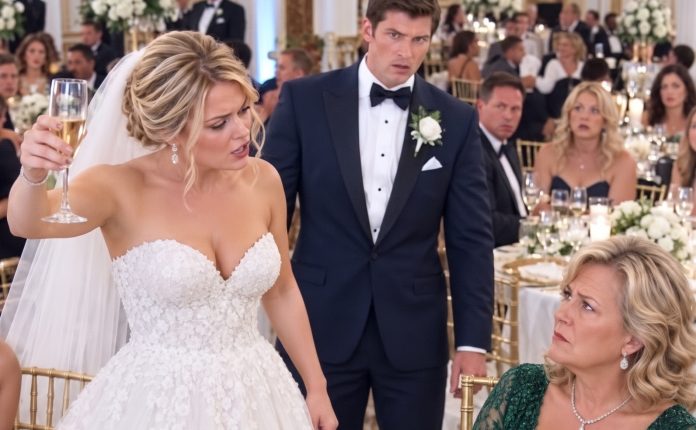
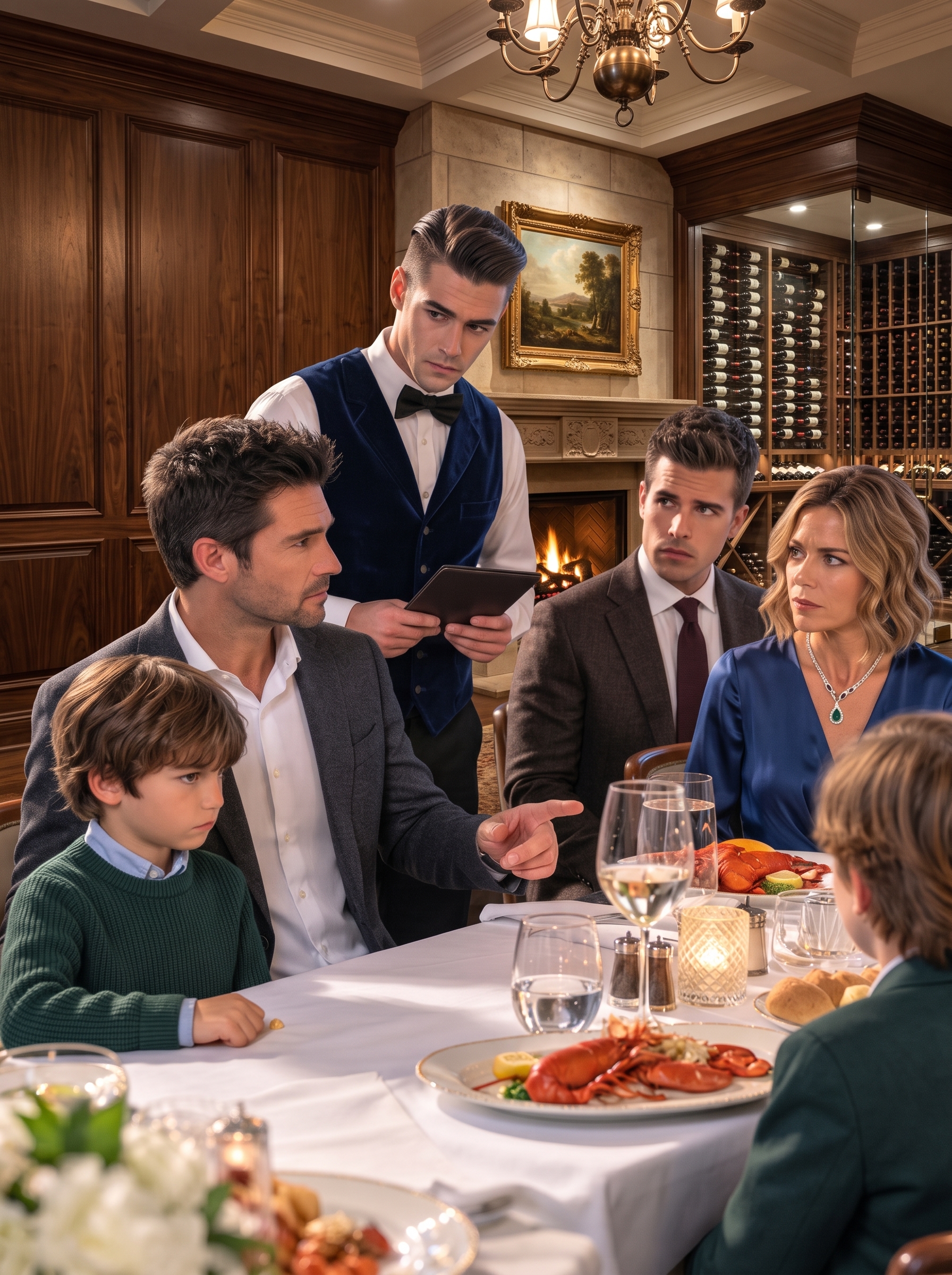
“He’ll be fine. He’s used to having less,” my sister-in-law joked while her children ate lobster and my ten-year-old son sat beside me with nothing in front of him.
I didn’t argue.
I didn’t raise my voice.
I simply waited.
When the waiter returned, I looked at him calmly and said, “Bring my son what I usually order at the Four Seasons.”
The entire table fell silent.
Naomi’s smile was the first thing to disappear.
Only moments earlier, she had been laughing as though humiliating my son was nothing more than another harmless family joke.
Caleb sat beside me at the far end of the long table.
No plate.
No fork.
No meal.
Across from him, Naomi’s twins were cracking open lobster shells while my brother Gavin casually poured himself more wine.
I looked over at Caleb.
He wasn’t complaining.
He wasn’t asking why everyone else had food and he didn’t.
Instead, he stared at the table and slowly pushed a tiny breadcrumb back and forth with the tip of his finger.
Somehow, that hurt more than if he had cried.
A waiter approached us.
“Would you like a menu, sir?”
Before I could respond, Naomi cut in.
“One menu is enough. Caleb already ate earlier, didn’t he?”
Then she laughed.
“He’ll be okay. He’s used to getting less.”
For another second, everyone continued eating.
Forks touched plates.
Someone lifted a wineglass.
Another relative gave an uncomfortable little laugh.
Then I spoke.
“I’d like a menu.”
The waiter hesitated.
“And one for the young gentleman?”
I allowed the silence to stretch.
Then I said calmly, “Actually, bring him whatever I normally order at the Four Seasons.”
Everything stopped.
Gavin froze with his fork halfway to his mouth.
Naomi finally looked straight at me.
Her lips were still curved into something resembling a smile, but the confidence behind it was gone.
I didn’t explain myself.
Instead, I looked at Caleb and gave him a small wink.
That was the first moment anyone at that table seemed to realize there might be things about my life they knew absolutely nothing about.
For years, my family had treated me like the brother who never quite made it.
Gavin was the successful one.
Corporate attorney.
Expensive suits.
Prestigious law firm.
He was the son my parents mentioned proudly whenever they talked to friends.
My life looked very different.
I had built a technology consulting company.
Quietly.
I didn’t drive flashy cars.
I didn’t wear designer labels.
I didn’t post photos from luxury restaurants or brag about contracts, clients, or investments.
I worked.
I saved.
I invested.
And most importantly, I raised Caleb.
Because I never advertised what I had, my family decided I probably didn’t have much.
For years, I let them think that.
Correcting every condescending comment seemed pointless.
But eventually, those comments stopped being aimed only at me.
They started landing on my son.
And that changed everything.
I could ignore being underestimated.
I could tolerate smug jokes about my clothes, my career, or the way I lived.
But I couldn’t sit quietly while Caleb learned to shrink himself so other people could feel important.
I wasn’t interested in starting a shouting match over lunch.
I wanted something stronger.
Something they couldn’t dismiss by accusing me of being overly sensitive.
The waiter soon returned with two menus and a fresh set of silverware.
He placed one in front of Caleb.
“The chef’s specials are listed on the back, young man.”
Naomi muttered, “He probably can’t even pronounce most of them.”
Her voice wasn’t quite as confident anymore.
I leaned toward Caleb.
“Want to split a steak?”
He nodded.
“With that sauce you always like.”
“Béarnaise?”
A small smile appeared on his face.
“Yeah.”
“Good choice.”
Gavin stared at us as though he were trying to solve a problem that had suddenly appeared in front of him.
“I didn’t know you were the Four Seasons type.”
I met his eyes.
“There’s a lot about my life you don’t know.”
He laughed.
But it sounded forced.
Eventually, lunch ended.
The disrespect didn’t.
A few weeks later, Gavin and Naomi invited the entire family to spend a weekend at an expensive mountain cabin.
The place had eight bedrooms, a hot tub, enormous windows overlooking the forest, and a kitchen bigger than most apartments.
The refrigerator was filled with food.
But almost every snack had a label.
GRANT.
CARTER.
Naomi’s twins.
Nothing said CALEB.
My son opened the refrigerator, noticed the labels, and quietly closed the door again.
I saw it.
So did Naomi.
That evening, Gavin prepared a massive seafood dinner.
Lobster tails.
Scallops.
Salmon.
One by one, everyone received a plate.
Until Naomi reached Caleb.
She stopped with the serving platter in her hands.
“Oh. I forgot to ask. Does Caleb even eat seafood?”
“He does,” I answered.
She looked down at the remaining portions.
“Well, everything has already been divided between the adults and the twins.”
Then came that same little smile.
“He’ll be fine. He’s used to going without, remember?”
Same words.
Same laugh.
This time, I stood up.
“I’ll be back.”
Gavin frowned.
“Where are you going?”
“Out.”
I drove down the mountain until I found the best steakhouse in the nearest town.
I ordered two filet mignons.
Mashed potatoes.
Asparagus.
And cheesecake.
Then I drove straight back to the cabin.
Naomi wrinkled her nose when I walked through the door carrying the bags.
“What is that?”
“Dinner.”
“For who?”
“My son.”
I opened every container and carefully arranged the food on a plate.
Then I sat beside Caleb while he ate.
Nobody laughed.
Unfortunately, the rest of the weekend only became worse.
Whenever I wasn’t nearby, the twins started picking on Caleb.
They mocked his clothes.
His books.
The way he talked.
At one point, I walked into the living room and found them tossing his sketchbook back and forth over his head.
“Where did you get this thing?” one of them laughed. “A thrift store?”
Caleb quietly reached for it.
I looked at Gavin.
“Your sons are bullying him.”
Gavin shrugged and laughed.
“They’re kids. Boys tease each other.”
Naomi joined in.
“Maybe if Caleb learned to stand up for himself, they wouldn’t bother him.”
The next morning, Gavin announced they were organizing a scavenger hunt.
For the first time all weekend, Caleb looked truly excited.
He grabbed a pencil and hurried toward the door.
Naomi stopped him.
“Oh, Caleb. We already divided everyone into teams.”
His expression changed.
“Can I just do it by myself?”
“That wouldn’t be fair. Everyone else already started.”
“He doesn’t care about winning,” I said. “He just wants to participate.”
Naomi gave a small shrug.
“House rules.”
Caleb didn’t argue.
He turned around, walked onto the back deck, and sat alone staring at the trees.
That was the moment I stopped making excuses for my family.
I walked over to Gavin.
“We’re leaving.”
He barely glanced up from his beer.
“You’re seriously overreacting.”
“No,” I said. “You’ve spent years confusing our silence with weakness.”
He smirked.
“So what now? You throw a tantrum and drive home?”
I stared directly at him.
“No.”
Then I lowered my voice.
“I’m going to make sure you remember this weekend for a very long time.”
The smile disappeared from his face.
We packed our things before sunrise.
Caleb climbed into the car holding his sketchbook tightly against his chest.
For most of the drive down the mountain, he didn’t say a word.
Then, from the back seat, I heard his quiet voice.
“Dad?”
“Yeah?”
“Did I do something wrong?”
I pulled the car over immediately.
For several seconds, I couldn’t answer.
Then I turned around to face him.
“No.”
He looked at me carefully.
“You didn’t do anything wrong. They did.”
He nodded.
But I could still see the uncertainty in his face.
Some part of him was wondering whether being excluded had somehow been his fault.
And that broke something inside me.
This wasn’t about rude comments anymore.
It wasn’t about lobster.
Or steak.
Or expensive restaurants.
Or money.
My own family had made my son question whether he deserved to belong.
That was where I drew the line.
What none of them knew was that I had already started keeping records.
Messages.
Screenshots.
Dates.
Comments.
Invitations.
Every joke they assumed would eventually be forgotten.
Every gathering where Caleb had been deliberately pushed aside.
Every seemingly small moment they brushed off but that stayed with my son long after we went home.
I saved everything.
And that Four Seasons comment at lunch?
It hadn’t been a bluff.
Neither had the promise I made to Gavin beside the fireplace.
That night, after Caleb went to sleep, I walked into my office and pulled an old notebook from the desk.
I opened it to a blank page.
At the very top, I wrote three words in capital letters:
MAKE THEM REMEMBER.
PART 2 — “MAKE THEM REMEMBER”
I didn’t sleep that night.
I sat in my office until 3 a.m., the notebook open in front of me, every page of my records spread across the desk. Years of screenshots. Years of messages. Every time Caleb had been excluded, mocked, or made to feel small.
And at the top of it all — one name I had almost forgotten about.
The family lake house.
My parents’…
PART 3 ENDING…👇
Lake house. The one Gavin and Naomi had been “borrowing” every summer for six years. The one where they hosted their friends, held their parties, and posted their photos — while telling everyone it was their place.
It wasn’t their place.
It had never been their place.
Three years ago, when my father’s health declined, the financial situation had quietly changed. My father had come to me — not Gavin — because “Gavin never picks up when it matters.”
I had paid off the mortgage.
Every cent.
The deed had been transferred into a family trust, with me as sole trustee. My father made me promise not to tell anyone.
“Your brother loves feeling like the successful one,” Dad had said. “Let him have his little kingdom. You’ll know the truth.”
I had kept that promise for three years.
That promise died at 3:17 a.m. that morning.
The reunion invitation arrived three weeks later.
Gavin sent it to the family group chat, as he did every year:
“Annual lake house weekend! Booked for the whole family, as always. 😎 Bring your appetites — lobster boil Saturday night! 🦞”
Naomi replied immediately: “Can’t wait! Our favorite tradition! 🏡❤️”
Our favorite tradition. At a house they didn’t own.
I stared at my phone for a long moment.
Then I typed back two words:
“I’ll be there.”
Gavin’s reply came fast: “Great! You can help with the grill 😂”
I didn’t tell him I wasn’t coming to grill.
I was coming to collect.
The weekend arrived.
Cars pulled up the long gravel driveway. My parents. Cousins. Aunts. Uncles. Everyone carrying coolers and bags, everyone laughing, everyone treating Gavin like the host of the year.
Naomi stood on the deck in a white sundress, handing out drinks like she owned the place.
Caleb and I walked up the steps last.
She looked at him and smiled that same smile.
“Oh, Caleb — we already assigned the bedrooms. The twins took the big room, obviously. There’s a cot in the storage closet if you—”
“That’s not necessary,” I said calmly.
Everyone kept talking. Nobody was listening.
So I walked to the center of the deck, set my bag down, and raised my voice just enough:
“Can I have everyone’s attention for one minute?”
The deck went quiet.
Gavin laughed from the grill. “What, did you bring your own charcoal again?”
I pulled a folder from my bag. I didn’t open it.
“Everyone here has spent the last several years enjoying this lake house. Gavin and Naomi have hosted you. They’ve told you it’s their tradition. Their place.” I paused. “How many of you believed them?”
A few nervous chuckles. My mother’s brow furrowed.
“Dad.” I turned to my father. “Three years ago, the mortgage on this house was in danger. Who paid it off?”
The deck went dead silent.
My father’s lips trembled. “You promised—”
“I promised not to tell him,” I said, looking at Gavin. “I never promised to watch him humiliate my son in a house that exists because of me.”
Gavin’s face went white. “That’s a lie.”
I finally opened the folder.
“Deed of trust. Sole trustee: my name. Paid in full: my account. Three years ago. Every page notarized.”
I set it on the table.
Naomi’s drink slipped from her hand and shattered on the deck.
“Now,” I said, my voice completely level, “let’s talk about house rules.”
I pulled out my phone and started reading.
“He’ll be fine. He’s used to having less.” — Naomi, March 14th.
“Does Caleb even eat seafood?” — Naomi, June 2nd.
“The twins took the big room.” — Today.
One by one, I read every message. Every screenshot. Every date.
The family stood in complete silence. I watched my aunts’ faces change. I watched my mother cover her mouth with her hand.
“There’s one more thing,” I said.
I looked directly at Gavin.
“You told me I was overreacting at the cabin. You smirked. You said, ‘So what now? You throw a tantrum and drive home?'”
I folded the folder shut.
“This isn’t a tantrum, Gavin. This is a notice. As of today, use of this property requires trustee approval. Consider this your first formal request —”
I handed him a single printed page.
“— which is denied.”
Nobody moved.
Then my mother started crying. Not sad tears — the other kind. The kind that come when years of pretending finally collapse.
My father walked over, put his hand on my shoulder, and said just one sentence, loud enough for everyone:
“He tried to tell me this for three years. I should have listened.”
Naomi was already gathering the twins’ things. Gavin stood at the grill, the spatula still in his hand, looking like a man who had just been evicted from his own kingdom.
Because he had been.
I picked up my bag and took Caleb’s hand.
“One last thing,” I said from the top of the steps.
Everyone turned.
“Caleb and I won’t be attending future events hosted by Gavin and Naomi. Not because we’re angry. Because my son deserves to be around people who see him — not around people who make him count breadcrumbs at a dinner table.”
I looked down at Caleb.
“Ready?”
For the first time all weekend — maybe for the first time in years — my son smiled without hesitation.
“Yeah, Dad. I’m ready.”
As we walked down the driveway, he looked up at me.
“Dad?”
“Yeah?”
“Did I do something wrong?”
I stopped, knelt down in front of him, and looked him straight in the eyes.
“No, buddy. You never did. And from now on, nobody will ever make you feel like you did. That’s a promise.”
He hugged me.
And behind us, through the trees, I could hear the family starting to argue.
Let them.
Some lessons can’t be taught. They have to be collected.
[ END OF PART 2 ]
THE END
Three weeks after the lake house, I received the letter.
It came from Gavin’s law firm — on official letterhead, no less. A demand to “review the validity of the trust” and a “request for mediation regarding rightful ownership.”
My brother was suing me.
Or at least, he was threatening to.
I read the letter twice, then set it down and called my lawyer — a quiet woman named Diane who had handled my company for years. I sent her the file. The records. The screenshots. The deed.
She called me back the next morning.
“Don’t worry about a thing,” she said. “But I need to ask you something. Do you want to destroy him?”
I thought about Caleb. About the breadcrumb. About the sketchbook being tossed over his head.
“No,” I said. “I want my son to never feel small again. That’s all.”
“Then here’s what we’re going to do.”
The mediation was scheduled for a Friday.
Gavin arrived in his best suit, Naomi beside him in a blazer that probably cost more than my first car. They walked in like they were walking into a courtroom drama they intended to win.
Diane and I were already seated.
The mediator opened the session. Gavin’s lawyer began speaking — lots of words about “family expectations” and “implied ownership” and “verbal agreements over years of use.”
Then Diane stood up.
She didn’t raise her voice. She didn’t need to.
“Ladies and gentlemen, before we discuss anything, let me clarify the legal situation in one sentence.” She slid a document across the table. “The property was transferred to a trust, fully paid by my client, with my client as sole trustee. This is not disputed. It is not questionable. It is fact.”
She paused.
“Now. My client has asked me to offer you a choice.”
She looked at Gavin.
“Option one: We proceed with the full legal process. Every message you’ve sent, every screenshot of your children bullying my client’s son, every ‘house rule’ designed to exclude a ten-year-old child — all of it becomes part of a very public family court record. Your law firm will receive a copy. So will the bar association.”
Gavin’s face went gray.
“Option two.” Diane’s voice remained perfectly calm. “You sign a settlement. You relinquish any claim to the property. You issue a written apology — a real one, not a lawyer’s apology — to Caleb. And you attend family counseling, all four of you, for six months. In exchange, the file stays closed.”
Naomi started to speak.
Diane cut her off gently. “And one more condition. The twins write Caleb a letter. Not because a judge ordered it. Because they mean it. If they don’t mean it, we’ll know.”
The room was silent for a long time.
Then Gavin looked at me.
For the first time in years, I saw something in my brother’s eyes that I didn’t recognize.
Fear? Shame? Maybe both.
“Why?” he asked quietly. “Why would you offer this? You could ruin me.”
I leaned forward.
“Because I’m not you, Gavin. I never was.”
They signed.
All of it. The relinquishment. The apology. The counseling.
Naomi’s apology letter to Caleb arrived two weeks later. It was three paragraphs long. The twins’ letters came separately — shaky handwriting, awkward sentences, but real. One of them drew a small picture at the bottom. A boy holding a sketchbook.
Caleb read them at the kitchen table.
He didn’t say much. He just folded them carefully and put them in his drawer.
Then he looked up at me.
“Dad? Do I have to forgive them?”
I sat down beside him.
“No, buddy. Not today. Maybe not for a long time. Forgiveness isn’t a payment you owe anyone. It’s a gift you give yourself — and only when you’re ready.”
He nodded slowly.
“Okay. Then I’ll wait.”
I ruffled his hair. “That’s the smartest thing anyone’s said all year.”
Six months later.
The counseling had ended. Some sessions went well. Some were a disaster. But they went.
Gavin called me one evening. Not his lawyer. Him.
“Hey. I, uh… I found something.” His voice sounded different. Quieter. “I was going through Dad’s old files. He kept a journal. Did you know that?”
“No.”
“There’s an entry from three years ago. About the lake house. About how you paid it off and didn’t tell anyone. He wrote… he wrote that you were the son he should have bragged about. And that he was too proud to say it out loud.”
Silence on the line.
“I’m sorry,” Gavin said. And then, barely audible: “I’m sorry I made your son count breadcrumbs at my table. And I’m sorry it took me losing a house to see what I was losing as a brother.”
I closed my eyes.
“Come over for dinner this Saturday,” I said. “Caleb’s been learning to grill. He insists on doing it himself.”
Gavin laughed — a real laugh, not a smirk.
“I’d like that.”
That Saturday, they came.
Naomi brought a gift for Caleb — not a labeled snack. A sketchbook. A good one. The kind with thick paper that doesn’t tear when you erase.
The twins stood awkwardly on the porch until Caleb finally opened the door and said, “You guys coming in or what?”
They went in.
It wasn’t perfect. Families like ours don’t heal in one dinner.
But when we sat down to eat — all of us, around one table, everyone with a plate in front of them — I watched Caleb pick up his fork with confidence. No hesitation. No shrinking.
He caught my eye across the table and smiled.
And in that moment, I knew:
I hadn’t taught them a lesson for revenge.
I had taught them a lesson in being seen.
And that was worth every penny of the lake house.
[ THE END ] 🎬