PART 1:
The day I forced my seventy-two-year-old
mother out of her own home,
she didn’t cry, argue,
or beg me to reconsider.
She simply looked at
the three grandchildren running
through the living room,
smiled gently, and said,
“I suppose children need room to grow.”
My name is Daniel Parker,
and for years I convinced
myself that what I did that
afternoon was reasonable.
My father had died five years earlier,
leaving our four-bedroom house in Ohio to me.
My wife, Rebecca, and
I were raising three children in
a cramped rental apartment,
struggling to keep up with bills.
Mom had been living alone in
that enormous house, and her health was declining.
She suffered from arthritis,
diabetes, and a heart condition
that required regular medication.
I told myself that moving her into
a nursing home would solve everyone’s problems.
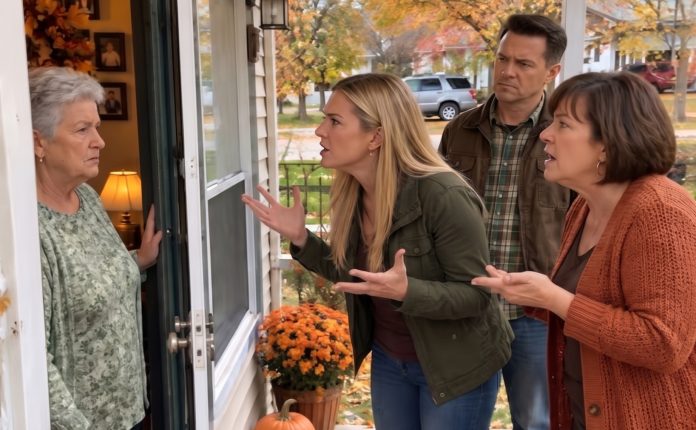
“Mom, the house legally belongs to me,”
I explained while Rebecca stood beside me.
“The kids need their own bedrooms, and we can’t afford anything bigger.”
Mom nodded without looking surprised.
“I understand, sweetheart.”
Her calmness irritated me more than an argument would have.
I had prepared explanations, excuses, even a speech about financial responsibility.
Instead, she walked slowly toward the kitchen window, where a small green plant sat inside a faded blue ceramic pot.
It was an ordinary-looking peace lily, with broad leaves and one delicate white flower.
“I only want to take this plant,” she whispered.
“Your father gave it to me on our twentieth anniversary.”
I shrugged.
“Of course. Take whatever personal things you need.”
She touched the pot carefully.
“Everything else is already yours.”
Later that afternoon, while packing her clothes into one suitcase, I asked where she wanted to live.
She looked at me with the same tenderness she had shown when I was a child.
“Take me to the least expensive nursing home, Danny. I know you don’t earn much, and I don’t want you spending all your money on your sick mother.”
Her words should have broken my heart.
Instead, I felt relieved.
The cheapest facility I found was Willow Creek Care Center, forty minutes outside town.
Its hallway smelled of disinfectant, its furniture was old, and the bedrooms were shared.
When we arrived, Mom studied the narrow bed beside the window.
“It’s lovely,” she said softly.
I knew she was lying.
A nurse named Eleanor helped her unpack while I completed the paperwork.
Before leaving, I promised,
“I’ll visit Sunday.”
Mom squeezed my hand.
“Don’t worry about me. Take care of those beautiful children.”
Sunday came, but Rebecca wanted help arranging furniture.
The next weekend, my oldest son had soccer practice.
By the third week, I stopped answering Mom’s calls during work because I assumed she only wanted to hear my voice.
She left cheerful messages anyway.
“Hello, sweetheart. Just checking whether the children are eating properly. Don’t forget your father’s birthday next Thursday. Love you.”
I never called back.
Thirty-four days after moving her, I received a voicemail from Eleanor.
“Mr. Parker, your mother’s condition has changed. She keeps asking whether you’ll come.”
I listened while driving home and promised myself I would visit the following morning.
But Rebecca needed the car, and I postponed it again.
Six days later, my phone rang at 6:17 a.m.
Eleanor’s voice was trembling.
“Daniel, I’m terribly sorry. Your mother passed away peacefully during the night.”
I stood frozen in our beautiful new kitchen.
The refrigerator hummed.
Upstairs, my children were sleeping in the bedrooms I had wanted so desperately to give them.
Suddenly, the house felt unbearably empty.
At the nursing home, Eleanor handed me Mom’s suitcase, a small envelope, and the blue flowerpot.
“She asked us to give you these personally,” the nurse explained.
“She spoke about you every day.”
I couldn’t answer.
Inside the envelope was a folded letter written in Mom’s familiar handwriting.
My hands shook as I opened it.
“My darling Danny, if you’re reading this, I’ve gone to join your father. Please don’t be angry with yourself. I know life has been difficult, and I know you love your children. I have one final gift for you. Before you decide what to do with my plant, search carefully inside the soil. Your father and I buried something there many years ago. What you find will explain why I never argued when you asked me to leave.”
I stared at the pot, then noticed something I had never seen before:
a tiny brass key hanging beneath one yellowing leaf.
—
PART 2: I carried the blue flowerpot home as though it contained something fragile enough to shatter.
Rebecca was waiting in the kitchen when I returned from Willow Creek.
“Did they give you any important paperwork?” she asked.
I showed her Mom’s letter and the little brass key.
Rebecca frowned.
“Maybe she hid jewelry in the dirt.”
I didn’t respond.
For the first time in years, the sound of my wife’s practical voice made me uncomfortable.
I spread newspapers across the kitchen table, put on gardening gloves, and gently loosened the soil around the peace lily.
About four inches beneath the surface, my fingers touched something hard.
I pulled out a small metal container wrapped tightly in plastic.
Inside were two yellowed envelopes, a photograph, and a second key.
The photograph showed my parents standing outside our house thirty-two years earlier.
I was eight years old, smiling between them, with a red bicycle at my feet.
On the back, Mom had written,
“Our first home, bought with love and everything we had.”
The first envelope contained documents from a bank account opened in 1998.
The account was in my mother’s name, with me listed as the payable-on-death beneficiary.
Attached was a recent statement showing $286,430.
I stared at the number, certain I had misunderstood.
My parents had never seemed wealthy.
Dad worked as a mechanic, and Mom spent thirty years sewing alterations for a neighborhood clothing shop.
We took modest vacations, drove used cars, and rarely ate at restaurants.
Yet somehow, they had saved a fortune.
The second envelope contained a letter addressed to me.
“Danny, your father and I saved every dollar we could because we wanted you and our grandchildren to have security. This money was meant to help you build a future without fear. But before you use it, there is something you must know about the house.”
My stomach tightened.
The letter continued.
“When your father became ill, we made an agreement. The house would pass to you after his death, but I would retain the right to live there for the remainder of my life. We believed you would never need a legal reminder to let your mother stay. Unfortunately, we also believed love could not become confused with ownership.”
I swallowed hard.
I remembered signing documents at Dad’s attorney’s office, but I had never carefully examined them.
I had simply heard that the house would eventually be mine.
Beneath Mom’s letter was another page, bearing the name of an attorney, Margaret Collins.
“Please contact Mrs. Collins before making any decisions about the bank account,” Mom had written.
The following morning, I walked into Margaret’s office carrying both envelopes.
She was a silver-haired woman who remembered my father well.
When I explained that Mom had died, her expression softened.
“Your mother came to see me eleven days before she passed,” Margaret said.
“She wanted to make sure you would receive everything she intended.”
I showed her the bank statement.
She nodded.
“The funds are real. But your mother wanted you to understand their history.”
She opened a thick folder containing property documents, medical bills, and handwritten records stretching back decades.
Then she showed me a copy of a recorded deed.
Dad had transferred ownership to me while preserving Mom’s lifetime right to occupy the property.
That right had remained valid until her death.
My throat tightened.
“You mean I couldn’t legally force her out?”
Margaret folded her hands.
“Your mother had every right to remain in that home. She chose not to challenge you.”
I lowered my head.
“Why would she do that?”
Margaret was silent for a long moment before answering.
“She told me she didn’t want her grandchildren growing up watching their father and grandmother fight over a house.”
Then she reached into her desk and removed a small white envelope.
“There’s something else, Daniel. She asked me to give you this only after you discovered the money.”
The envelope was marked in large, careful letters:
“THE TRUE REASON I KEPT THE PLANT.”
My hands trembled as Margaret pushed it toward me.
“Before you open it,” she said, “you need to know that your mother made one final visit to this office after entering Willow Creek. She wasn’t here to change her will. She was here to protect someone she loved.”
—
Same as before: your wording is unchanged and only the spacing is different. Send Part 3 whenever you’re ready.